

North looking more and more like the South: new study
Research shows troubling increase in vegetation north of 60

This map shows the percentage of plant growth increase over the past 30 years. (HANDOUT IMAGE)
What you saw growing far to the south 30 years ago, you can now find growing today in the Arctic.
That’s among the troubling findings shared by an international team of 21 authors from seven countries who have published a study in the journal Nature Climate Change that looks at satellite data from the past 30 years.
As snow and ice cover in the northern latitudes diminished in recent years, temperatures and vegetation in the Arctic increasingly resembles those found at several degrees of latitude farther south as recently as 30 years ago, their NASA-funded study found.
The impacts could be wide-spread, the study’s authors say.
“Think of migration of birds to the Arctic in the summer and hibernation of bears in the winter: any significant alterations to temperature and vegetation seasonality are likely to impact life not only in the North but elsewhere in ways that we do not yet know,” said Dr. Scott Goetz of the Woods Hole Research Center in Massachusetts.
The study, “Temperature and vegetation seasonality diminishment over northern lands,” shows there’s been a southward shift of six to seven degrees of latitude in temperatures and vegetation over the past three decades.

Based on an analysis of 17 climate model simulations, the changes could be even more extreme by 2100 — an impact equal to more than 20 degrees of latitude compared to the 1951-1980 reference period.
This could see Iqaluit, which lies at about 65 degrees latitude, experience the kinds of temperatures and vegetation now found in southern Quebec, at about 45 degrees latitude.
The study notes an increase of seven to 10 per cent in vegetation over the past 30 years.
Warmer springs are now leading to longer growing seasons because there is ample sunlight and plants are thriving.
That’s why the Arctic landscape is now beginning to look like its lusher southern counterparts, the researchers say.
How long the lushness lasts is anyone’s guess: the benefit of extra heat is already decreasing in some northern areas because there is not enough rainfall to sustain the greener landscape.
And this is increasing the risk of fires and pest attacks, the researchers say.
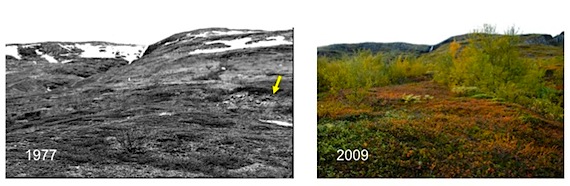
This photo shows the increase of vegetation in Abisko, in Arctic Sweden, over a 30-year period. (HANDOUT PHOTO)
(0) Comments