

Nunavut hunter support program returning as charitable trust
No date for disbursements yet from $14 million fund
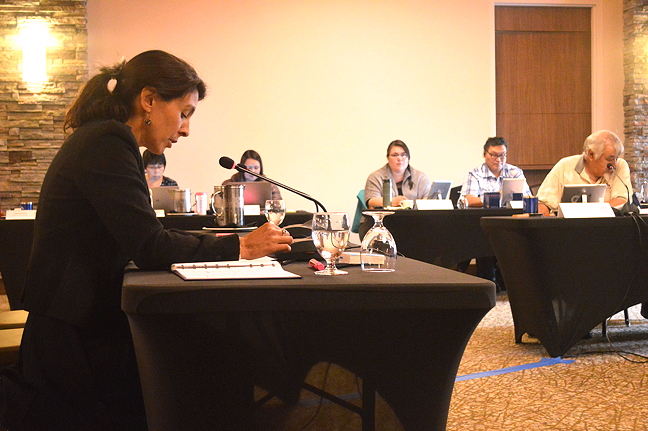
Nunavut Tunngavik Inc. Chief Operating Officer Udloriak Hanson speaks to NTI’s board members at a Sept. 1 meeting in Iqaluit. (PHOTO BY STEVE DUCHARME)
Nunavut Tunngavik Inc.’s Nunavut Harvester Support Program will be rebranded into a charitable entity following a final round of planning, says NTI vice president, James Eetoolook.
The hunter support program has lain dormant since 2014, when NTI announced it was reviewing the program.
The program will be brought in-house and administered by NTI’s department of Inuit Programs and Services through a new entity, Eetoolook told Nunatsiaq News at a board of directors meeting in Iqaluit Sept. 1.
“The new entity has now received its charitable status, and will be receiving the remaining fund from the Hunters Income Support Trust totaling approximately $14 million.”
NTI says it is in the process of designing the programming that will be offered to hunters, as well as seeking further funding to “ensure the longevity of the program.”
“NTI wishes to ensure the hunter support program be continued in the very near future as a means of protecting and promoting cultural harvesting practices and as a means of alleviating food security issues in our communities,” Eetoolook said.
NTI provided no date for the program’s launch, but said it will provide an update as soon as the program is finalized.
NTI directors discussed several other issues at their meeting this week. Here are two topics of note.
Nunavut Trust debt
NTI has paid off nearly one-third of its outstanding debt to Nunavut Trust, which manages the $1.14 billion settlement Inuit received from the Government of Canada through the 1993 Nunavut Lands Claim Agreement.
NTI borrowed more than $149 million in its early years to pay start-up costs for itself and the three regional Inuit associations.
That debt now stands at about $21 million, according to NTI’s director of finance, Sharron Griffin, who told board members the organization used its surplus money from 2015 to pay the Trust back nearly $11 million.

“If we continue with the path, we can pay off this deficit in two years,” NTI President Cathy Towtongie told board members.
The Trust’s legal mandate is to maintain the original sum paid through the NLCA, accounting for interest. But Trust managers dipped into the principle sum to give NTI its start-up loan.
NTI was supposed to pay the Trust back in full by 2007, but never reached that goal.
At NTI’s 2015 annual general meeting in Apex, Nunavut Trust’s chief financial officer, Fern Elliot, told NTI board members the Trust had missed out on $182 million in additional distribution money to NTI and the RIAs over the years, in part because beneficiary organizations have been spending outside the Trust’s ability to earn.
NTI received $53.3 million in 2015 from the Trust, down from $87.1 million in 2014, but the organization closed the year out with a surplus, ultimately used to pay down the loan.
New charity coming
NTI now intends to establish a new charitable organization, dubbed the Nunavut Tunngavik Foundation, using a portion of leftover money from the 2006 Indian Residential School Settlement Agreement.
The foundation will fund Inuit cultural, educational and language programs in the territory.
“The implementation of the Residential School Settlement Agreement is nearing the final stages. The remaining funds from the ‘Common Experiences Payment’ will be transferred to First Nations and Inuit,” NTI’s chief operating officer, Udloriak Hanson, told board members.
NTI will receive between $6 million and $9 million in surplus money from the Indian Residential School Settlement Agreement (IRSSA) and it will be used according to the terms and conditions established in the 2006 court ruling that established the IRSSA, she said.
That includes the reclamation of Inuit culture, language and identity, addressing harms from the legacy of residential school and funding support for formal education such as elementary, secondary and post-secondary education.
“The funds from the foundation will be accessible to all Nunavut Inuit,” Hanson said.
“The foundation will allow NTI to fulfill the terms and conditions and also to accept, receive funds, donations from outside sources to advance Inuit education in general.”
NTI board members concluded their meeting Sept. 1 and will reconvene for their annual general meeting in Rankin Inlet, scheduled from Oct. 18 to Oct. 20.
(0) Comments