


Nunavut Corrections Act consultation meets silence in Iqaluit
Justice officials looking to update old corrections act with Inuit values and IQ
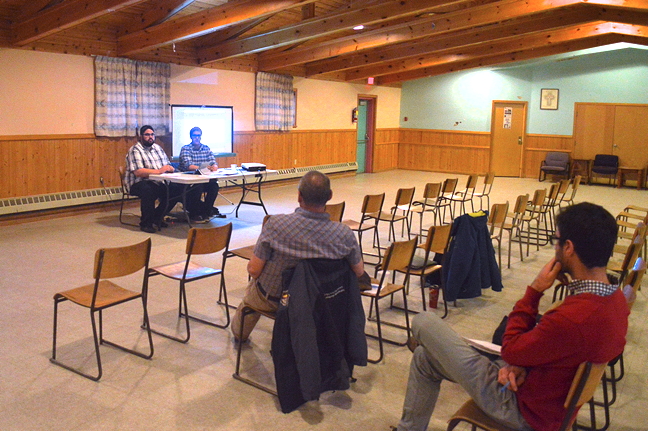
What if they held a meeting and no one came? Nunavut justice staff were hoping to consult Iqaluit residents Sept. 6 on what they might want, or not want, in a new made-in-Nunavut corrections act. But only reporters showed up. (PHOTO BY STEVE DUCHARME)
If there’s any support from Iqalungmiut for a new “made-in-Nunavut” corrections act, that wasn’t apparent during a community consultation hosted by Nunavut’s Department of Justice Sept. 6 at the Anglican Parish Hall in Iqaluit.
Not one member of the public showed up.
The department’s director of policy and planning, Stephen Mansell, and senior policy analyst Mark Witzaney fired off a series of questions to a room containing a handful of justice department staff and members of the media.
The consultation was meant to gather community input on several potential reforms to a proposed new Nunavut Corrections Act which the justice department says will incorporate modern corrections practices, recognize Inuit societal values and improve oversight.
But the event lasted less than an hour when the department’s prepared questions met with rounds of silence from the thinly populated room.
Witzaney explained that Nunavut’s current corrections act, inherited from the Northwest Territories in 1999, hasn’t been updated in more than 30 years.

“It contains some things in it that are probably not appropriate anymore,” he said.
A new corrections act would prioritize community reintegration of inmates either serving sentences in Nunavut or held in remanded custody in Nunavut facilities, he added
The justice department wants the new corrections act to emphasize Inuit Qaujimajatuqangit in programming offered at correctional facilities, recognize Nunavut’s official languages legislation and accommodate more programs and services in Inuktitut.
Programs now offered at Nunavut correctional facilities deal with substance abuse, anger and stress management, but the justice department wants to legislate Inuit-specific programs such as outpost camps with elders on the land, carving programs and work release assignments for minimum-security offenders.
Those programs are currently offered in some facilities but are under-utilized, Mansell said.
The department has also proposed independent disciplinary boards for inmates, which they say will improve oversight and protect prisoner rights.

Currently, an internal disciplinary board sits at each facility, which is filled by its own corrections staff who handle inmate discipline.
Punishments laid down by the current disciplinary boards include restriction of privileges for inmates and, in some cases, segregated confinement up to a maximum of 15 days.
The consultation’s Inuktitut translator, Lazarus Arreak, who had the night off due to the event’s poor attendance, made the only comments for the department’s Iqaluit visit.
Arreak said that Nunavut’s dire need for mental health professionals, along with the territory’s housing crises, are contributing factors to the success of the new act.
“Mental health is a big priority for the territory,” he said, adding that “Nunavut was way back” in providing aid for those suffering from mental illness.

Arreak also said many of Nunavut’s homeless commit crimes during the winter so they can get a warm place to live behind bars, contributing to overcrowding.
“That’s not an unheard-of story. Definitely its something we need to work with [Nunavut Housing Corporation] to make sure it doesn’t happen. The Department of Justice is just one part of continuing care,” Witzaney responded.
Mansell also told Nunatsiaq News that Nunavut’s health department has yet to be consulted on the specific proposals for the new corrections act, but said the two departments are constantly sharing information.
Officials gave no schedule for implementing the new corrections act, however Mansell indicated that the department wants to table it during this fourth assembly of the Nunavut legislature.
The justice department’s Iqaluit consultation was the first in a tour of community visits across Nunavut this month.
The consultation’s first scheduled visit in Cape Dorset Aug. 31 was cancelled because of a search for a missing kayaker.
Justice department staff will continue their consultation tour on the corrections act in Rankin Inlet, Sept. 11, followed by visits to Cambridge Bay, Sept. 15 and Kugluktuk, Sept. 18.
(0) Comments