

Quviasuvik and the air drop
Christmas memories from Kimmirut
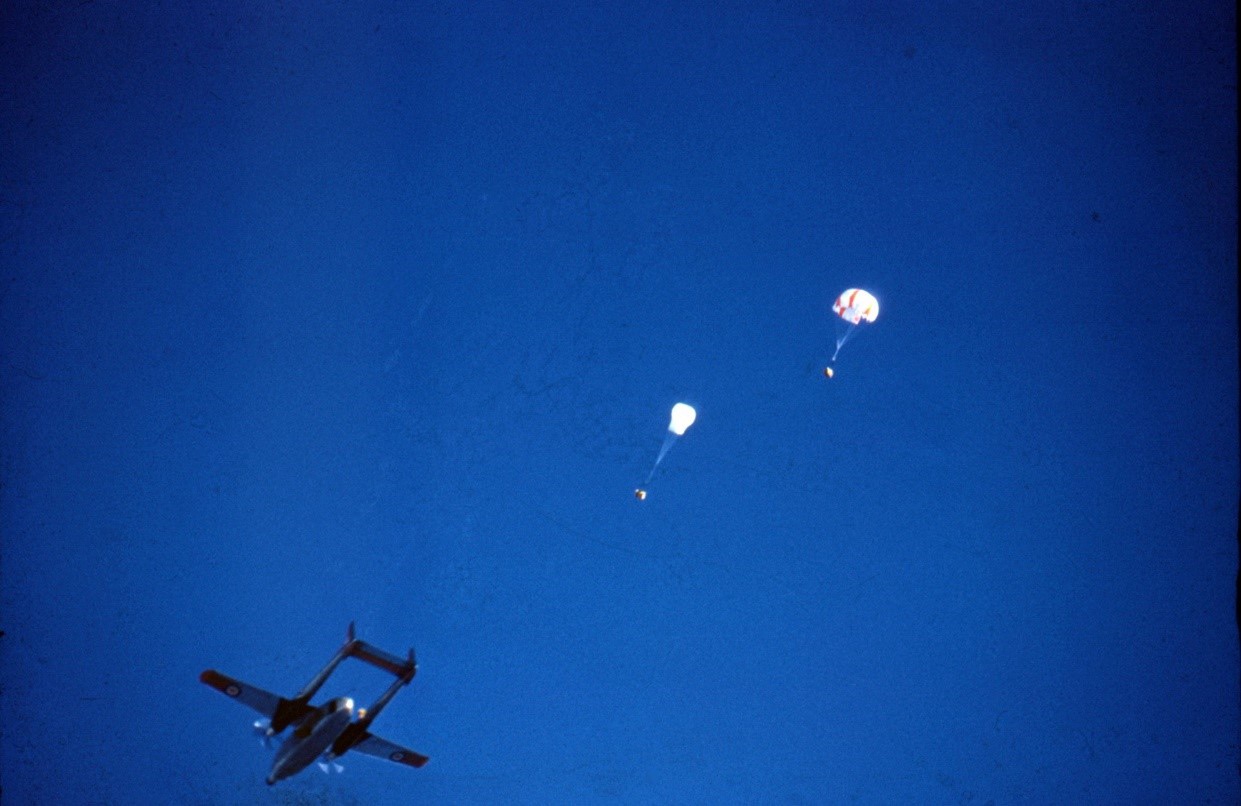
An airplane drops mail and other supplies to Kimmirut in this file photo provided by Rev. Michael Gardener. The Christmas air drop created a sense of excitement, recalls Ann Meekitjuk Hanson in this reminiscence of Christmases past. (File photo by Mike Gardener)
Ann Meekitjuk Hanson, the first editor of the Inukshuk newsletter — the forerunner to Nunatsiaq News — reflects on the excitement of the Christmas month and the air drop she recalls while growing up in Kimmirut in the 1950s.

Ann Meekitjuk Hanson recalls the annual Christmas air drop and other activities that created excitement when she was growing up in Kimmirut in the 1950s. (File photo by David Venn)
Quviasuviup Udlugiit, or Christmastime, was different from the other times of year.
There was glee in the people, in the air, in the weather and the anticipation of air drops, and the arrival of people from their ukialiviit, their ancestral winter homes, because this meant celebrations, a church service and a feast.
During the first part of Christmas month, we children were told to listen for an unusual roar in the air, a rumble — a different sound.
So, we listened when we went outdoors, all of us wanting to be the first to hear this sound. Who wouldn’t want to be a hero and be the kid who was first to hear this roar?
At last, an unusual sound on a clear day. Listen hard! A faint rumble, a rolling steady sound, it is getting louder and closer, breaking the constant quiet in the sky. Then a shout: “It is coming!”

People in the village literally popped out of their dwellings and looked around with their heads tilted up as much as they could. They didn’t talk, because they were listening.
Then it appeared, a big machine travelling through the air. Qangatajuraluk! It would make one round and then disappear, then one more time, this time lower, the third time with what appeared to be a door open, too far up in the air and too fast to see anyone.
It disappeared again down the bay. When it returned, it was at the same altitude but with its door opened and a small figure at the door!
The plane disappeared again. On its return, more boxes dropped, this time close to each other. What a sight!
On the ground, we were laughing. Some children cried from fright. Men ran to their dogs and hitched them up to their sleds to retrieve the dropped items that were scattered on the sea ice.
There was so much excitement in the village. The few Qalunaat — the Hudson’s Bay Co. manager, his clerk, the RCMP member and our Anglican minister — were talking to each other in their language and looked happy. They knew they would be getting long-awaited mail and Christmas presents from their homes.

The air drops happened because we had no runways where planes could land. The boxes contained mail, old newspapers, old magazines, family allowances for the Inuit women, which were one year’s worth of family income, and Christmas presents for the Qalunaat.
The church received clothing, socks, shawls, quilted blankets and anything useful from the Anglican Women’s Auxiliary from Toronto and other cities.
There were also hard candies, which were given out sparingly.
We didn’t see the Qalunaat for a few days because they were reading all their mail, newspapers, magazines. And then they re-read them over and over.
The second excitement of Christmas month was when the Inuit started to come to our village — dog team by dog team — from their ancestral winter homelands. Some of them travelled several days to get to Kimmirut.

They built their snow houses to live in, some stayed with us in our little dwelling, some at RCMP quarters across the bay, at the Akavak home.
It was so good to see different people for a change.
We also gathered at the church and had Christmas stories told to us by Rev. Mike Gardener and wonderful Christmas hymns.
The women were busy making new clothes for Christmas — new kamiks, sealskin boots, with beautifully embroidered top duffle socks, new caribou parkas, new caribou or sealskin mittens, new calico cloth and dresses for women.
I had nothing new, only hand-me-downs, but they were new to me.
Since it was soon to be Christmas, the women sewed and made things all day and night, including Sundays. They were told it was OK to sew on Sundays, or to make things, because it was Christmas.
Christmas morning was different. It was calm and solemn. Everyone moved slowly and didn’t talk much. We all went to church. The adults greeted each other with a handshake. It was very ceremonial, and almost serious. The children, we were to be quiet and observe. We were not to disturb anything.
The next day — a day after Christmas — adults exchanged gifts. The gifts were not wrapped.
Men gave dogs to other men, some traces of lasso ropes (made from whale hide or different kinds of seal), supujuq (primus stove), and hunting implements or old sleds.
The women gave to other women their very best ulus, cotton dresses, sealskins, rabbit skins, anything they wanted to give. I remember my aunt cleaning these beautiful three glasses. She washed them, wiped them, blew her breath on them and then wiped them again. They became beautiful.
Years later, I learned they were pickle jars my aunt had retrieved from the garbage bin of the nurse.
The children did not get any gifts. We just watched. I was 14 years old when I received my first Christmas gift in Toronto from my foster parents. I was speechless.
There were outdoor games on the sea ice, races and strength games. At night there were long dances at the old American hall.
The dances were learned from the whalers a long time ago, something like reels and square dances. Women played the igiruut — a music box like an accordion.
They were lively dances, with one leader running the dances. His name was Siujuk and he was the crowd’s favourite.
The celebration of Christmas was more church-oriented at the time. After the church service, we had feasts. It was always beans.
I remember the steam coming from the boiling beans in the church. The beans were probably made by the Hudson’s Bay Co. manager Gordon Rennie.
Dec. 25 is called quviasuvik in the southern Baffin dialect, meaning “time to be happy.”
The quviasuvik is long, from December to the end of January.
People still exchanged gifts well into January. This is probably because there were celebrations at this time of the year even before Christianity was introduced to the Inuit in the late 1800s and early 1900s.
It was to welcome back the daylight. When the sun began to shine more and more, which would be after the winter solstice on Dec. 21, people celebrated to the fullest with games, songs, drum dances, feasts, and more games.
That is why Inuit so readily accepted and cherished Christmas when Christianity was introduced.
The hand was used to measure the daylight. A hunter out on the sea ice used his hand to measure each day. He placed his hand and lined it with the edge of the sea ice and the sun — if the sun had gone up above the top of the thumb and hand, the daylight will increase each day. Time to celebrate!
This return of longer daylight coincided with Christmas celebrations after Christianity was introduced.
We’ve had many wonderful Christmas celebrations, with many changes along the way. We were introduced to a new tradition, to celebrate a birth of Christ, which falls about the same time when our ancestors celebrated to welcome the return of the sun — an old tradition.
We have much to celebrate these two events to the fullest. Merry Christmas, everyone!
Family allowance parachuted to you , now , all you have to do is check online . No longer , the cheque is in the mail or in the air.
In December of 1968 with roaring engines a Hercules aircraft did the Christmas Mail drop for Padloping Island
The Post Office has held back the mail for that outpost of civilization for a few weeks before loading it into a wicker basket and clipping that to a parachute.. The airplane roared overhead at about 500 feet with the back door open. Our came the parachute and the wicker basket of mail and a frozen Christmas Tree..
There only was one problem.
Padloping had been closed six months earlier and so at the last minute the flight was diverted to Broughton Island.
Very interesting Bert. There are many stories about air drops, one of them is from Kimmirut, one dropped basket was never found so it is still out there on the land, probably lots of mail, Christmas presents, candies, etc.