

Iqaluit mayor wants incinerator similar to Nuuk’s
Solomon Awa visited facility in Greenland capital with Nunavut municipal leaders in August
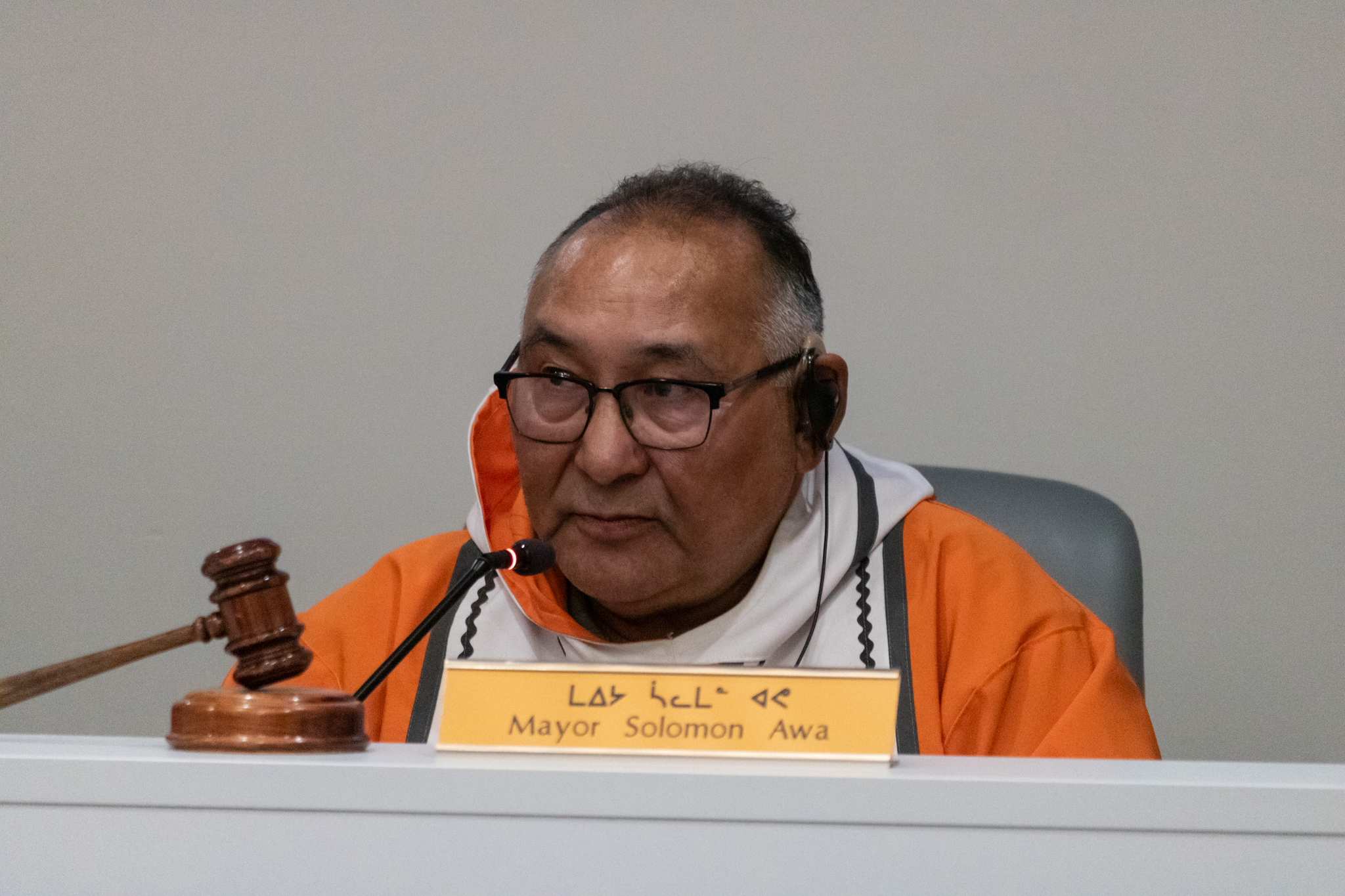
Iqaluit Mayor Solomon Awa plans to discuss the possibility of building an incinerator in the Nunavut capital with the territory’s mayors in November. (Photo by Jeff Pelletier)

Iqaluit Mayor Solomon Awa says he wants an incinerator facility in his city similar to the one in Nuuk, Greenland.
He provided an update on some of the travel he was up to in the latter half of the summer during Tuesday’s city council meeting.
In August, Awa was part of a delegation of Nunavut municipal leaders who visited Nuuk. They toured the city’s incinerator plant which takes in garbage, burns it at temperatures over 850 C, and uses the heat generated to warm 4,000 to 10,000 homes and buildings in the city of around 20,000.
“I would like to plan to request for an incinerator for our city,” Awa said, speaking in Inuktitut.
“I believe our government in Nunavut and our federal government should consider funding similar projects in Nunavut.”
Coun. Simon Nattaq, who has also visited the Nuuk facility, said an incinerator for Iqaluit should be “seriously” considered.
He noted garbage from the city’s landfills often gets blown by the wind onto the land and into the water.

In June, a Nunatsiaq News reporter was given a tour of Nuuk’s incinerator plant. Frank Rasmussen, CEO of ESANI A/S, Greenland’s national waste management company, demonstrated how around 90 per cent of the garbage brought in gets fully incinerated.
The remaining 10 per cent is either sent to a landfill or is scrap metal that can be recycled or repurposed.
Built at a cost of C $50 million, the facility operates around the clock, is staffed by 10 skilled workers and receives garbage shipped in from other Greenland communities.
A filtering process ensures harmful chemicals are not released and the air around the facility remains clean.
The topic of an Iqaluit incinerator has been brought forward to council several times over the years, but no such facility exists.
“We need to spend money to help our environment,” Awa said in an interview, when asked about a possible $50 million price tag.

“Some people might say that’s costing too much money, but it’s going to help the environment.”
Awa said he plans to discuss his proposal with the territory’s mayors in November when the Nunavut Association of Municipalities meets in Iqaluit.
He said an incinerator would help Iqaluit avoid adding to its landfills.
“It’s becoming a mountain,” Awa said.
“If we start using an incinerator, there will be nothing.”

Tuesday was Awa’s first regular meeting back in the mayor’s seat since July. For the two August meetings and the first one in September, he tuned in via teleconference while deputy Mayor Kim Smith sat in his place.
 Nuuk's incinerator plant came into use in January. (Photo by Jeff Pelletier)


There’s a type of incinerator that I think would work very well. The Japanese came up with a high-temperature plasma smokeless incinerator that basically takes garbage apart on an atomic or molecular level. This means there’s no smoke or pollution emanating from the incinerator. The downside is it’s very expensive and energy intensive. Still, it might be something worth looking into. I don’t know a lot about it so off someone knows more, please feel free to share your knowledge and correct me if I got something wrong.
I think it (plasma incinerator) is a good solution too. The sun does this dance as it has for 4 billion years synonymous with plasma incinerators being built along with nuclear power plants. The upside of being energy hungry is it’s ability to balance with the downside of nuclear waste from nuclear power plants. Hence, Nuclear Power Plants are the most efficient way to get our junk back where we took it from. Expensive and takes a lot of resources of which we must take part. Wonder if Nunavut and Iqaluit is up to the challenges .
The issue with an incinerator is energy. To run efficiently they must burn at a very high heat and really never cool as the start-up cost makes it inefficient and costlier. An incinerator would dramatically increase fuel costs for Iqaluit, as in tens of millions of $ per year. How that is collected is a tricky issue. Also, does nothing for metals, electronics, glass, mixed materials, vehicles, or organics. They mostly burn packaging, paper, furniture, and flammable construction materials.
An incinerator plant like the one in Nuuk uses approx. 150-200 kW electricity. In Nuuk, additional fuel is only added when the temperature goes below a specific setpoint. A rough estimate could be around 10.000 liters yearly. This will depend on the regulations by the environmental authorities. The process to incinerate the waste could easily be done with less than 100 liters/year.
The plant handles approx. 2,5 tons/hour of MSW and generate 6,5 MW of heat. If there is not great way to utilize that energy for heating in nearby buildings through a district heating grid, a portion of the heat could be used to generate the electricity needed, thus being self-sufficient.
So, the kind of garbage that blows all over the place near the landfill? That’s great. As for the energy cost, the heat that is generated by the incinerator in Nuuk is used to heat homes.
https://nunatsiaq.com/stories/article/two-new-incinerators-aim-to-ease-greenlands-trash-problem/
It is a good idea but it is also staffed by 10 skilled worker as it runs 24/7. The city itself has a really high turnover rate and vacancy, so it will be closed half the time or broken due to lack of maintenance, for eg, the hot tub at the pool.
We have to consider our high incompetence levels here. If it was privately run, I’d have more hope.
Yea, Just leave that $35 million Dollar project for the new dump that is way beyond the Upper Base. Thanks for the new road I guess…Great View up there 😀
I like Solomon, but I think off base with this. I believe he likes the idea of an incinerator. The Nuuk plant is too large for Iqaluit, plus it is right between the town and the airport (both places that the waste plant would not be able to be built) and right beside the deep sea port where it receives waste from other communities. Nuuk is twice the size of Iqaluit and still has to bring in material from other Greenlandic communities with deep sea ports. How many deep sea ports does Nunavut have?
Eco Waste Solutions offers a much better option for incineration, but again you need the technical staff to operate, thinking back to the ongoing gong show of the wastewater treatment plant, do we really need another project like that.
Is composting an option for the arctic, a plant the separates the compostable waste from the trash? I’m imagining a conveyor belt of trash with workers in full face masks and overalls, elbow length industrial strength rubber gloves doing the separating from the trash bag.
Just for everybody`s information , a similar plan was proposed probably 20 years ago and brushed off without much research.
Since that time we paid for how many “ solutions“ to the garbage problem ?
It has been a gold mine for the consultants.
Thanks
Human resources that are competent promt skillful unbiased sober truthful commited to both the environment outside and inside their homes and willing to pass their skills onto the next generation is the solution to our mountain of garbage. I have alot of respect for you Solomon I hope your dream becomes a reality but it is unfortunate that when differences between people’s arise, stuff won’t happen. What I said above are values that we share no matter…
But didn’t a past engineer with the city research options for waste management in Iqaluit a few years ago, propose options and wasn’t a plan put in place that includes the new dump but also some waste diversion? And can’t journalists dig a little bit of background info and provide a bit of analysis instead of simply being mouthpieces for government officials?
I love this idea, its worth the fuel needed to run it. Residual heat transfered for home heating is totally logical, and needed to be done 20 years ago. He’s got my vote in the next election. We also need new subdivisions!