

Sanikiluaq students get a ‘taster’ of what it’s like to do wind turbine work
Group of participants aged 15 to 28 take part in maintenance training in Gaspé, Que.

Sanikiluaq students and mentors celebrate Nunavut Day during a two-week course in Gaspé, Que. (Photo courtesy of Nunavut Nukkiksautiit Corp.)

Updated July 28 at 11 a.m. ET
When Timiusi Kittosuk walked into a wind turbine blade factory in Gaspé, Que., earlier this month, he could smell a mix of gas and nail polish remover.
A few employees in white protective overalls were working with fibreglass, a material made of glass threads and hardened liquid plastic that’s one of the main building components of wind turbine blades.
Looking at the scene, Kittosuk felt he had found his vocation.
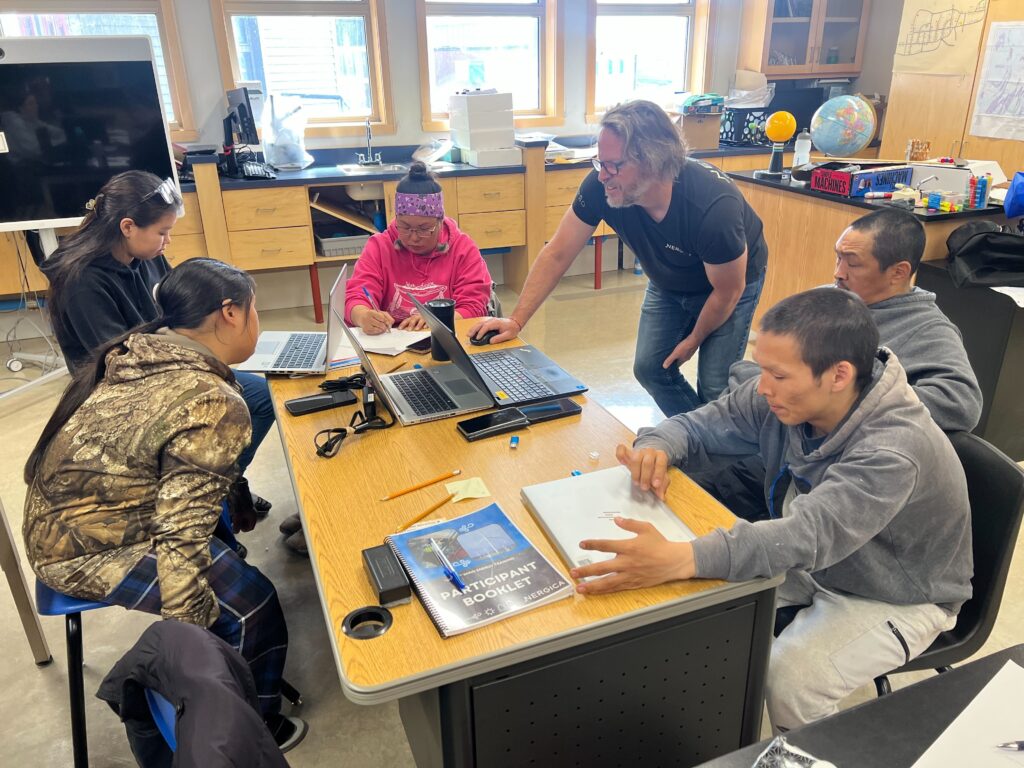
Sanikiluaq students take part in a two-week wind turbine technician course at Collège d’enseignement général et professionnel in Gaspé, Que., earlier this month. (Photo courtesy of Nunavut Nukkiksautiit Corp.)
“It made me want to join them to build blades for the wind turbine,” he said in an interview Wednesday.
The 27-year-old was one of eight Sanikiluaq students who signed up for a weeklong trip to Gaspé as part of a two-week course to learn how to be a wind turbine technician. The students are 15 to 28 years old and the course ran from July 5 to 16.

It was organized by Qikiqtani Inuit Association and Nunavut Nukkiksautiit Corp., and funded by Qikiqtani Inuit Association’s Qikiqtani Skills and Training for Employment Partnership with funding from the federal government’s Skills and Partnership Fund.
The two organizations are leading a $20-million project which includes building a wind turbine in Sanikiluaq expected to produce enough power to offset up to 70 per cent of the current diesel fuel usage in the community of 1,010 people.
It’s expected to be completed by late fall or early winter. The corporation is looking for locals, like Kittosuk, to provide maintenance for the turbine.
The two-week course was just a “taster,” said Jess Puddister, strategy and operations manager at Nunavut Nukkiksautiit Corp. It doesn’t yet qualify the attendees to work at a wind turbine.
Moving to Gaspé for a full, roughly one-year wind turbine maintenance program at Collège d’enseignement général et professionnel would be a big commitment. The company wanted to “give people a sense of what the full certification would be about,” Puddister said, adding the hopes are that three or four will complete the course.
Nukkiksautiit Corp. is prepared to cover tuition fees, living expenses and, potentially, provide a stipend, she said.

“It would be our hope for sure that they would want to come and work with us and stay in Sanikiluaq,” she said.
“But maybe they might want to work somewhere else, like Timiusi [Kittosuk] is saying, he’s really fascinated by the blade manufacturing. I think that’s awesome.”
Kittosuk said he does want to spend time working in Sanikiluaq after he finishes the full training, which he plans to apply for as soon as the course opens.
But after that, he wants to move to Gaspé, put on white protective overalls and advance his career there.
“I see myself building blades with those guys in Gaspé,” he said.

Note: This story was updated to include information on program funding
Yet another article on renewable power projects that makes no mention of how this is going to lower what are currently the highest power rates in the country.
Future sustainable Arctic development needs cheap, abundant and reliable electricity.
This is not a solution.
This renewable energy will save so much diesel fuel over the next few years once its build up and running for community of sanikiluaq.
But of course in our remote community the migration routes of Canada geese, snow geese, and other living species will be affected if these operations of the turbine happen.
Inuit communities use so much diesel fuel over the centuries, this renewable energy is to sustain more fuel for better purposes and use renewable for power homes and other resources…. We live in remote community and these shipping costs are getting higher for fuel and diesel shippings to remote areas
, petrol.
Wildlife may go in couple of years but may find their original routes…..
sanikiluaq is first Nunavut community to produce wind energy and hopefully the rest northernmost communities will get it. But of course in order to get an actual wind turbine. You have to record the wind of your area for a duration of 2-3 years the heights of the wind and direction of wind.
Sanikiluaq’s trainees were fascinated about wind turbine technician and of course they wanted to continue training.
Sorry but Sanikiluaq is not first.
Cambridge Bay had a c small wind farm in the late 1990s.
Catholic missions in Kivalliq had wind chargers before 1940
Last year 2024 our community almost ran out of diesel. This project will save so much diesel of course if it’s continued project
Anything which reduces the volume of diesel fuel burned is good for the community, the territory, Canada and the globe
Not if the territory is saddled with high power costs. Electricity costs affect everything downstream. We are supposed to be tackling the high costs of living in the North. Lowering power costs is an essential component of that.