

‘Not kings’: Could Nunavut switch to party-style politics?
As territory’s new government takes shape, some argue Nunavut should move on from consensus government
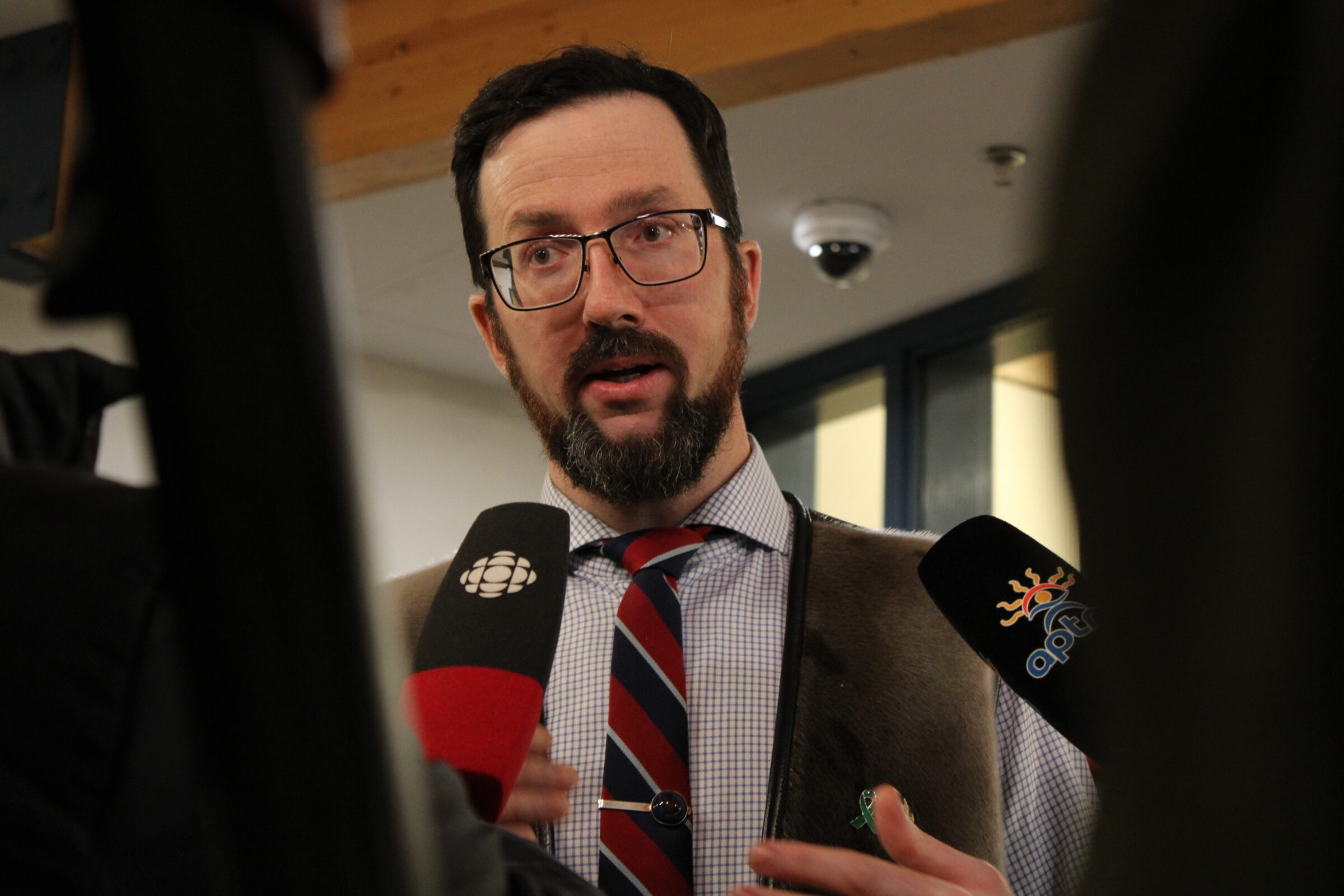
Premier-elect John Main speaks to reporters after being selected to lead the Nunavut government in Tuesday’s leadership forum. (Photo by Arty Sarkisian)

As John Main was making his pitch Tuesday to become Nunavut’s next premier, he said something one Carleton University researcher believes defines what the territory’s politics is about.
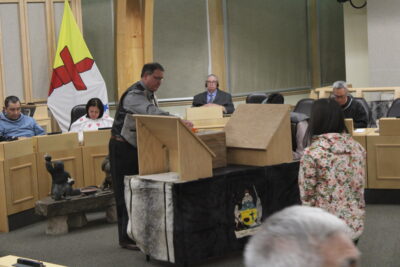
George Hickes and other MLAs cast their ballots for premier during the Nunavut leadership forum Tuesday. (Photo by Arty Sarkisian)
“Premiers are not kings,” Main, the MLA for Arviat North-Whale Cove, said during the leadership forum where he was selected premier over David Akeeagok, who represents Iqaluit-Niaqunnguu.
In Nunavut’s consensus-style government — where there are no political parties — that statement is truer than in most other provinces and territories, said Jerald Sabin, associate professor at Carleton University in Ottawa.
“In a party system, the ‘first among equals’ becomes more like the ‘king among equals,'” said Sabin, who was at the legislative assembly Tuesday researching consensus governments.
In most Westminster-style or parliamentary legislatures, the leader of the winning party gets to hand-pick members who will serve in cabinet.
But in Nunavut, although Main as premier gets to assign and switch portfolios of his eight ministers, he cannot choose who serves in cabinet — that decision is made through a vote by the other MLAs, as happened Tuesday.

“So he is literally first among equals who has to work with others,” Sabin said.
When Nunavut was created in 1999, it inherited the consensus form of government from the Northwest Territories — no political parties, and all decisions are made by a majority vote in the assembly where the premier and ministers are always outnumbered by regular MLAs.
But over the years, some have argued Nunavut would benefit by changing the way it chooses its leaders.
“We have outgrown this consensus government,” said Manitok Thompson, a former MLA in Nunavut and the N.W.T.
The consensus style, she said, is often touted as being closer to the “Inuit way” of governing. But the way Inuit managed their communities before the public government was established is nothing like what happens now at the legislature in Iqaluit, Thompson said.
It was almost like “communism” or “dictatorship,” she said of the traditional way.

Elders had the power and could make decisions about all aspects of life including justice, marriage and food distribution.
“If they said that a child will now be taken care of by a different family, that was the law,” Thompson said.
“But when the British came over, they treated all Inuit like children. They thought Inuit are just ‘yes people’ that live in harmony and can’t have any arguments.”
Without party affiliations, it’s hard to tell what individual MLAs stand for. Often, Thompson said, instead of dealing with territory-wide issues like housing and suicide, MLAs speak instead about hyper-local issues that should be the job of hamlet councillors.
To switch systems, Nunavut would need to amend its election laws which currently don’t mention parties, Sabin said.
While it’s legally possible, partisanship as a “political culture” must emerge on its own in Nunavut society.
Parties could be based on religion, race or regional leanings, such as the failed attempt to create a separatist Bloc Kitikmeot in 2007, Sabin said.
So far, though, he sees no sign that Nunavut might soon see organized political parties.
Sabin said his research comes at a critical moment for Nunavut politics.
In the territory’s first election in 1999, voter turnout was 86 per cent. In 2013, it was 65 per cent, then just under 48 per cent in 2021.
In the recent Oct. 27 territorial elections, turnout was 48 per cent.
“Clearly, there’s a larger legitimacy crisis going on,” Sabin said.
Thompson agrees.
“We are discouraged there is no change, things have not changed,” she said. “We don’t see debates happening, so people don’t feel like the government works for us anymore.”
What I do like about Consensus government, unlike partisan system is that the divisiveness partisan systems create are not as obvious in consensus. Let me say that I know jack about political science, but I feel that each community represented by an independent member is more fitting for Nunavut that the party system. Yes maybe you lose out on the ability to form a majority government in Consensus, but no one can run around creating laws that only benefit a subset of people inside consensus government. Argument could be made that less can be done under consensus. At the end of the day, if partisan system organically makes it way into Nunavut politics than so be it, but to force it seems like a terrible idea.
Henry ford and generasion Z watches you
Switching to the party system would be a terrible decision for Nunavut. The them vs us that we see at the provincial at federal level would be turned up to 11. It would be junior high nonsense in the legislative everyday. This system at least forces people to work together and main some level of decorum.
Imagine , American style system .
I feel much more engaged with our consensus government than do with the party politics of the south. Often parties will stand on this side and that side of an issue, but I like many people, usually sit somewhere in the middle. Sometimes I feel frustrated with how our government works, but I much prefer it to southern party politics.
Hate this KIngs phrase, if any group of MLAs majority don’t like the direction of the GN, they can turf the Premier or cabinet minister, and if a civil servant does not do their job they can be moved or terminated. Something that does not happen in party politics enough today.
For context – the reference to a King is a bit of an inside joke related to someone honestly mistaking John for royalty and asking for a photo with him this past spring.
Not sure why this is brought up. I personally haven’t heard anyone around me say they think that we should go towards party politics. Our communities and MLAs are still small enough to make contact with candidates and hear about their priorities as well as share our concerns. No need for a more polarized society now.
No. Just No. Partisan Politics is poisonous and has been detrimental to prosperity and peace. Independents can (and should) truly speak for the people they represent.
Maybe tell that baker laker that thought JM was the king of England,lol
“Senator” John Main has a nice ring.🤣🤘
The greater question to be asked here is the following. Why should each eligible voter in Nunavut not have a “direct” say in who becomes the Premier? Why should they not know who has Premiership ambitions? If the idea is that the Premier is simply a figure head, then fine. No need to be involved in that decision and no need to move away from the current system. However, if the Premier is actually expected to set the tone, the agenda, the direction and represent all Nunavummiut then the system should change to reflect this.
The reality is that Nunavummiut currently have absolutely no idea what direction Nunavut will go given the fact they are denied the ability to vote for a Leader. They have no ability to influence the direction it should and needs to take to address the challenges it faces and will face moving into the future. If one wonders why voter participation rate is below 50% it need not look further, then the disconnect and disinterest Nunavummiut feel regarding the greater picture and future of Nunavut. More importantly, their inability to influence it. Nunavummiut deserve a system that permits them to choose a leader directly. Not 22 Elected individuals, who in most cases the voter, even in their own constituency had no idea what that candidate stood for outside of local community issues. The idea that anyone of the 22 elected candidates can become Premier simply through a “secret ballot” makes no sense in today’s modern and complex world.
This consensus government model has hindered Nunavut over the last 25 years. Choosing a candidate based on nominations from other elected candidates; a then 20-minute speech from the would-be candidates and then 20-40 questions which often are so ridiculous, that they would not be asked in a High School Council election for President. There is something fundamentally wrong with that system.
I don’t think anyone who would like to see the “consensus government” changed, is advocating for a confrontational political model. The consensus model has however permitted and let slide, the lack of delivery of tangible results. It has accepted mediocrity, mismanagement, dereliction of duty and most importantly accountability. The current system has not delivered the results Nunavummiut deserve. How many Cabinet members have you seen or Premiers have you seen step down (not forced out i.e. 2018 and almost in 2024) due to clear and demonstrated negligence, mismanagement or wrongdoing (think about this past 4 years Social Services and Housing)? How many high-ranking Senior Officials within the GN or its Agencies have you seen dismissed? You will need to think hard on that one.
There is a format by which the system can me modified to allow Nunavummiut to vote for a Leader. A simple system that allows for an election which includes 22 MLAs and declared candidates for Premier. By adding those seeking the Premiership to all 22 Constituencies ballots, easily permits this. It also allows for debates to be held, where those candidates vying for the Premiership can be asked to clearly articulate their vision for Nunavut. These debates can be shared by the GN Webcast, media, streaming and social media platforms. Then a choice is made. Once the election is held, they everyone across Nunavut (including the 22 candidates) know what Nunavummiut truly wanted and what direction they expect their government to take. You can then role in the existing consensus government format to carry forward with the rest of the process (you leave the safeguards to permit removal and censure, etc…). You then repeat every 4 years to allow the votes of Nunavummiut to judge what has or has not been delivered.
This way everyone from the individual voter to the elected candidates knows what Nunavummiut wanted. Is it perfect? No. Does it allow everyone a voice? Yes. What it truly does though, is ensures that Nunavummiut have the power in their hands to use it.
In Nunatsiavut, the Inuit self-government in Labrador, there is a separate election for a (powerful) President; all beneficiaries get a vote. The President along with the First Minister (= Premier) chooses the cabinet from the elected members, but the entire Assembly has to approve the choices. The President can (and does) remove ministers from cabinet if he or she finds it necessary. It is a ‘consensus government’ without parties, much like in Nunavut and the NWT, but cabinet tends to be more cohesive than in Nunavut.
The Labrador system seems to be the most appropriate step to take now, not party politics, which is an extremely adversarial system.
Would you still vest the regular members with the authority to remove the Premier? That’s a key aspect of the current system and a critical check on executive overreach.
There are party politics in our federal system, and yet we do not have any say over who will be prime minister. You get to choose a party. That party chose their leader. So nothing you are saying here makes sense.
Sorry “Dudetown” but you definitely get to choose. The parties have a leadership convention and choose the leader. Everyone (voters) then know who that leader is and what they stand for (they and their party). You then go to the polls and vote for the candidate in your riding that represents the party and leader you would like to have. So clearly “you” do choose who you would want as leader.
No one here is advocating for parties or leadership conventions. What is being advocated is Nunavummiut knowing who wants to be Premier, what they stand for and what direction they would line to take Nunavut. And then having the ability to vote for who best represents them. Simple!
“To me consensus seems to be the process of abandoning all beliefs, principles, values and policies in search of something in which no one believes, but to which no one objects—the process of avoiding the very issues that have to be solved, merely because you cannot get agreement on the way ahead. What great cause would have been fought and won under the banner ‘I stand for consensus?”
Margaret Thatcher
Margaret Thatcher also caused 25% inflation during her tenure and widened wealth inequality to unsustainable levels.
‘Sigh’ with the red herring, as usual.. completely irrelevant to the point.
George, the ever teary MLA, once again raised his voice about Inuit employment but when the vote came, he leaned toward Mr. Main. Was it conviction, or just another performance from ‘Fake George Hickes’? The crowd wasn’t sure, but the whispers grew louder.
Premier John Main has not been transparent while he was minister of health about health benefits for elders. My mother told me their is four per year since last year, yet many families only learned about it informally. Elders deserve clear communication about their rights. If such vital information is withheld, it raises serious questions about what else may be kept from the public. Nunavummiut deserve honesty and openness from their leadership.
My problems with the current system are two fold:
1. While you may know WHO you are voting for in this system, you have no idea WHAT you are voting for when you go and vote.
I get tired of going to the ballot box voting for who I think is the best person but having no idea of what policy direction will come out of the election regardless of who wins. When you have parties, at least you know what you’re getting in terms of policies, and if that party wins and then fails to deliver on their promised policies you can hold them accountable in the next election. In Nunavut’s system, who knows?? You just vote for the best person and cross your fingers. I wonder how we stand up to other provinces in terms of voter engagement.
2. Nunavut voters have NO SAY in who will be our LEADER.
I’m sure Mr. Main is a competent and decent man, but only about 15 people had the privilege to decide whether he would be premier versus his competitor Mr. Akeeagok. With political parties, the voters have the options before them for the Premiership, and they can choose the best one when they cast their vote. Is it possible for a sitting Premier to be deposed by his own party? Sure it is. But that’s extremely rare and I’m not sure that has even happened before.
Anyway, I hope that a few of you see where I’m coming from
I think that with devolution, partisan system would be best to give a platform on lands and resources. Bizarre manifestation of the premiers mind to be a king.
Every caucus member of a party is pretty much always whipped to vote whatever the king/queen (party head) decides. Party elections say nothing useful on policy and simply promote their leader for as the best king and other kings as evil in the three (two) party system, The local rep flying the party flag simply has to show up at parliament, lockstep vote with the king, and stand up and clap every time they say anything, For this reason I haven’t voted in a party election system in decades and would stop if Nunavut went that way.
We are not ready for a party system in our GN, with Nunavut having about 80% Inuit population yet with very little control of our government, what little control we have in a consensus system we have a bit more individual control, when our government is mainly controlled and run by the managers, directors and policy makers that represent about 30% of the population, a party system will only give a small minority that much more control, every elected official would have to go by the party vote, going against their own interests and mandates.
Until we have real control of our own government we are not ready to go into a party system where just a few leaders and their staff have majority control in how their party members vote and support legislation.
We still have a lot of work ahead of us to make changes in our government to represent our Nunavut interests. Right now we are not there yet,