


Arctic Talent: Iqaluit seamstress talks amautiit, parkas, and making an atigi for Mark Carney
Emily Joanasie sees colour as an important part of her creations
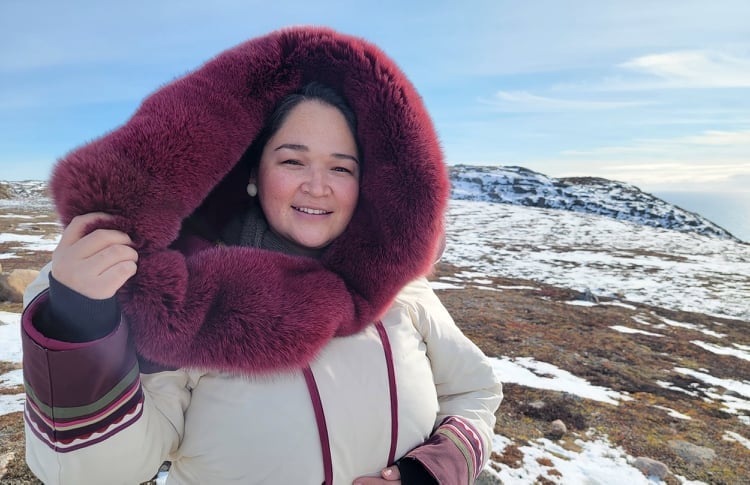
Emily Joanasie wears an amauti she made for one of her children. (Photo courtesy of Emily Joanasie)

When newly appointed Prime Minister Mark Carney visited Iqaluit on March 18, emerging into the public eye wearing a blue atigi with yellow lines overtop his suit, it prompted a lot of questions online.
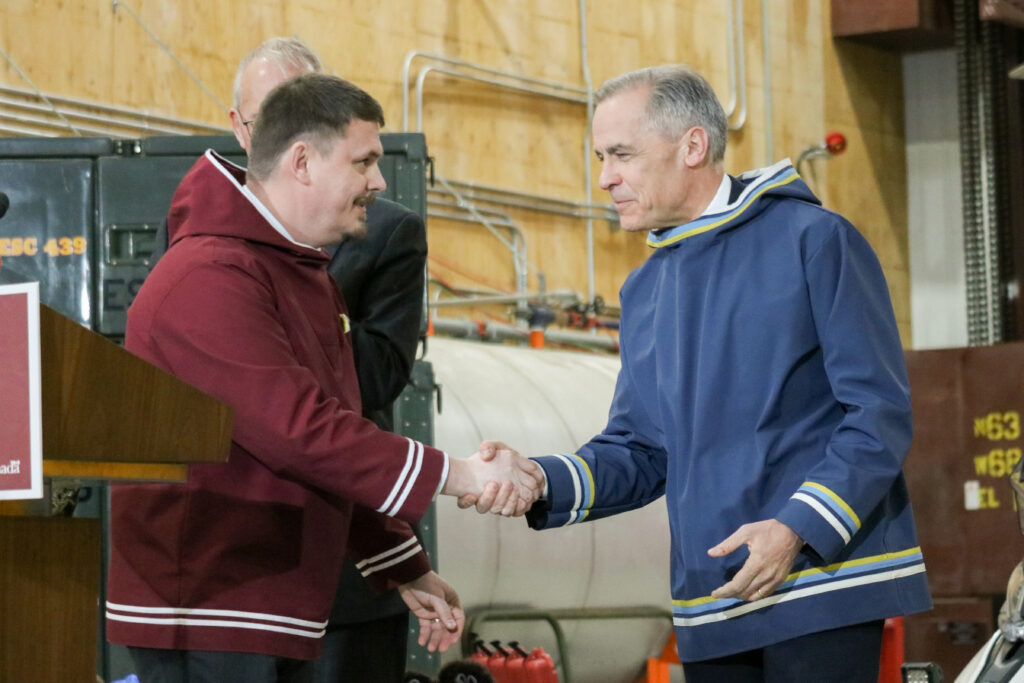
Then-premier P.J. Akeeagok, left, shakes hands with Prime Minister Mark Carney in Iqaluit in March 2025. Carney is wearing an atigi made by Iqaluit seamstress Emily Joanasie. (Photo by Jeff Pelletier)
What’s that “hoodie”? Can you buy it on the internet?
And most important: who made it?
“I still laugh about that,” said Iqaluit seamstress Emily Joanasie, who made the atigi, a traditional Inuit men’s hooded pullover parka.
She was the one responsible for Carney’s appearance that day. But now, as she looks at photos of the prime minister in her creation, she sees a problem.
“I think many Inuit seamstresses have a real good skill of looking at someone and sizing them up,” Joanasie says.

But she had never seen Carney, and the atigi ended up being a bit large on him.
“So he needs to come back,” Joanasie said.
“He should have a walk-in closet of them. He’s allowed. Everybody’s allowed. That’s a hope for me, is that people have more pride in themselves to wear our cultural things on regular and not just special occasions.”
Joanasie recently sat down to talk about how her long career as a seamstress unfolded.
2005: Joanasie, 22, makes her first white amauti, or women’s parka with a carrying pouch, with pink lining.
“I grew up knowing that when you start having children you need to start making your own amauti,” she said.

However, she was 15 when she had her first son and had to use her mother’s old amauti.
“I felt like I wanted to do it different with my daughter,” Joanasie said, adding she’s now made amautis for all of her children.
2010: At first, Joanasie is shy about her work. Only after making an amauti for her third child does she feel confident enough to start sewing for others, mostly giving her creations to friends and family as gifts.
Around that time, she makes her first sale — a regular parka.
She also puts an amauti up for sale. It’s a mix of blu-ish purple, lavender, green and mint green fur, making the whole thing look like northern lights. But it’s too colourful for most people’s liking, and Joanasie ends up giving it away.

Her instinct is to always make a piece of clothing brighter.
“Coming from a community that has dark months, I often felt like it’s nicer to bring out brighter colours in our community, especially when we deal with such dark things socially.”
2020s: The trend for Inuit clothing is simple and neutral — which is not what Joanasie likes.
Inuit parkas have also adopted the modern fit and become less bulky, which in the past provided more space for layers of clothes for warmth.
“So it’s bringing in a little bit of Inuk flair to the mainstream influence, I guess,” she said.
2025: Joanasie gets an order from Nunavut Tunngavik Inc. to make an atigi that the organization will give to the prime minister when he visits.
She receives specific instruction on the colours, but decides to “test the boundaries,” she says.
Instead of making the lines yellow, as she was asked, she chooses a more flashy lime-green colour.
“I wanted it to still have my signature of being a little bit different,” Joanasie said.
Tips from the trade: Sign up for any courses or masterclass sessions you come across. Ask question if you don’t get something. And most important, just do it.
“Don’t be afraid to test, to do what you do in a different way,” Joanasie said.
Joanasie’s Arctic Talent picks: Cultural counsellor Elisapi Aningmiuq and educator Liina Ivik.
It’s call silapaq not Atigi
Silapaq is the cover of the atigi
Atigi is parka
Each community/region has different dialects and may have different words for the same thing. So, you’re use to calling it a silapaaq* and others are use to calling it an atigik.
It’s called Atigi, not Silapaaq
Silapaaq are snowpants
In Baffin region we call them “Atigi or Qalipaaq”
Snow pants are called
Kaliialuks
Qalipaaq is sweater
This volume knob goes to 11 not 10!
Wow! Uakallanga! This story makes me so happy. Emily, you’re so amazing and talented.