

Inuit art offers Toronto students window into different world
Historic private school adds Ningiukulu Teevee’s stained-glass window depicting ‘The Owl and the Raven’ to chapel

Angela Terpstra, the head of school at Toronto’s Bishop Strachan School, looks up at a stained-glass window created by Inuk artist Ningiukulu Teevee and installed at the school’s chapel last year. (Photo by Lu Chau, courtesy of Bishop Strachan School)
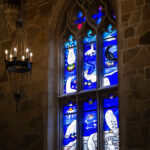
A stained glass window depicting the Inuit legend “The Owl and the Raven,” is seen at Toronto’s Bishop Strachan School. (Photo by Lu Chau, courtesy of Bishop Strachan School)
A new Inuit-designed stained-glass window in the chapel at Toronto’s Bishop Strachan School allows students to connect personally with Canada’s path toward truth and reconciliation.
The chapel’s stained-glass windows are mostly warm reds and yellows, but a new installation by Inuk artist Ningiukulu Teevee stands apart: a luminous blue window depicting the Inuit folktale The Owl and the Raven.
“It took my breath away,” said Angela Terpstra, the head of school, recalling her first look at it and describing how the light can refract into a rainbow across the chapel.
The window was created in memory of alumna Grace Peebles, who loved the chapel and cared deeply for the North. Completely donor-funded, it cost in the “region of $100,000,” Terpstra said.
Peebles died in 2021 after suffering an epileptic seizure.
“It started with a tragic event that then led into something restorative,” Terpstra said.

“She really loved the chapel, not necessarily as a religious space but as a space where she could sing, where she went for meditation and contemplation.”
Terpstra said the school wanted a memorial that could also broaden students’ understanding of Canada.
The imagery draws on an Inuit legend about an owl and a raven, a choice Terpstra said was intentional for the school, which teaches junior kindergarten to Grade 12.
She said she wanted even the youngest students to look up and understand that the window was telling a story about friendship and reciprocity — but also that it was “not all serious, there’s something lovely and fun about the windows.”
The window’s storytelling is also a lesson in perspective.
Students are asked to read the panels from the bottom left, moving through the centre and across, rather than in typical Western left-to-right reading order — a reminder that different cultures create meaning differently.

Terpstra said the window is intended as a “provocation” to contemplation that might lead to questions and action.
Sue Obata, the stained-glass artist who painted the window, said bringing Inuit imagery into a traditional chapel helps move reconciliation from abstraction into students’ daily lives.
“It starts with respect. Respect for people who are different,” she said.
“Every time we look at something different and appreciate it, that breeds respect.”
The project began with sketches by Ningiukulu Teevee and was translated into stained-glass layouts by Norbert Sattler at Sattler’s Stained Glass Studio Ltd. in Nova Scotia, then painted and assembled by Obata.

She said one technical challenge was honouring Teevee’s graphic, two-dimensional linework without imposing the three-dimensional modelling common in European ecclesiastical stained glass.
Obata said blue has a long history in church glass as a “quiet,” sacred colour suited to contemplative spaces. Blue also supports the story’s imagery, suggesting sky and water behind whales, a narwhal and a descending owl.
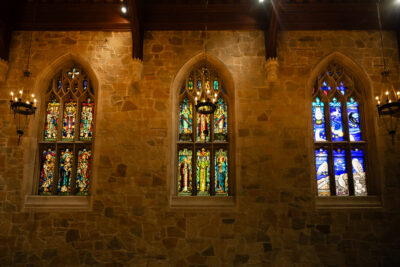
A new stained-glass window depicting the Inuit legend “The Owl and the Raven,” right, is next to two Christian-themed windows in the chapel at Toronto’s Bishop Strachan School. (Photo by Lu Chau, courtesy of Bishop Strachan School)
Terpstra, whose 20-year tenure at the all-girls school ends in July, placed the project in a longer institutional arc.
Bishop Strachan School was founded in 1867, the year of Canadian Confederation, and Terpstra said that history comes with obligations. The window is now a permanent reminder for students to consider their perspectives and their obligations to truth and reconciliation.
(0) Comments