


Arctic research station gets new mandate, money to spread around
CHARS ramping up in Cambridge Bay with pilot projects and calls for proposals
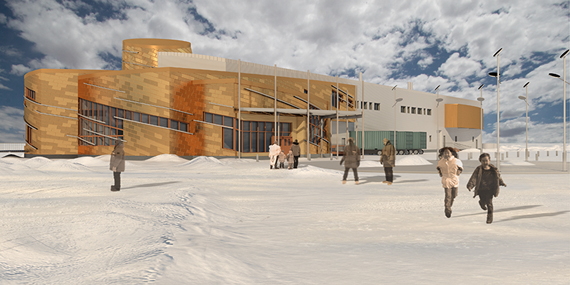
This is an artist’s rendition of what the finished CHARS main facility will look like. (PHOTO COURTESY OF SCIENCE.GC.CA)
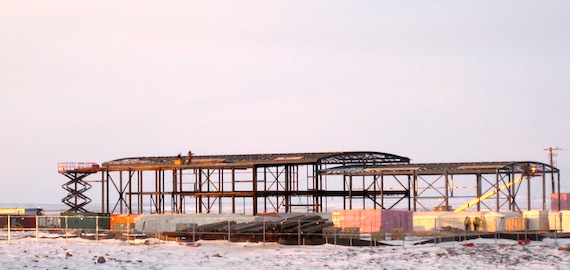
The Canadian High Arctic Research Station is currently under construction in Cambridge Bay and is slated for completion in 2017. (PHOTO BY JANE GEORGE)
Canada’s premier Arctic science and research facility, currently under construction in Cambridge Bay and slated for completion and full operation in 2017, got its official marching orders this week.
The Canadian High Arctic Research Station Act, buried deep within Bill C-43, the Economic Action Plan 2014 Act, No. 2, got royal assent this week in Ottawa, which means it’s now officially law.
The CHARS portion of the larger act establishes the centre’s mandate and governance structure and also repeals the Canadian Polar Commission Act, effectively rolling the commission’s mandate into CHARS.
Aboriginal Affairs and Northern Development Minister Bernard Valcourt issued a statement Dec. 17 saying the act’s passage proves his government’s commitment to High Arctic sovereignty and to northerners.
“Once implemented, the Canadian High Arctic Research Station Act will also strengthen the voice of northerners in Arctic science and technology at home and around the world and will strengthen Canada’s role as a global leader in cutting-edge Arctic science and technology,” Valcourt said in the statement.
Just days before it received royal assent, Martin Raillard, CHARS’ chief scientist, said he looked forward to the new act during a presentation to academics, policy makers and northerners at ArcticNet’s annual research conference in Ottawa Dec. 11.
“Before we were embedded in the central government and now we’re becoming an independent organization,” he told his audience.
“We’ve merged with the Canadian Polar Commission and that’s good news for us because it makes us more flexible, more able to conduct science efficiently, more able to network.”
Not that he has the authority to speak to reporters.
After his speech, surrounded by local and international journalists, Raillard had to decline comment while a colleague hastily called AANDC public affairs to get permission to do interviews.

“I would love to talk to you about this, but I can’t,” he told reporters, after just talking about it, from the stage, for 20 minutes.
In his speech, Raillard explained what CHARS has been doing while this new law was winding its way through the legislative process.
Managers have been busy hiring staff, issuing calls for funding proposals and completing their first field season, in May, he said.
That first field season included mapping soils, vegetation, geology and animals from Kugluktuk to Taloyoak and sections to the north and south of that band of Kitikmeot communities.
He stressed, both in his speech and in answers to questions from conference participants, that the CHARS management committee is comprised of scientists and northerners to ensure local interests, priorities and concerns are incorporated into project design and execution.

Working groups will also have representatives from communities and aboriginal organizations, he said, as well as from academia, government and industry.
While that may be true at the lower level, according to the act, CHARS will be governed by a board of directors consisting of nine members appointed through Orders in Council.
Orders in Council are made by Canada’s Governor General on advice from the corresponding minister which, in this case, would likely be the AANDC minister.
Prime Minister Stephen Harper announced this summer that CHARS will get $142.4 million over six years for construction, equipment and ramp-up.
Starting in 2018, CHARS will get $26.5 million per year, Raillard said, for its ongoing science and technology program and for station operations.
CHARS has a four-fold mandate, Raillard explained:
• resource development that is “economically and environmentally sound and promotes social development,” and research into renewable resources and “unconventional energy sources that contribute to greater energy security and sustainability”;
• exercising sovereignty: surveillance of Canada’s Arctic regions, management of Arctic waters and improving emergency response;
• strong and healthy communities: improve infrastructure, diversify economic opportunities, improve the health and wellness of northerners and northern community; and,
• environmental stewardship and climate change: improving environmental stewardship and strengthening mitigation efforts through “greater understanding of changes in the Arctic climate and the links to global systems and increased capacity to adapt.”
Raillard’s presentation seemed to jive with functions spelled out in the new law.
But the actual CHARS Act lists a few other functions for the Cambridge Bay facility that include to “plan, direct, manage and implement programs and projects relating to scientific research and the development of technology,” and “to promote the testing, application, transfer, diffusion and commercialization of technology.”
In plain language, that means the government expects CHARS not just to study the North, publish findings and influence Arctic policy, but to develop technologies that CHARS can patent and sell for money.
Those practical expectations are further defined under the Act’s section on “powers,” which includes designing, trademarking and receiving fees from patents, copyrights and trademarks.
This may partly explain why the act was embedded inside the Conservative government’s Economic Action Plan.
As bureaucrats, scientists and northerners get comfortable with the new law and mandate, researchers in Cambridge Bay have already launched local pilot projects on wind and solar power to examine potential alternative energy sources for powering CHARS, and other northern infrastructure, Raillard said.
A call for proposals on renewable energy and technology transfer went out in August 2014 in the hopes of identifying energy options for the North and reducing reliance on diesel fuel and heating oil.
“There are other technologies out there that could be adapted and that’s an important job that we have been asked to do,” Raillard said.
In March 2015, CHARS plans to release its “State of Arctic Energy” research report. Raillard provided few details on the report except to say it will review current domestic energy use in the Arctic and provide “a foundation to guide future research efforts at CHARS.”
Raillard listed two priorities for the next call for proposals: baseline data for resource development in the Baffin, Kitikmeot and Nunavik regions, and predicting the impacts of climate change on shipping, on communities and on northern infrastructure.
“What does this mean for Tuktoyaktuk? Or Inuvik? We’re scaling it down to that level — how is it going to affect the buildings and the ice roads, things that matter to people in the North, to make it real for them,” Raillard said.
From 2015 to 2018, CHARS will hand out roughly $7 million in research money broken down to $5 million for resource development research and $2 million for climate change monitoring.
Once those projects are underway, CHARS managers will to turn their attention to building international partnerships, Raillard said, and attracting international researchers.
(0) Comments