

Fireballs and shooting stars
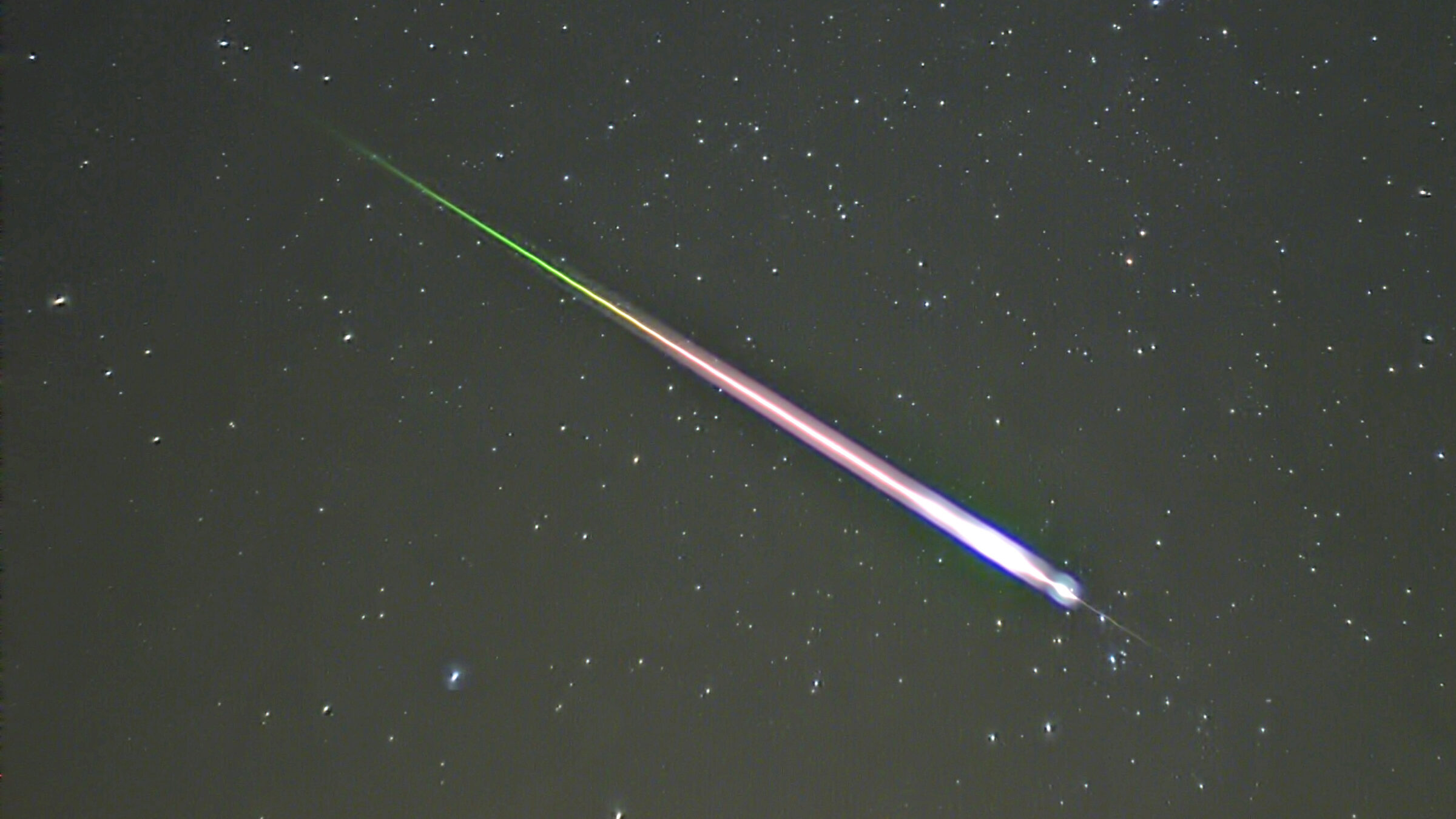
A meteor is seen during the peak of the 2009 Leonid meteor shower. In Labrador in 1799, when a non-believer of Christianity saw a meteor shower, he rushed to the mission at Hopedale and roused the Inuit there, crying out, “Let us all turn to the Lord with our whole heart, and be converted.” (Photo courtesy of Huntster/Wikimedia Commons)
When I lived in Arctic Bay, it was extremely rare to hear thunder and see lightning. Such things just didn’t occur in the mountainous country of North Baffin Island. Of course it rained in the summer and fall, sometimes heavily. Inuit who had lived farther south in the Baffin Region and on Melville Peninsula said they knew of thunder and lightning. And the Inuktitut language has words for both. But many people who had spent their lives only in the High Arctic had never experienced them.
And then one night — and I can’t remember what year it was — there was a tremendous rainstorm. The roads turned to mud; the rain kept coming.
And then the thunder and lightning started. It didn’t last for long, but it was spectacular. For some who had never experienced it before, it was downright frightening.
An elderly lady came out of her house and ran down the road, shouting “Jisusi tikiliqtuq! Jisusi tikiliqtuq!” (“Jesus is coming!”)
Atmospheric phenomena have always played upon superstition.
On Christopher Columbus’s fourth voyage to America, his ships were becalmed for months in the Caribbean Sea. At first, the Taino tribespeople generously provided the Spaniards with food. But eventually they grew tired of the crew’s incessant demands and mistreatment. Columbus was faced with a possible mutiny by his own men, as well as his and their starvation.
Fortunately for him he had an almanac with astronomical tables. He knew that there would soon be a solar eclipse. He called the Taino leaders in for a meeting and told them that his god was angry with them for not providing food. He told them that his god would give a sign to show his displeasure – he would withdraw the moon from the sky and it would turn red.
A total lunar eclipse occurred on February 29, 1504. The moon entered the earth’s shadow and, as predicted, turned a bloody red.
The Taino were terrified and rushed to the ships immediately with food.
Columbus pretended to consult with his god. But in his cabin, he was timing the length of the eclipse with an hourglass. He came out of his cabin just as the moon was due to begin its reappearance and told the Taino that he forgave them as long as they would continue to deliver food.
The moon reappeared and the Taino kept up their deliveries.
I was reminded of this when I read recently about the effect of a meteor shower on Inuit in Labrador in 1799.
Inuit there had only recently heard of Christianity — strange stories told to them by white men about a man named Jesus who had lived long ago, but whose birth had been foretold by prophets. A star featured large in the telling, a star that had led wise men to his birthplace. These must have been perplexing stories to the Inuit who first heard them. They are perplexing enough even today!

A man named Kapik had hitherto been unimpressed with the Moravian missionaries on the Labrador coast. They knew him as a heathen — a non-believer. He was living in his traditional camp when a huge meteor shower occurred in the early morning of November 12. It was the Leonid Meteor Shower, a meteor storm that occurs roughly every 33 years. Inuit had seen meteors before, what are sometimes called shooting stars. There is a word for them in Inuktitut.
Inuit often say that the word for a shooting star is ulluriat anangit (star feces). But elders claim that that is kid’s talk, that the proper word is ingnirujaq (bearing fire or sparks).
George Kappianaq of Igloolik explained that “it is called ingnirujaq because it is brighter than fire, brighter than the flame of a qulliq (a soapstone lamp).”
Far away in Venezuela, the scientist Alexander von Humboldt saw the shower and described it as “most extraordinary fiery meteors … seen towards the east,” and said that “thousands of fireballs and shooting stars were falling one after another for four hours.”
In Labrador, the sight of such a tremendous meteor shower made a deep impression on Kapik. A Moravian account says he was “almost beside himself with terror.” He rushed to the mission at Hopedale and roused the Inuit there, crying out, “Let us all turn to the Lord with our whole heart, and be converted.”

The missionaries seized the opportunity and “before long he who had done all he could to injure the cause of Christ, was himself a Christian.”
The missionaries may have invoked the words of Jesus from Matthew 24 about the end times: “The sun will be darkened and the moon will not give its light; the stars will fall from the sky, and the heavenly bodies will be shaken.”
A similar occurrence happened again at Hopedale a few months later. On the night of January 14 “immense fiery rays and balls” were seen. The missionaries again seized their opportunity. “The Esquimaux believed they [the balls] were sent to announce the end of the world, nor did we pretend to contradict them, but took that opportunity to represent how needful it was to be prepared, and to seek to make sure of our souls’ salvation.”
Taissumani is an occasional column that recalls events of historical interest. Kenn Harper is a historian and writer who lived in the Arctic for over 50 years. He is the author of Give Me Winter, Give Me Dogs: Knud Rasmussen and the Fifth Thule Expedition, and Thou Shalt Do No Murder, among other books. Feedback? Send your comments and questions to kennharper@hotmail.com.
Thank you Kenn for sharing about revival, repentance and turning to the Lord Jesus at Labrador back in 1799
Thank you, Ken for sharing stories. I love reading them all.
Thank you Ken for your non critical story about how Christopher Columbus and other Colonizers used their knowledge of astronomy to bring Christianity through fear to indigenous cultures many years ago