

YWCA-Agvik renews push for a Clare’s Law in Nunavut
‘Knowledge is power’ to prevent intimate partner violence, say advocates
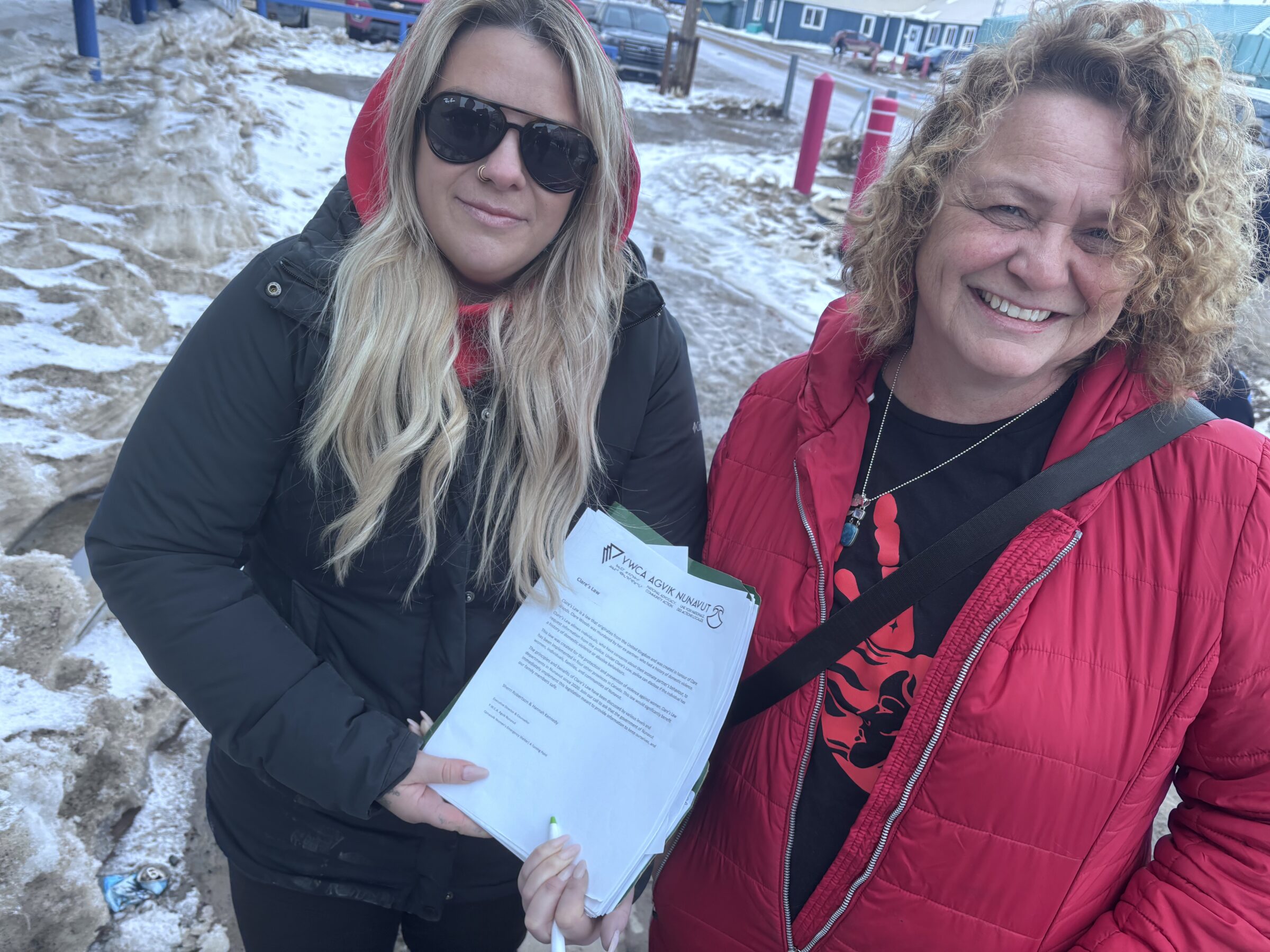
YWCA-Agvik social worker Hannah Kennedy, left, and executive director Sherri Robertson seek signatures on a petition calling for the implementation of a Clare’s Law by the Government of Nunavut, on Tuesday. (Photo by Daron Letts)

Advocates for a law that would allow police to warn people about a potential partner’s history of criminal violence or abuse are once again calling for its implementation in Nunavut.
YWCA-Agvik Nunavut staff collected signatures on a petition at Tuesday’s Red Dress Day event in Iqaluit. It’s the annual day across Canada to remember missing and murdered Indigenous women and girls, gender-diverse and two-spirit people.
“We are in the early stages,” Hannah Kennedy, a YWCA-Agvik social worker, said in a phone interview Wednesday.
Kennedy is co-ordinating a campaign in Nunavut to support the adoption of a so-called Clare’s Law — also known as an interpersonal violence disclosure protocol — that would allow police to tell someone if their partner has a history of criminally violent or abusive behaviour.
Currently, a federal privacy law prevents Nunavut RCMP from disclosing that information.
Clare’s Law is named after Clare Wood, a 36-year-old British woman who was killed in 2009 by a man whose violent criminal past she didn’t know about. Versions of the law have been passed in Saskatchewan, Alberta, Manitoba and Newfoundland and Labrador. The Quebec legislature is also considering it.
“Knowledge is power,” Kennedy said. “Clare’s Law gives people the ability to make informed decisions.”
The program flags past convictions for stalking or harassment, breaches of no-contact orders, sexual violence and other violent or abusive behaviour.
In 2023, the City of Iqaluit passed a motion that called on the Nunavut government to pass a similar bill.
In 2020 and 2023, the Nunavut Justice Department examined what adoption of a Clare’s Law might look like. But it stalled each time.
“Since Clare’s Law involves the disclosure of information held by police, implementation of such a program would require RCMP involvement,” said Stephen Shaddock, the department’s director of policy and planning, in an email earlier this week.
“I think it’s a matter of ‘will not’ — not ‘cannot,’” YWCA-Agvik executive director Sherri Robertson said in a phone interview Friday.
Robertson argues that Clare’s Law makes public information accessible to vulnerable people who may not know how to find it online.
YWCA-Agvik has been circulating the first draft of the petition since 2025. They are consulting with YWCA’s national office to draft a formal version of the petition, which Kennedy expects to present to MLAs in the fall.
Anyone in need of help can contact their local community justice outreach worker or victim services (1-866-456-5216) for support, Shaddock said.
(0) Comments