

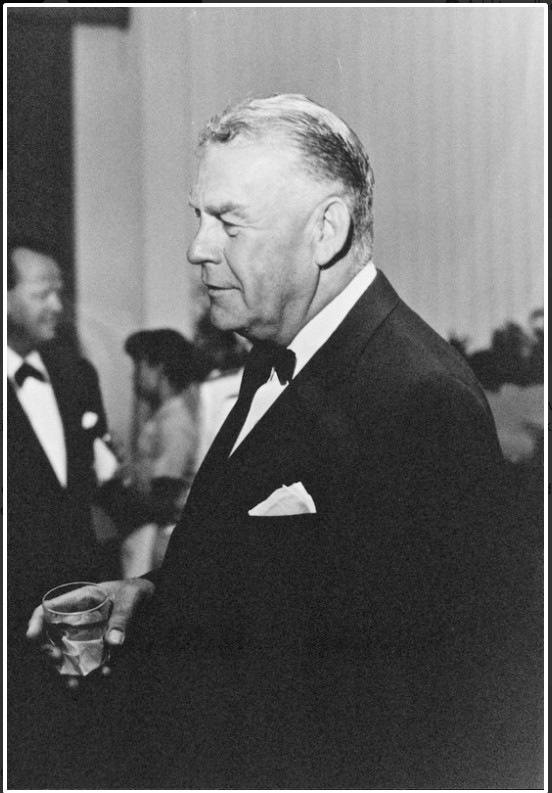
Eske Brun was the governor of Northern Greenland, based at Godhavn (now Qeqertarsuaq), during the Second World War. (Photo by Jorgen Taagholt, courtesy of Arktisk Institut (Denmark), #64979)
The defence of Greenland Part 2: Eyes on Greenland
This continues the Greenland defence series.
Canada had believed that the neutral United States would accept a small Canadian occupation force in Greenland more than a British one, which would have contravened the Monroe Doctrine. But Ottawa had misread Washington.
On April 23 and 24, 1940, Prime Minister Mackenzie King met with President Franklin Roosevelt in Georgia.
King wrote in his diary that “the Americans were anxious that Canada should not undertake anything in particular… He [Roosevelt] thought no effort should be made, either by the United States or Canada to get possession of Greenland, that whatever was done should be done subject to Greenland managing her own affairs.”
Before returning to Canada, King visited Washington where he met twice with the American Secretary of State Cordell Hull, who was more forceful than the president had been. He insisted that any Canadian plans to occupy Greenland be abandoned and clarified his department’s position on the applicability of the Monroe Doctrine.
To Hull, it mattered not that Canada was a North American country. He rejected the right of any third party to interfere in the political or military affairs in Greenland – Canada included. He thought that the cryolite mine could be defended by local residents if arms were supplied by the United States.
King also met with Canada’s envoy to Washington, Loring Christie, and wrote of the meeting, “I was astonished to find that he had been given instructions to say that Canada would prepare a defence force for Greenland… Clearly our people had been a little over-zealous in preparing for a little war on Canada’s own account.”
Roosevelt thought that a German attack on Greenland was unlikely, but conceded that, if there was one, the Allied forces would have to take action. King was in a quandary. He was damned by America if he took military action and damned by Britain if he didn’t.
King returned to Ottawa and attended a cabinet meeting on May 1. He wrote, “Found to my amazement that… a military expedition [had been] fitted out to go to Greenland.”
When he was asked if they should be demobilized, “I said certainly and at once.”
On the same day, King received a cable from Vincent Massey, Canada’s High Commissioner in London, relaying Britain’s request for Canada to seize the mine and suggesting that Washington need not be consulted: “In the opinion of the United Kingdom authorities, it would not be necessary to make a formal communication to the United States government before the expedition is dispatched.”
Cabinet met again the following day, and that afternoon the military officials were ordered “that ‘Force X’ is to be demobilized and all action in connection with it suspended.”
So, suddenly, the possibility of Canadian military intervention in Greenland ended. Or so it seemed.

But federal officials weren’t done with the matter. On May 6, they wrote for King a memo entitled “Proposals for a Canadian Policy relating to Greenland.”
While a military force was off the table, they suggested that the Hudson’s Bay Company ship Nascopie should go to Greenland with supplies and return with a cargo of cryolite. The memo also suggested that Canada should establish a consulate in Greenland and send a consul on the Hudson’s Bay Company ship. King agreed with both suggestions.
Certain officials continued to try to resurrect the plan of military intervention, which upset King. It made him feel “a little nettled,” and he wrote that he had “made it clear that we had previously settled the policy of the government which was that our action was to parallel that of the U.S.”
But Canadian bureaucrats persisted and prevailed. Two RCMP officers would accompany the Nascopie, ostensibly to secure the safety of the mine. But accompanying them would be four more officers in plain clothes and a Canadian military officer, Major G. L. W. MacDonald, all appearing to be civilians.
MacDonald, an artillery officer, was to survey the mine site and determine locations for gun emplacements and other works needed to defend the site. This work was to be done surreptitiously; he was instructed to be “scrupulously careful that your actions do not disclose the purpose of your presence in Greenland.”

When Denmark fell to the invading Germans in 1940, Greenland had been a Danish colony for over two centuries. Its population was about 20,000 Inuit and a few hundred Danes who were employed by the trade monopoly, Det Kongelige Grønlandske Handel, and the Lutheran Church.
The island was a closed territory. Outsiders were not allowed to travel to Greenland without special permission. It was divided into two administrative districts managed by Danish civil servants, most commonly referred to in English as governors.
The northern district was headquartered in Godhavn (now Qeqertarsuaq) and managed by Eske Brun. The southern district was under the authority of Aksel Svane in Godthaab (now Nuuk), about 350 kilometres north of Ivigtut. These two men reigned supreme on domestic matters within Greenland, loosely supervised by the Greenland administration in far-off Copenhagen.
A vast ocean separated Greenland from Denmark and there was always the possibility that communication between the two could be interrupted. In 1925, Denmark had passed the Act on Greenland’s Administration, which detailed how Greenland should be run in the event of an emergency. It granted emergency powers to the two governors who, “as the representatives of the Danish Government in Greenland, are to be considered the responsible authority in the country and can in exceptional circumstances take such measures as the interests of the population may demand.”
And in 1939, as war clouds gathered over Europe, fearing the worst, the Greenland administration shipped additional food and supplies to the island.
When the unthinkable happened on April 9, 1940, it was obvious to the governors that the events constituted just such an emergency as the Act of Greenland’s Administration had contemplated. The two governors assumed unprecedented authority.
But in another far-off city, someone else had quite different ideas.
To be continued…
Taissumani is an occasional column that recalls events of historical interest. Kenn Harper is a historian and writer who lived in the Arctic for over 50 years. He is the author of Give Me Winter, Give Me Dogs: Knud Rasmussen and the Fifth Thule Expedition, and Thou Shalt Do No Murder, among other books. Feedback? Send your comments and questions to kennharper@hotmail.com.
(0) Comments