

Arctic Talent: Yurak approaches life with punk rock joy
Iqaluit artist quits day job, pursues entrepreneurship
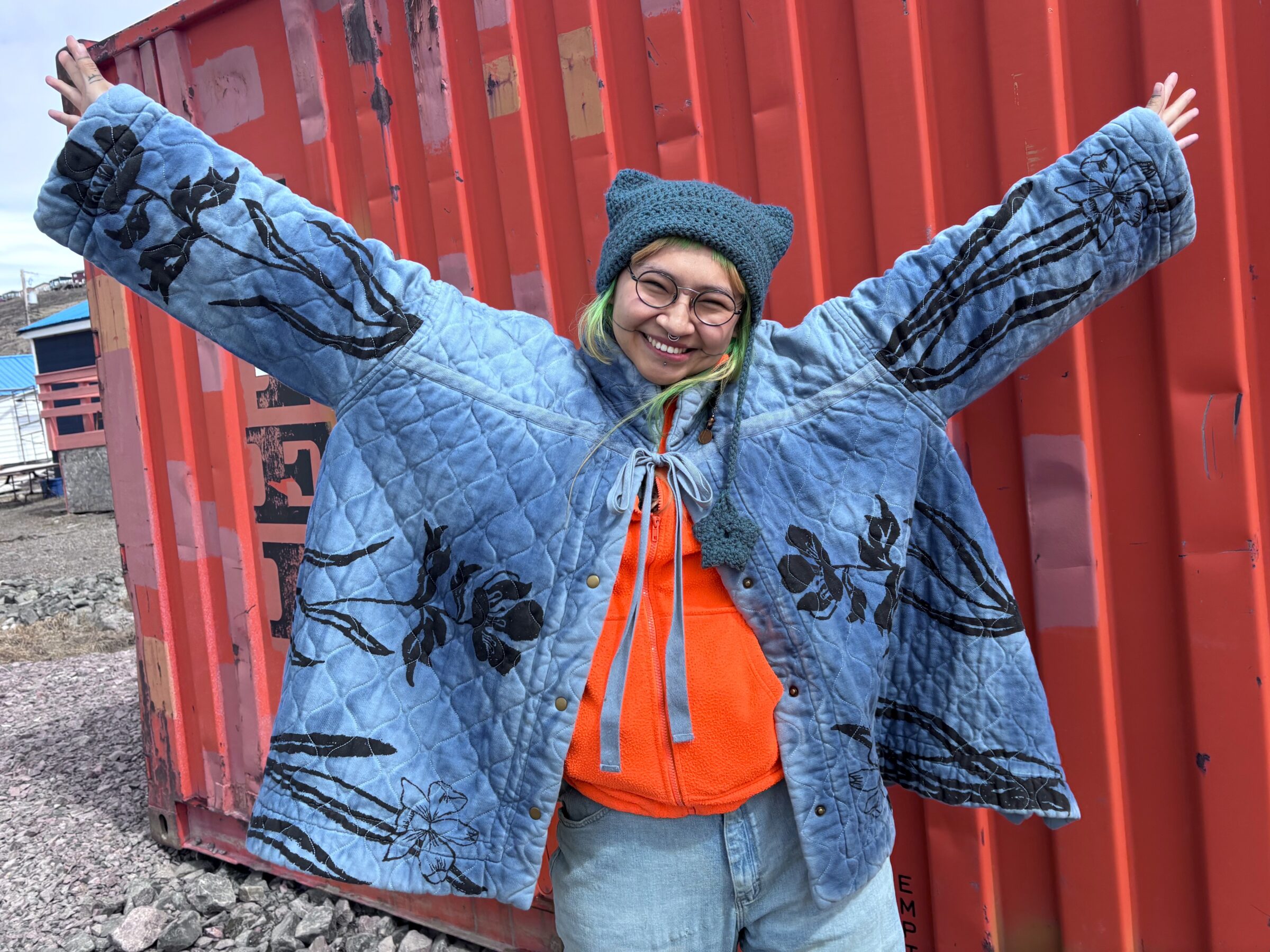
Yurak, the pen name of Iqaluit multi-media artist Siku Rojas, is preparing an outdoor exhibition later this summer. (Photo by Daron Letts)

Yurak is a non-binary, full-time artist-entrepreneur of Inuit-Kichwa descent, who carries an offbeat business card with a QR code instead of a phone number.
They love life. “Immensely.”
Born Siku Rojas to an Inuk mother from Igloolik and Kichwa father from Peguche, Ecuador, Yurak is inspired by both Indigenous sides of their close-knit extended family.
With empathy as a muse, Yurak creates and sells colourful artwork that celebrates diversity across many media, including hand-press printing, painting, beading, pen-and-ink, stained glass sculpture, digital design, and traditional Inuit tattoos, known as tunniit in Inuktitut.
Yurak’s art embraces a queer punk rock vibe.
“The punk aesthetic is about standing up against injustices in the world, but in a very artistic way,” the 23-year-old said.
For Yurak, the personal is political.
“To be queer, you have to be an activist,” they said. “You have to be able to deconstruct all these terrible structures we have that prevent us from living a good life.”
What are those barriers?
“Assumptions,” Yurak said. “When it starts being told as truth, that’s when it becomes racism. It’s passed down. It’s learned.”
The solution?
“It’s about learning something else. Something better. Something more loving.”
The Iqaluit-based artist and business owner explained what led them to quit their day job and take a leap of faith.

Spring 2018: Fifteen-year-old Yurak displays pottery in a student exhibition at Nunatta Sunakkutaangit Museum. Three sell for $15 each.
Fall 2018: Resilience, a watercolour depicting sealskin kamiks, earns the teen an award from the National Centre for Truth and Reconciliation in Winnipeg.
Winter 2019: “You should post to Instagram,” suggests older brother Kunuk Kotierk. Yurak posts a self-portrait in pencil.
Eventually, followers start purchasing Yurak’s art.
Winter 2020: Yurak learns how to create small screenprints using an embroidery hoop and mesh by watching Youtube. The museum buys the prints.
Summer 2022: Yurak learns to create tunniit using a needle dipped in tattoo ink — the hand-poke technique. They go on to tattoo more than 40 people across Nunavut, the Northwest Territories, British Columbia and Greenland.
Spring 2023: Yurak quits their job to enrol in EntrepreNorth’s nine-month entrepreneurial start-up program. Yurak then opens an online business and sells art in-person at almost every Iqaluit craft fair since.
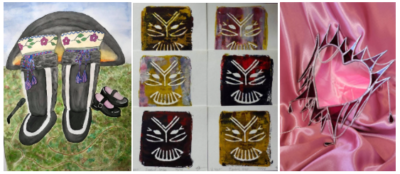
Three works over the years: Resilience, left, is a 2018 watercolour painting that depicts “the bright futures of Inuit despite our trauma;” A Spirit is a 2020 screen print the artist sold on Instagram; and Bleed is a 2026 stained-glass mirror that shows “the rough sides of love.” (Photos courtesy of Yurak)
Spring 2024: Yurak becomes assistant artistic director on the North of North sitcom set. They design and apply temporary tunniit on the arms and face of actor Tanya Tagaq, who played the sea goddess Nuliajuq.
Summer 2025: Yurak adds stained-glass sculpture to their artistic repertoire.
One piece, a see-through glass box that incorporates beaded sealskin and is titled A Reflective Glimpse is displayed at Ottawa’s SAW Gallery during Pride.
June 2026: They are working to stage a three-day, outdoor exhibit of new work later this summer, as part of a $5,000 Inuit Art Foundation grant.
Talent tip: “I love being alive. This can be hard to say at times, but I know it’s the truth. This love motivates me to project that eternal feeling to others through creation. I hope I can help us hold space for the magical feeling of life.”
“To be queer, you have to be an activist,” they said. “You have to be able to deconstruct all these terrible structures we have that prevent us from living a good life.”
This is the part the people are generally tired of. You don’t have to be an activist to be queer. What terrible structures are preventing you from living a good life?
You had pottery sell in a student exhibition at the museum.
You won an award from the National Centre for Truth and Reconciliation.
You’re able to freely post, advertise, and sell on Instagram to your followers.
You’re able to freely learn more of your craft on YouTube.
You’re able to sell your work to the museum.
You’ve been able to tattoo people here and elsewhere.
You’re able to quit your job to enroll in a 9-month start-up program (likely fully funded?)
You’re able to have an online business and sell at craft fairs.
You got hired to be an Assistant Artistic Director for a National TV show.
Your work is exhibited at the SAW Gallery in Ottawa.
You received a $5,000 Inuit Art Foundation grant.
All of this by 23 years old. You’re doing great, way better than most at 23. You’ve accomplished a lot, and have even had help along the way. You love life immensely. You are free to do whatever anybody else in this country is free to do, and you even have some funding streams directed at your personal identity. What and where are these terrible structures preventing you from living a good life?
Said the cis-het person who’s never experienced feeling unsafe for who you are.
Name a country where it’s illegal to be straight…We’ll wait.
This is a such typical empty response.
1. You still didn’t name any terrible structures preventing you from living a good life.
2 We don’t live in a country where it’s illegal to be straight, gay, or bisexual, so appealing to the laws of other countries is irrelevant. There’s approximately 130 countries where it’s legal to be gay. The Spartacus Gay Travel Index and the LGBTQ+ Travel Safety Index both name Canada as the safest country for queer people.
3. Anybody can experience feeling unsafe for who they are. Women and men of any sexuality can feel unsafe in situations when they are alone, isolated, or vulnerable. Women are more likely to experience domestic violence, but men are actually more likely to experience violence from a stranger. We live in the real world where, unfortunately, dangers due exist and we all have to exercise good judgement and caution to keep ourselves in safe situations.