


Arctic defence must be built on partnership, not past mistakes: Inuit leaders
Natan Obed and Pita Aatami say Inuit must be partners as Ottawa spends on northern security
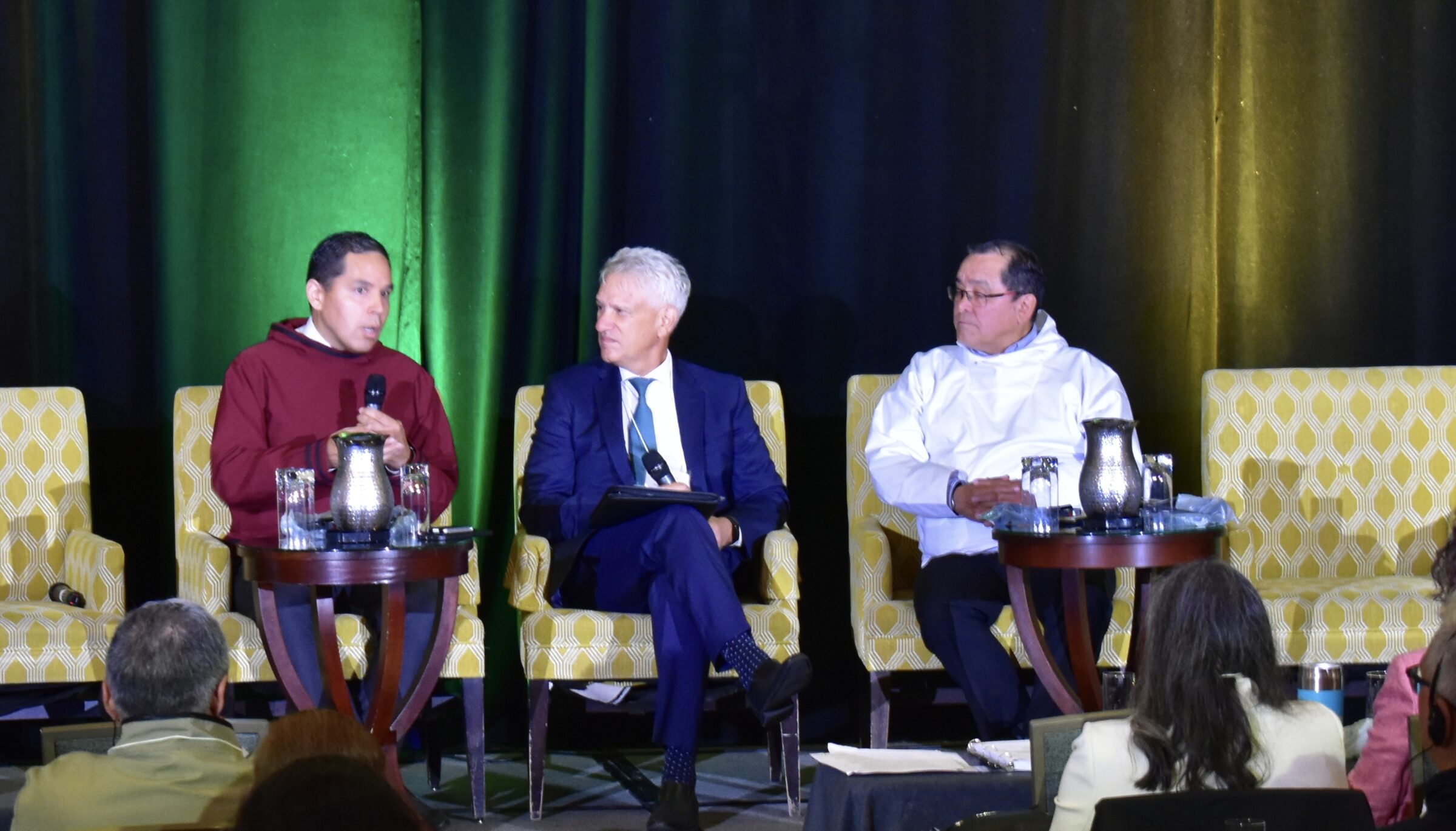
From left: Inuit Tapiriit Kanatami president Natan Obed, moderator Rob Russo of the Economist and Makivvik Corp. President Pita Aatami discuss Arctic sovereignty, defence and security during ITK’s Nilliajut conference in Ottawa on Friday. (Photo by Nehaa Bimal)

Inuit leaders warned Friday that Canada’s plans to spend tens of billions of dollars on Arctic defence could repeat past harms in the North unless Inuit are involved as partners.
“If a partnership with Canada is not on the table, if we are not going to be respected partners, then should we not be looking for other partners as well to uphold our interests?” Inuit Tapiriit Kanatami president Natan Obed said at Nilliajut – Asserting Inuit Rights in Arctic Security – a one-day conference at Ottawa’s Fairmont Château Laurier hotel.
Obed added that this is not a “threat” but a “practical consideration” amid Canada’s efforts under Prime Minister Mark Carney to diversify partnerships beyond the United States, which has threatened the country’s sovereignty.
At the conference, Obed and Makivvik Corp. president Pita Aatami, took part in a discussion on the history of militarization in Inuit Nunangat, which journalist Rob Russo moderated.
The discussion came as the federal government advances a generational Arctic defence strategy, including more than $40 billion in planned spending for upgraded bases, radar systems and northern operational hubs.
The plan includes forward operating location upgrades in Yellowknife, Inuvik, Iqaluit and Goose Bay; new rapid-deployment hubs in Whitehorse and Resolute; and a NORAD-aligned Arctic radar partnership with Australia.
Obed said Inuit reactions to the new wave of spending are shaped by their past experiences.
“The ability for Canada to colonize Inuit was aided and abetted by the militarization of Nunavut,” he said, referring to U.S. military infrastructure built during the Second World War and the Cold War that expanded Canada’s reach into remote regions and facilitated forced relocations.
Environmental consequences of military development also remain visible across the North, as Aatami recalled that when American forces departed Kuujjuaq following World War II, they buried heavy equipment and vehicles rather than remove them.
He also described how thousands of barrels of asphalt intended for a second military runway sat abandoned in the community for decades before eventually being used to pave local roads.
“It’s no wonder then that today, when we talk about the militarization of the Arctic and security, sovereignty and defence… that our immediate reaction is worry,” Obed said.
Yet neither Obed nor Aatami argued against defence spending or military partnerships outright.
In the past, Aatami said Inuit were consulted by the U.S. military on where to build airstrips. He would like to see the Canadian government do similar consultations today.

The idea of “dual-use infrastructure” — projects that strengthen both Canada’s security capabilities and everyday life in northern communities — was put forward as an Inuit-led approach.
Looking ahead, Obed outlined what success could look like if Arctic spending is aligned with Inuit priorities, such as universal broadband connectivity across Inuit Nunangat, stronger health-care systems and more housing.
“Canada is our preferred partner. It is the partner that we have spent the last 50 years working with and we have no interest in forging other paths,” said Obed.
Here is a comment that our national news service the CBC won’t allow on its website: Can we figure Russia into blame someway for all things going bad. The MIC (military industry complex) muscles it’s way into most everything coming from the West into just that. The ignorance of the public at large is what maintains the status quo where the top 10% keep us the 90% down and stupid. That’s the state of our faux democracy today.
Moderated by no, not one of the reps from the Economist magazine. It’s one of the most proactive sources for promoting continued colonization, the status quo, more conflict. God no.
Lots of money to be doled out for the “defence ” of canada , these guys are not in the “defence ” business , yet , they want ,a piece of the pie .
It is almost laughable to hear some of these Inuit organizations and businesses claim the “need/necessity” for an “Inuit led approach” to justify them getting money out of these upcoming Defense programs/projects. The so-called Inuit businesses and Org’s that you hear most about are experts in getting Government money. However, when you look at who actually benefits from that money or “gets rich” from it. It is certainly not your average Nunavummiut. Some of these companies cannot even build houses efficiently and effectively but now want money so they can jump into executing defense contracts. The Inuit Orgs are supposed to be involved how exactly? To get money, take their cut and then give out contracts? Not sure who that benefits but certainly not Nunavummiut. If you’re not sure, just look at the stockpile of money (hundreds of millions) they sit on and how effective they have been in addressing any of the longstanding issues that plague Nunavut society.
No one likes to talk about this, but the simple fact is most of the so called “Inuit owned businesses” (not ones owned by token Inuk figure heads who present for a southern based company which filters the majority of its money down south). But actual Inuit owned businesses, do not even employ a majority of Inuit workers. The reason? Well simple. Lack of local trained, experienced, qualified and willing to work, workers. If they cannot get enough local workers to work or be trained to be carpenters and other trades. What happens? Simple again. Workers have to be brought in from outside the territory. Then what happens.? Even simpler. The vast majority of the money leaves the territory with very little benefit to the local population or economy. So, where would highly trained, specialized and qualified workers in the defense sector have to come from to fill these jobs? Yup, you got it.
This is not rocket science. Who ends up with the vast majority of the benefit and most importantly the money? You guessed it again. The owners and leaders of those Inuit businesses and organizations. Given the total lack of responsibility and accountability that permeates the territory; these businesses and organizations just continue to benefit the few and ignore the majority. Lack of performance delivery, respect of budgets, employment & training for local workers all ignored in the name of profits. With zero consequences! And yes, we know. There is plenty of blame to go around regarding locals work ethic and dedication, and commitment to education, etc… and that certainly should not be ignored in the equation. However, to make claims that “They want it to be “Inuit led” is a farce disguised as a grift. It is not, “Inuit led”. It is, “led by a few select Inuks”
So, all we are hearing now in regard to the vast amount of money the FED’s want to spend on defense in the North. Is the sound of those few select voices and a few greedy hands of the usual suspects rubbing together in anticipation of the grift of getting 90% of the pie that benefits them with a few crumbs to the average Nunavummiut. And as a bonus. To get that 90%. They put NO “cash in the hat” and take NO risk. Its great work if you can get it.
Meanwhile the average Nunavummiut gets no further ahead.
There is no argument to be made that a group of people should have a special say in Canadian affairs because of their ethnicity. It’s one person, one vote here
Trying to siphon money that is to be used to buy ammo !
Rather treasonous comments by natan
I cannot believe how self centered our new crop of leaders can be.
Here we are in 2026 with the head of ITK saying that ““The ability for Canada to colonize Inuit was aided and abetted by the militarization of Nunavut,”
At the beginning and during the Cold War, White Christian Capitalist Westerners considered the Soviet Union to be an existential threat to themselves and their way of life, with Nuclear annihilation of the entire planet hanging in the balance.
In addressing this monumental threat, Inuit were mere backdrops to the construction and operation of first the DEW line system and then the NWS.
This was not the case of White, Christian Capitalists wanting to turn the Eskimo into assimilated Canadians by means of work and other exposures to a conveniently local radar site.
If there was a better way of finding out when and if the Soviet Bombers or ICBMs were coming that did not involve the huge expense of impinging on the Inuit world, you can bet your bottom dollar it would have been done as a paramount priority.
It will help the reconciliation process if we better understand what happened.
All of what happened to our people was not orchestrated based on its eventual consequence.
Much of what happened to us was done on a completely thoughtless basis.
Most of what happened to Inuit was is now euphemistically called collateral damage.
When and if Ukraine takes back Crimea and Putin’s regime crumbles, we may be amazed to find that all this talk of dual use nation building military investment finally respecting Inuit needs evaporating overnight.
Because the truth of it is, we are a small part of the world immensely influenced by what happens elsewhere, not what happens here.
With all the opaque governance and lack and accountability issues with the regional Inuit development corporations, they are a potential risk to national security. I’m shocked by Natan’s rather threatening comments. If the corporate Inuit elite really want a piece of the action, maybe they can start by being the kind of partner who is openly trying to achieve common goals to benefit defence and northern development by getting their own house in order and not just try to skim off the top of any proposed Federal investment. Trying to think of national security and QC’s board and current President in the same context for example should be terrifying to all observers. It would be like DND being forced to partner with a mashup of small time mobsters and clowns.
The RIAs should demonstrate professionalism and seriousness by finally appointing Inuit who are educated and have a clue what they are doing instead of recycling the same old incompetent cronies to oversee the Dev Corps. Everyone is tired of that funny smell that keeps seeping out from the Dev Corps boardroom. There needs to be change or Canada should just spend its defence funds as it sees fit and to hell with the grasping Inuit orgs.
Now they are saying past mistakes. See how they have been working past mistakes, finally mr obed is working hard now. He must have many mistakes too from not working on Inuit complaints. We need new ITK president. Me obed don’t do any work. Always says past mistakes when they are about to be investigated. Or government workers must told him to work hard.
He also was the director for the worst run department at NTI.
There’s been endless material written, and much said in the name of war and of peace. I say that we would be living today in beautiful, peaceful, coexistence, harmony, respect, yada yada if wealth had been the solution – to ending conflict. The problem is that the wealth in and of itself attracts some of the worst characters provides fertile ground in which they the worst of humanity grows/flourishes. NN is one of the few media sources in the “West” that permits us to openly speak of that, of all we see and hear and read of day after day in media. Indigenous people have warred but it had had its place limited in indigenous culture, unlike in the West where it dominates, head and shoulders above all else. God help us I pray in earnest.
“If Canada does not cooperate, Inuit may seek alternatives in ways that could collide with Canadian security interests.”
That may get Ottawa’s attention, but it portrays Inuit leaders as irresponsible or disloyal. In an Arctic environment already shaped by concern over Russia and China, that is a serious risk.
If Inuit want to participate in billion-dollar defence planning, Inuit organizations need strong capacity in defence, technical, legal, environmental, procurement and security expertise funded at the scale of the projects.
It and has been for a very long time money laundering AT-LARGE, warring. We have taken it to a higher level and not by choice but for a class of very wealthy, influential few. On the route there will not be a light at the end of the road, Revolution is the way beyond, See Chris Hedges heavily suppressed NYT former journalist FMI 🙃
This should be a wake up call for all countries that have Inuit, specifically Canada. There is a naive view that Inuit are Canadian (American, Danish or Russian). I stand with Natan when he says that we have a nuclear option if our colonizers take us for granted. I hate to burst your nice middle class bubble- but Inuit world view is only beginning to take shape and it’s not going to be comfortable for the rest of Canada. We’re done with being puppets, the smiley local partner and ‘take it or leave it’ negotiations. You need to be ready for these difficult conversations and spend the needed money for basic needs that your southern families take for granted. We do not have the basics like water, housing, and economic opportunities like the rest of Canadians. I believe Canada is the best place of all of our colonizers but if Canada continues to ignore our way of life, our world view, then maybe we’ll need to find a partner that won’t continuously treat us like second class citizens in our homelands.