


Kotierk calls for Nutrition North to subsidize ‘all items’
Government to consider recommendation along with other feedback from Indigenous partners and northerners, spokesperson says
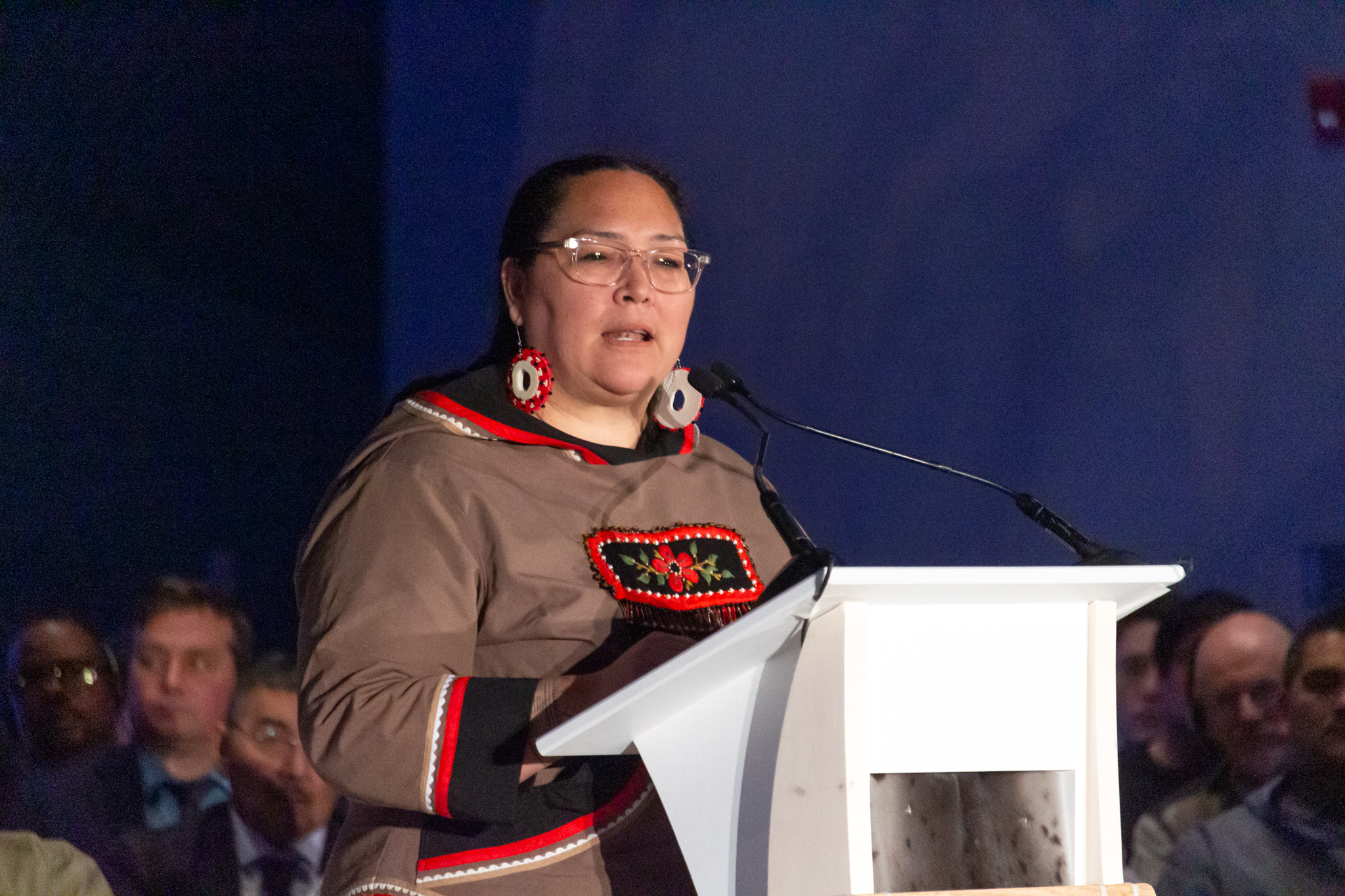
An external review of the Nutrition North program led by former Nunavut Tunngavik Inc. president Aluki Kotierk calls for the federal government to subsidize “all items” instead of just nutritional food it has traditionally covered. It’s a recommendation the government is considering along with other feedback it has received as part of a review of the subsidy program. (File photo by Jeff Pelletier)
Aluki Kotierk, the federal government’s handpicked adviser on reforming Nutrition North, says “all items” should be subsidized to put grocery prices in northern communities on par with the south.
This recommendation is one of more than a dozen conclusions included in her external review, which was published on the government’s website June 26.
“I am of the view that all items in Nutrition North Canada-eligible communities should be subsidized,” Kotierk wrote in her submission to the minister of Arctic and northern affairs.
Kotierk was appointed in February 2025 to do an external review of Nutrition North following allegations that northern retailers were not passing Nutrition North subsidies to consumers.
“We need to do our due diligence in making sure that every single penny of the retail subsidy is going to northerners,” then-northern affairs minister Dan Vandal told Nunatsiaq News in October 2024.
Kotierk’s submission acknowledges these allegations but suggests inflation might also be driving up costs. She instead focuses on problems she sees with the way the federal government handles Nutrition North subsidies.
“Why is a prepared salad bag not subsidized when all the components of the salad bag are subsidized,” she said in her submission.
“I have tried to think deeply and in different approaches to understand why pasta shaped in a certain way is subsidized when nutritionally equivalent pasta in a different shape is not subsidized? It makes no sense to me and I suspect that it would not make sense to a Canadian living in Vancouver or Regina or Halifax.”
The submission does not include an estimate of how much expanding subsidies would cost the program that spent $163 million in the 2025-26 fiscal year subsidizing nutritional food in 124 northern communities, including those in Nunavut and Nunavik.
Kotierk said she anticipates the government will raise this concern but she believes people who live in remote communities “should be able to expect a standard of living and accessibility that is on par with other Canadians.”
Nunatsiaq News asked Northern Affairs Minister Rebecca Chartrand’s office about the idea that the government should subsidize foods that are not considered nutritional — soda pop and potato chips, for example.
“The government is considering that recommendation alongside the full body of feedback received from Indigenous partners and northerners,” Chartrand’s press secretary Erika Lashbrook Knutson said in an email Monday.
Kotierk could not be reached for comment about her report for this story.

In other recommendations, Kotierk suggested parliamentarians should require an evaluation and monitoring of food insecurity at regular intervals — such as every three years.
Systemic issues require a systemic approach, said Georgina Loyd, assistant deputy minister of Northern Affairs for Crown-Indigenous Relations and Northern Affairs Canada in an interview Friday.
“This [submission] is one piece of input as part of the reform,” Lloyd said, adding the government has also collected feedback on Nutrition North through an internal government evaluation, research grants and a food sovereignty summit in Ottawa in March.
The government’s next step is to review all that information to formulate a strategy for reforming Nutrition North, Lloyd said.
Part of Kotierk’s job was to consult with national and regional Indigenous organizations and relevant federal organizations. But her submission doesn’t mention whom Kotierk consulted.

Nunavut MP Lori Idlout wonders who she spoke to.
“Did she meet with companies? Did she meet with bureaucrats? I found that information lacking in the report,” Idlout said in an interview Friday.
“I think it would have been good to see if she met with others to help with her analysis.”
It just occurred to me, why wasn’t the Office of the Auditor General of Canada tasked with undertaking this review instead? It has the staff and the expertise in analyzing government programs and whether programs are succeeding in their mandate. It also has broad investigatory powers to allow it to delve deeply into where the money is going and how it’s being spent. Having that office do would have led to a way better product.
The AG’s office wasn’t tapped for this because then the full measure of the Ottawa largesse funnelled to Nunavut would be hindered.
That suggestion is right on the mark. However, given the history of AG Reports in Nunavut and the total lack of application of the recommendations of multiple reports submitted and that in some cases have been done 3-times in 6 years for the same department. Someone at the FEDS probably just figured let’s try a different approach and inadvertently fell on something and someone far worse. Aluki Kotierk
“Why is a prepared salad bag not subsidized when all the components of the salad bag are subsidized,” she said in her submission.
————–
This is just a distraction, nothing more.
There have been direct and critical accusations laid against Nutrition North for years with many in power alleging corruption. “We need to do our due diligence in making sure that every single penny of the retail subsidy is going to northerners,” then-northern affairs minister Dan Vandal told Nunatsiaq News in October 2024.
So, where are the answers? Where did the money go? Where is the actual report?
I certainly hope the suggestion of pumping more money into the program without a proper auditing of the money that has already gone isn’t the direction we are taking. All I see here is fluff.
She should of stayed quiet.
Stay quiet and let the stores keep pocketing the money.
“Kotierk said she anticipates the government will raise this concern but she believes people who live in remote communities “should be able to expect a standard of living and accessibility that is on par with other Canadians.””
For other Canadians, those who live in remote communities have worse access to medical services, pay more for food and have fewer options when it comes to most things when compared to those living in large metropolitan areas.
We need to compare apples from a town of 1000 with no road access to apples from another town of 1000 with similar transportation infrastructure challenges. Then, I think we might already find ourselves on pretty equal, maybe even better, footing to other Canadians.
Also, in this scenario where all food items are subsidized, is more money thrown in to cover those items, or is money being pulled from healthy foods? The current system, though it sometimes seems silly when items are cherry picked, is an attempt to incentivise healthy choices. I see only good in that.
I may be cherry picking too, but I don’t think a 10 year old should be drinking subsidized redbull and skittles lunches.
Jesus wept. Tell me there’s more to a report it took more than a year to complete than this. It doesn’t matter that it was donated by the writer. What matters is in the time this wasted a more substantive and maybe – just maybe – applicable report could have been completed.
let’s just make blanket statements as recommendations. Why should we subsidize pop and chips? If the stores want to make their profit on these items they should.
You don’t need more reports you have to look at the the structure where NWC and ACL Act as the wholesalers and drive up the price at the wholesale level before the stores even see the produce
ya, this is seriously ridiculous. she didnt do a thing. thats obvious. how shameful of her to have even put this out there.
Publicly disclosed report:
https://www.nutritionnorthcanada.gc.ca/eng/1781709808624/1781709823117
wow! upon seeing the link im shocked that they accepted the document as a review of the Nutrition North program, jeez the bar is set extremely low! They didnt think a policy analyst should actually analyze the cost and not just have some lady ranting about how other people have been saying the same thing for years?
How is this document of Kotierk ranting an actual review???
Sad… very sad
Thanks for doing that. My Google just isn’t strong enough, I looked everywhere.
This was more of an essay, than a year long million dollar funded report. No research, numbers, stats, interviews…..just an essay on her personal view. Why is she being held as competent?
Sometimes it is better to say nothing and be thought a fool then to open your mouth and remove all doubt. Sad essay. Probably get a good grade at NS though.
Good Lord! Being an “Inuit Leader” has become such an A-Game grift.
Yup.
The most sought-after “jobs.”
Aluki submits her Nutrition North report late. Her report: all items should be subsidized. She submitted the report late for this? What else is in the report?
Lot’s of ‘feels’ … little data.
It’s a sad day when one starts to run out of descriptives to express the total lack of leadership and accountability in Nunavut. This is what passes and is now deemed acceptable or common to Nunavummiut. Major issues that need direct and immediate attention, solutions and measurable programs just get studied incessantly. Multiple reports are created and tabled. Politicians do their verbal dances, photo ops, and absolutely nothing changes or improves.
The sad part is no one. Like no ONE does anything. Not the GN. Not the FEDS. Not the Inuit Orgs. They just talk and talk and pass the potato around. No one is held accountable; No demand for high levels of performance is made. Nunavummiut just accept whatever is handed to them.
That supposed report that Kotierk submitted (three months late and apparently for free) was not worth the back of the KD package she wrote it on. She should be ashamed. It is disgraceful (go read it for yourself at the Government website). Then she does not even have the courage or conviction to present the report or speak to the media or anyone else for that matter to defend her actions (lack thereof), the lack of substance and overall failure of her report to address what she was hired to do. Nope Nunavummiut get nothing. What Nunavummiut do get is good old Lori piping in with the questions. Where were the questions three months ago when the report was due Lori? Where were your demands for action and accountability and results? Oh, sorry forgot, this is Nunavut.
Why in Nunavut is it acceptable for such serious issues to be dealt with so amateurishly, so off handedly, so nonchalantly? Why is it acceptable? My guess (and it’s only a guess) is that no one really cares that much. They don’t believe anything will change, so they just accept failure. If this is the reason, then it will only change once people stand up, speak out and start demanding accountability and action. Until then, the useless reports will keep coming, the never-ending talk will continue.
While the wheels keep spinning and Nunavummiut remain in the exact same spot.
Another review coming to a territory near you, keep moving the goal posts farther apart,
Typically when you read a report like this, especially a report as significant as this one you see a lot of details that are missing here.
Feel free to correct me if I have missed something. But when I read this report, I see no data or evidence.I see no quotations from people interviewed. I see no examples of problems she has uncovered.
In short, I see no evidence of any investigation at all. Nothing. To me, it’s one person’s opinion on Nutrition North and nothing more.
Imagine living in a world where the taxpayer subsidizes pop, chips, and slushies. Might as well include beer and cigarettes as well? Gimme a break
I was thinking groceries or packing all the difference because it feels like they give you a pretend price and claim it has been discounted. Northmart, Coops, all ripping us off and prented to apply the discounts.
My take on this report is a little different than the rest of the commenters on this story.
In short – if the feds has wanted an audit, they would have asked an auditor to compile the report. They didn’t…they asked a political leader with a well-known history of advocating for equity and what they received was *shocker* a narrative report with a focus on equity.
My question back to the critics is, ultimately, beyond the knee-jerk outrage at the feds potentially subsidizing pop-chips-kuku and the like, what do you disagree with or find inaccurate in the report?
@Hmmm says quote, “they asked a political leader with a well-known history of advocating for equity and what they received was *shocker* a narrative report with a focus on equity”. Really? They (the FEDS) asked for a Narrative on equity? Is that what you’re building your attempted defense of Kotierk’s complete and utter failure of her mandate on? Given one year to prepare a REPORT (one she was going to be paid handsomely for until she realized she better do it for free because she was going to only provide a “narrative”). Yeah, she was hired to prepare a REPORT, not a narrative, not a point of view, not “what she thinks”. A REPORT with details, statistics, analysis, and most importantly…get this; a set of supported, well thought out, and defendable recommendations.
WOW! Crazy right? Hired to produce a REPORT not a Narrative. You asked quote, “what do you disagree with or find inaccurate in the report”. Here is a start. Everything, although there is really “nothing” to consider as, “Everything”. So let’s start with. Where are the set out recommendations in bullet points such as:
* What is the actual required funding and where does/should it come from.
* Who should manage the program. Is it the FEDS, GN, Inuit orgs. Who is best suited to ensure its implementation, monitoring and review.
* What steps the FEDS could/must take to manage a more strategic program, plan and funding.
* How to ensure equitable and targeted distribution of funds to have the greatest positive impact on the most vulnerable (i.e. children and the elderly).
* What educational programs must be created to accompany the plan & program to ensure understanding amongst Nunavummiut.
* What cooperation and involvement the actual merchants (Northern, CO-OP etc.). should and must play in ensuring a successful delivery of any program. What accountability do they have for demonstrating compliance and results for Nunavummiut. (you know show any funding is actually being passed on through better grocery prices).
* What should be the GN’s role (yeah, the actual government that is supposed to represent Nunavummiut but seems to fail to understand this) in any plan or program.
* What are the measurable matrixes.
* What are the key indicators to determine success or failure and more. importantly adjustment of the plan or program given that data collected.
*What is the level of transparency required to convince Nunavummiut that the program is actually benefiting and working for them.
You need more? Or is that enough? One year (12 months) to prepare it, took 15 months to complete (delivered 3 months late) and contains the earth shattering, groundbreaking, monumental conclusion catch phrase, “Subsidize Everything”.
So, what you are seeing and hearing Hmmm is not quote, “knee-jerk outrage”. Its frustration and bewilderment from Nunavummiut delivered in a box containing a coke can and bag of chips.
And dont forget the responsibility that our 1 and only air line Canadian North plays in the terrible cargo services to get the fresh food to the communities. How often does the food that arrives in a community gets sent straight to the dump because it was spoiled and still shipped anyway. The Coop still pays for the cargo and needs to make that money up somewhere. So costs go up. But Canadian North doesn’t care they get paid no mater how long or damaged the cargo is when it arrives.
See these are the types of comments that reflect the exact lack of accountability that exists in regards to our Nunavut “leaders”. Always making excuses for them because their “family name”, recycling that they have done as “earth shattering work” for nunavummiut…. The bar we have set with this kind of blind support is the lowest level compared to the rest of Canada if not the world. We run around in circles every year trying to figure out basic human needs for Inuit but don’t get anywhere because of ABETTORS such as yourself. There is NO accountability and nothing will ever change until they are replaced with someone who can actually execute the job and make a difference.
I expected her to attempt to meet her mandate. Her mandate was to consult regional and national indigenous groups and make recommendations on one of the major issues facing Nunavummiut.
Do you see any evidence of her consulting any groups? I shouldn’t even be asking the question…. she should be providing a list of groups consulted, but she didn’t.
The thing is, she doesn’t even hide it. This report is ripe with her using the pronoun “I”. Here is one of many examples I refer to:
“I have thought about whether or not the government should consider price caps on certain items. I am of the view that there would again be a question of what items should have a price cap and the determination of that would be culturally biased and may not adequately meet the needs of residents of the Nutrition North Canada eligible communities.
Stop making excuses. The one thing all the major issues facing Nunavut share (Food insecurity, Housing, Education and TB) is their leaders are dropping the ball while the problem grows.
She needed 15k in travel expenses and 15 months to write a personal essay about her childhood memories?
It makes you wonder what non-Inuit communities served by Nutrition North must think.
Nutrition North serves 124 communities and less than half of them are Inuit communities. Meanwhile, there is certainly a strong Inuit theme all through this report that makes Nutrition North appear to be an Inuit only program.
But, she is clearly writing what she knows vs what she learned.
As soon as I walked away, it hit me I forgot this…
She is supposed to be consulting the communities in the program, but writes:
“Nutrition North Canada eligible communities
It is not clear to me how communities become eligible to participate in the NNC program. My understanding is that in 2011 it started off with communities that had taken part in the food mail program. It is my view that Canada needs to take a comprehensive review to determine which communities should be included in the NNC program.”
First, how does the consultant not know how you become eligible? Shouldn’t that topic have come up in consultations or research? How is this possible?
Second, she doesn’t know how communities become eligible, but she recommends Canada review the eligibility process? It’s hard to tell if she is just blabbering to fill space or if she really is that arrogant.
An official government report written in first person (“I think”, “I feel”, etc) is wild to see. Even in basic high school classes we were taught that unless something is a personal narrative (or similar) a report of this nature should make a claim, and then support the claim with evidence rather than first person statements. Odd.
I wonder who she had write this?
This is how she was at NTI, and now after being appointed President of the international ICC her former CEO is trying for ICC Canada, these two have together have done so much damage for Inuit and NTI I can only imagine how it would be with ICC. Scary thought.
On 1st read it is a classic case of bureaucratic mismanagement. Those nearest the source of funding take full advantage to reap the rewards while the ones it are meant to benefit are far and away down the chain. All that is missing from the nutrition north review report is this statement.
That may be what is happening, but what the report is missing is robust evidence, including the voices of Nunavummiut (not only one person), and logical analysis of how NNC interacts with the overall food system.
Lol