


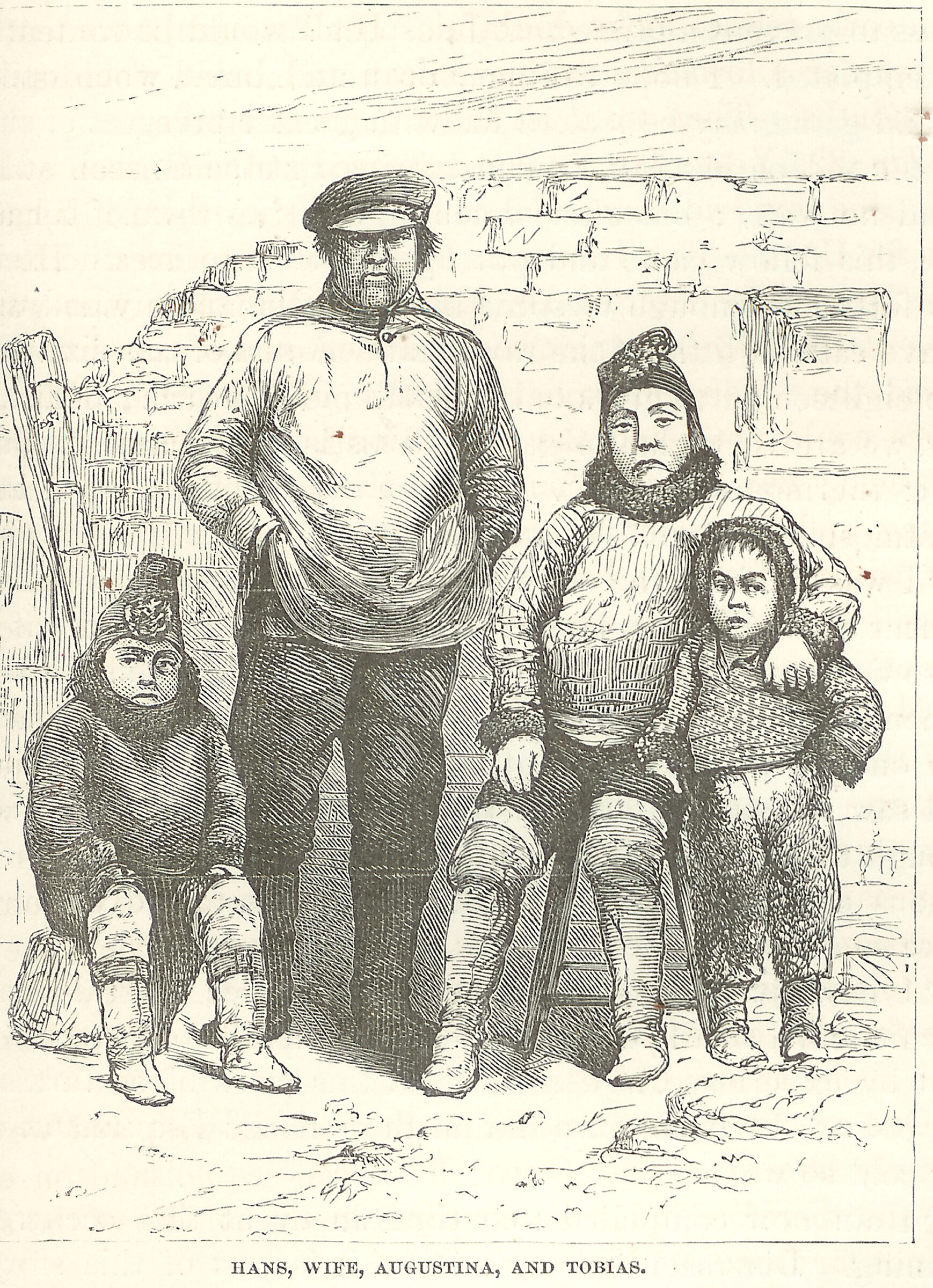
Hans Hendrik, shown here with his family, wrote a memoir in which he talked about how terrified he was of experiencing the winter darkness in the high Arctic for the first time. (Graphic from Kenn Harper collection)
The winter dark
In 1903 Knud Rasmussen was experiencing his first taste of life in the far north of Greenland, a winter adventure that would change his life and draw him back to the Inughuit — the Polar Inuit — time and time again.
One fall day, on his way back to the hut that expedition members had built and in which they would pass the winter, he happened upon an old woman who stopped him and pointed out over a calm sea to a black bank of fog that shrouded the horizon.
“Out there over the sea,” she said dolefully. “It is the dark coming up, the great dark!”
The Inughuit live farther north than any other Inuit. In Qaanaaq, where I spent a few winters in the 1980s, the sun disappears for 120 days. If a new moon should happen to roughly coincide with the winter solstice, then the darkest period of a long winter is dark indeed.
Greenlanders have a name for this sunless period: kaperlak (you might see it written as kaperdlak if you are reading something written in an old account). It is a word that describes the dark time, the winter night north of the Arctic Circle, for south of that unseen line the sun does not disappear completely.
In far northern parts of Canada, too, there is a word, tauvikjuaq, which means “the great darkness.”
Suersaq – or Hans Hendrik as he was known to non-Inuit – was a Kalaaleq – a Greenlander from below the Arctic Circle – who first went to the High Arctic with an American explorer, Elisha Kent Kane, in 1853.
His home was on the approximate latitude of Iqaluit, but he passed that first winter north of present-day Qaanaaq. To put this in a Canadian context, it is quite a bit farther north than Grise Fiord.
Suersaq’s first dark season terrified him. One of the few Inuit to leave a memoir from that time, he wrote, “Then it really grew winter and dreadfully cold, and the sky speedily darkened. Never had I seen the dark season like this, to be sure it was awful, I thought we should have no daylight any more. I was seized with fright, and fell a weeping. I never in my life saw such darkness at noon time. As the darkness continued for three months, I really believed we should have no daylight more. However, finally it dawned, and brightness having set in, I used to go shooting hares.”
Contrast those observations of a West Greenlander newly-arrived in the far north, with the observations of the Inughuit themselves, as recorded by Rasmussen.
He saw that people of the far north, like people everywhere, like change.
Poetically, he wrote, “When, a whole summer through, your eyes have been bathed in light day and night, you long to see the land vanish softly into the darkness again, that the stars and the moon may light their lamps.”
The Inughuit lived lives circumscribed by the sea and the icecap. In the summer they were confined to the relatively narrow strip of land that separated these two predominant features of their geography. The coming of the polar night meant the coming of an ice surface on which to travel.

“Now the dark nights are coming,” the men told Rasmussen, “soon the ice will close in the sea! Be glad, for soon blubber lamps shall light those who go out to fetch meat from the flesh-pits! And windows and fires shall light far out in the night, and hasten the lagging pace of late-returning sledges!”
To the Inughuit, the people of the far north, the polar night was liberating. They celebrated all the good things it would bring: the frozen sea, hunting on the ice, sled-trips after bears and, for the men, a respite from the sweltering houses.
And soon enough it would end and usher in a glorious spring time of increasing light, when the sea surface was still frozen and the hunter’s world expanded.
Taissumani is an occasional column that recalls events of historical interest. Kenn Harper is a historian and writer who lived in the Arctic for over 50 years. He is the author of Give Me Winter, Give Me Dogs: Knud Rasmussen and the Fifth Thule Expedition, and Thou Shalt Do No Murder, among other books. Feedback? Send your comments and questions to kennharper@hotmail.com.
(0) Comments