


Preaching in a sealskin church
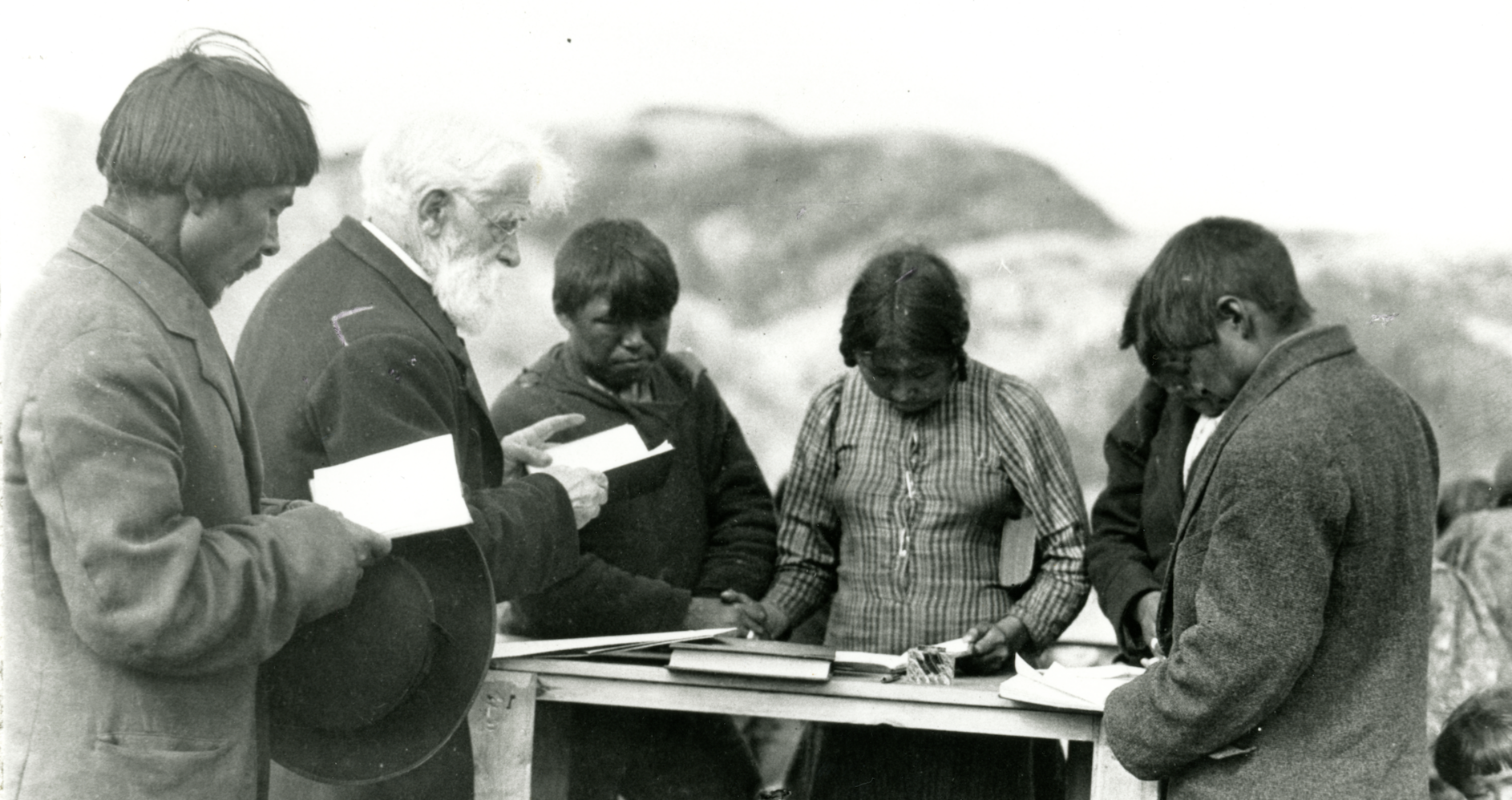
Rev. Edmund James Peck and a group of Inuit are at prayer on Blacklead Island in this undated photo. (Photo courtesy of General Synod Archives, Anglican Church of Canada, P7502-12c.)
When Rev. Edmund James Peck – Uqammak to the Inuit – and his assistant Joseph Parker arrived on Blacklead Island in Cumberland Sound off the east coast of Baffin Island in the summer of 1894, they took up their quarters in a building that had been provided to them by the Scottish whaling company operating there.
The building was nothing more than a shack, only 200 square feet in size. They had to live in it and cram their year’s supply of perishable goods into it.
Although there were a number of Scottish whalers on the island, Peck and Parker had come to minister to the Inuit. Some time after their arrival, Peck took a census and found that there were 171 people living on the small island, in some 40 tents.
Immediately the two missionaries established a routine which they generally followed rigidly unless they were travelling. Much of that routine centred around the learning of Inuktitut.
Peck already spoke the language, from his almost two decades of missionary work on the Quebec coast, but Parker was new to the North and to the language. Peck had not only to learn the nuances of the Blacklead Island dialect that differentiated it from that of Quebec, but also to instruct Parker in the basics of the language. The routine, which required strict self-discipline, was as follows:
“Rise 6:45 a.m., light fires, prepare breakfast; breakfast 8 a.m., prayers 8:30 a.m.; study of Eskimo language with Mr. Parker from 9 a.m. to 10 a.m.; visiting and preparing Eskimo addresses from 10 a.m. to noon. Then came the preparation of dinner. Dinner 1 p.m., private reading and study from 2 p.m. to 3 p.m., school for children from 3 p.m. to 4:15 p.m., visiting and exercise from 4:15 p.m. to 5:30 p.m., tea 5:30 p.m.; after tea, prepare for evening meeting, which is at 7:30 p.m.; after the meeting, study of the language with Eskimos; family prayer at 10 p.m.; then private reading and devotion till 10:45 p.m. This ended the day and bed had been earned.”
The cramped quarters the two men shared were too small to accommodate many visitors, and they badly needed a place of worship.

The solution to their problem was ingenious, and it was provided by the Blacklead Inuit themselves. They constructed a large tent of sealskin. Indeed it was so large that Peck referred to it as a sealskin “tabernacle.”
Peck wrote: “Our church – if such it can be called – is 20 feet long and about 10 feet wide. It is made principally of sealskins sewn together, which skins are stretched on a frame and seats are placed inside on which the people sit in rows.”
In a letter to the Church Missionary Society, he wrote, “When I mention the encouraging fact that the whole structure was erected, and to a great measure planned, by the Eskimos themselves, friends will readily see that we have every reason to thank God, and toil on for his people’s salvation without doubt or despondence.”
Peck held his first service in the sealskin church on Sunday, Oct. 7. For him, it was “a very happy but wearing day.”
In his journal, he wrote that “we visited the people from tent to tent, and invited them to come to our opening meeting. Many came, and they joined heartily in the few hymns they knew.”
This was the humble beginning of Peck’s missionary activity on Blacklead Island, an era that would last through four two-year stints, each punctuated by a year’s furlough in England.

In 1905 Peck finally left Blacklead for good, leaving the mission without a white missionary, but in the capable hands of the Inuit that he and his colleagues had instructed and inspired.
Taissumani is an occasional column that recalls events of historical interest. Kenn Harper is a historian and writer who lived in the Arctic for over 50 years. He is the author of Give Me Winter, Give Me Dogs: Knud Rasmussen and the Fifth Thule Expedition, and Thou Shalt Do No Murder, among other books. Feedback? Send your comments and questions to kennharper@hotmail.com.
(0) Comments