


Arctic Talent: Pang rapper fights the power
Jeremy Young calls for Inuit revolution in rhyme
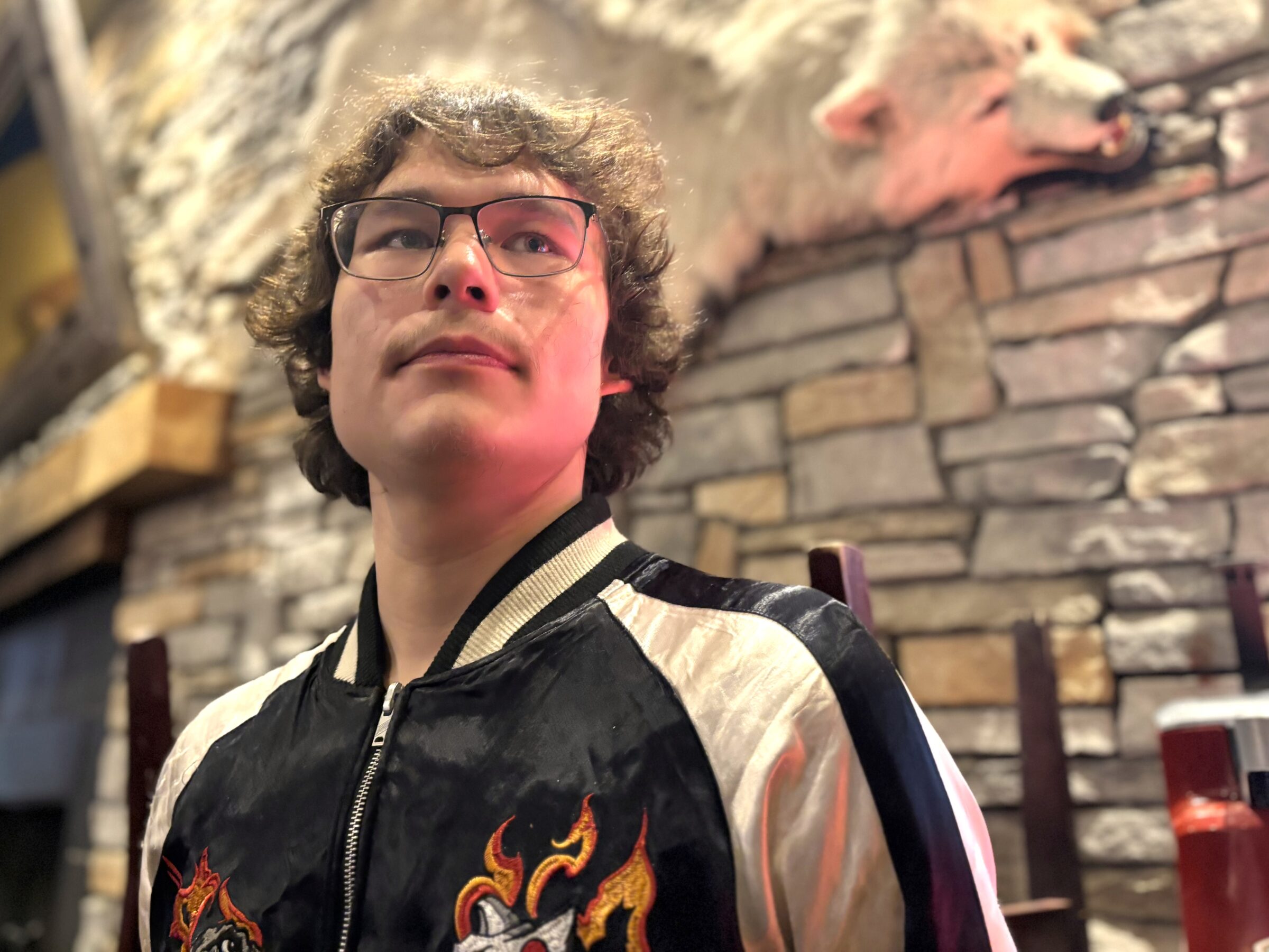
Rapper Jeremy Young, seen here at Iqaluit’s Storehouse Bar & Grill, where he often performs, uses his music to advocate for an independent Inuit state. (Photo by Daron Letts)

Residential schools, prisons, hospitals, rehab, psychiatric admissions, the foster system — for Iqaluit-based rapper Jeremy Young, these represent cycles of colonization in which Inuit remain trapped.
“Indigenous people live very institutionalized lives,” the 26-year-old artist said. “Just because you see an Indigenous person walking around free doesn’t mean they are not stuck in a cycle of institutionalization.”
That’s the theme of Institutionalized, an original rap song Young performs live on stage and in the streets, accompanied by a wireless speaker.
“It’s like that’s our role in life as Inuit — to be a permanent underclass,” he said. “Don’t be ridiculous. We are an amazing people. We are strong.”
Originally from Pangnirtung, Young’s early artistic and political vision grew out of a summer 2017 trip to Greenland with the Students on Ice Foundation, a charitable organization that connects youth between Nunavut and Kalaallit, Greenland.
Ever since, Young has imagined an independent Inuit state combining the regions.
”It is the same Arctic — the same Inuit, just a different colonial language,” he said.

Young describes his artistic journey, in which he blends hip hop with a call for Indigenous liberation.
Spring 2017: West Coast rapper Kendrick Lamar drops his critically acclaimed track Humble — a critique of superficiality in rhyme — and 17-year-old Young is hooked on hip hop.
Young shares Lamar’s conviction at the time that art can save the world.
“It is the reason I found direction,” Young said. “I put everything into becoming a rapper.”
Fall 2017: Young moves to Iqaluit, “the big city,” and is smacked with culture shock.
“The kids were more like city kids from down south,” he said.

“It was hard.”
Young blares politically conscious old-school 1990s hip hop.
His peers vibe to trap music, an offshoot musical genre featuring a distinct percussion style and tendency towards themes of poverty and drugs.
Winter 2018: Young writes his first original rap song. He pens two dozen more over the years.
Spring 2021: Ground-penetrating radar locates an estimated 215 potential burial sites at the former Kamloops Indian Residential School in British Columbia.

“That was a turning point for me,” Young said. “I found it was too important to be just an artist.”
Also disturbed by the murder of George Floyd by Minneapolis police officers a year earlier, Young dives into the political theory of 1960s Black Panther co-founder Huey P. Newton and the The Autobiography of Malcolm X.
”He talks about the nuts and bolts of how to start a revolution,” Young said.
Summer 2022: Young performs live for the first time at The Chartroom Lounge. He spits out the song All Caps, a nod to graffiti taggers by the late underground British-American rapper MF DOOM.
”I’ve never looked back,” Young said. “Through the lens of storytelling in hip hop, I realized I come from an amazing storytelling culture.”
Fall 2022-Spring 2026: Young haunts local open mics, performing up to five songs per night.
Summer 2026: Young meets his hero, John Amagoalik, the father of Nunavut, at the Inuit Circumpolar Council General Assembly.
”He is a huge inspiration to me as someone who wants to create our own Inuit state,” Young said.
Talent Tip: “I practice a song for 10 hours before I perform it onstage.”
(0) Comments