


Bold moves signal Nunavut, Ottawa are looking past U.S.
As longtime partner becomes less reliable, Ottawa, GN and NTI show signs of working around neighbour to the south
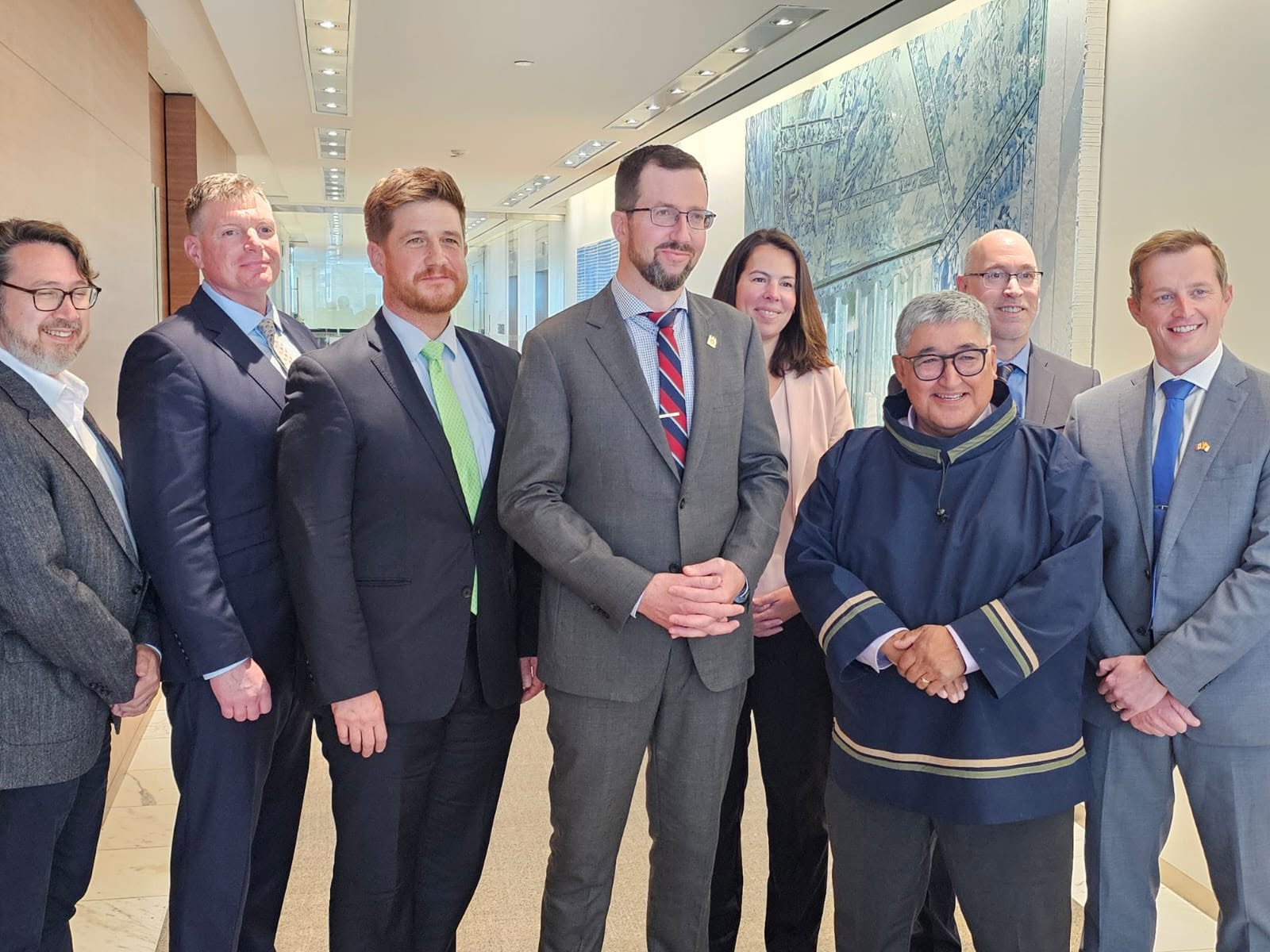
Nunavut Premier John Main, centre, poses in Toronto Monday at the Canada Investment Summit, where financiers across the globe were invited to discuss investment opportunities with project proponents across Canada. Main is pictured, from left, with Jeff Maurice, vice-president of partnerships at Arctic Economic Development Corp.; Sean Leet, managing director of Arctic Economic Development Corp.; Michael McNair, president and CEO of Arctic Economic Development Corp.; Anne-Raphaëlle Audouin, CEO of Nukik Corp.; Paul Irngaut, vice-president of Nunavut Tunngavik Inc.; Brendan Bell, CEO of West Kitikmeot Resources Corp.; and Keith Drover, director of projects for Iqaluit Nukkiksautiit Project.

Nunavut’s premier is eyeing global investors. Its former premier’s gaze is fixed on Arctic nation-building projects instead of the Canada-U.S. relationship. And Canada’s prime minister is exploring the idea of the country being, at least symbolically, European.
More and more, everyone seems to be looking away from the United States as a dependable partner.
It was a busy week for both Canada and Nunavut. All of their bold moves signalled two things: how much of Canada’s economy involves building big infrastructure projects and how eager leaders are to work around U.S. President Donald Trump.
The Government of Nunavut and Nunavut Tunngavik Inc. went to Toronto’s financial district Monday to woo potential investors for the big infrastructure projects planned for Nunavut.
The territory wants money to help build four projects: the Grays Bay road and port, the Kivalliq Hydro-Fibre Link, a hydroelectricity generator for Iqaluit and a deepsea port in Qikiqtarjuaq.
In a statement Wednesday, Premier John Main summed up his pitch: “Nunavut has so much to offer global investors as a territory rich in natural resources and a strong environmental framework for certainty.”
The Nunavut-led meeting coincided with the federal government’s first-ever Canada Investment Summit in Toronto.

Prime Minister Mark Carney said Canada is trying to attract $1 trillion dollars in investment over the next five years. (To put that in perspective, Canada’s gross domestic product — the value of all the goods and services produced in the country in a year — is about $2.5 trillion).
Building big things quickly has been a hallmark of Carney’s government since he became leader of the Liberal party in 2025. It’s his plan for strengthening the economy as Canada relies less on U.S. trade.
Even some officials who have been assigned to help navigate Canada’s thorny relationship with the U.S. are looking past the U.S.
Former Nunavut premier P.J. Akeeagok sits on the Advisory Committee on Canada-U.S. Economic Relations, a panel of 28 leaders tapped to advise the federal government on the bilateral relationship.
As Trump imposed tariffs on Canadian imports and Carney brought in counter-tariffs, council members like former Quebec premier Jean Charest and former Conservative cabinet minister Lisa Raitt did media interviews about Canada’s changing relationship with the U.S.
But when a Nunatsiaq News reporter asked Akeeagok about his work with the council, he didn’t say much about tariffs or trade. Instead, he leaned into promoting the four nation-building projects in the Arctic.

Then, on Wednesday came news the European Union wants Canada to become its first “associate member,” a twist that wasn’t on anyone’s radar a week ago.
Carney hadn’t said much about it publicly, then — poof! — we woke up to discover we’re going to be European. Or, associate Europeans, whatever that means. No doubt it will become clearer in weeks ahead.
The speed at which EU membership came up says a lot about how quickly Europe and Canada are responding to Trump’s unpredictability.
As Canada aggressively broadens its options for trade partners and investors, things are moving fast. Going to Toronto to attract investors was a smart, bold move for the GN and NTI. There’s a lot of potential for Nunavut to benefit from that.
I have been noticing that the new NTI president has not been attending meetings have been only seeing the NTI vice president only what going on with her?