

My travels as a small-town Inuk woman
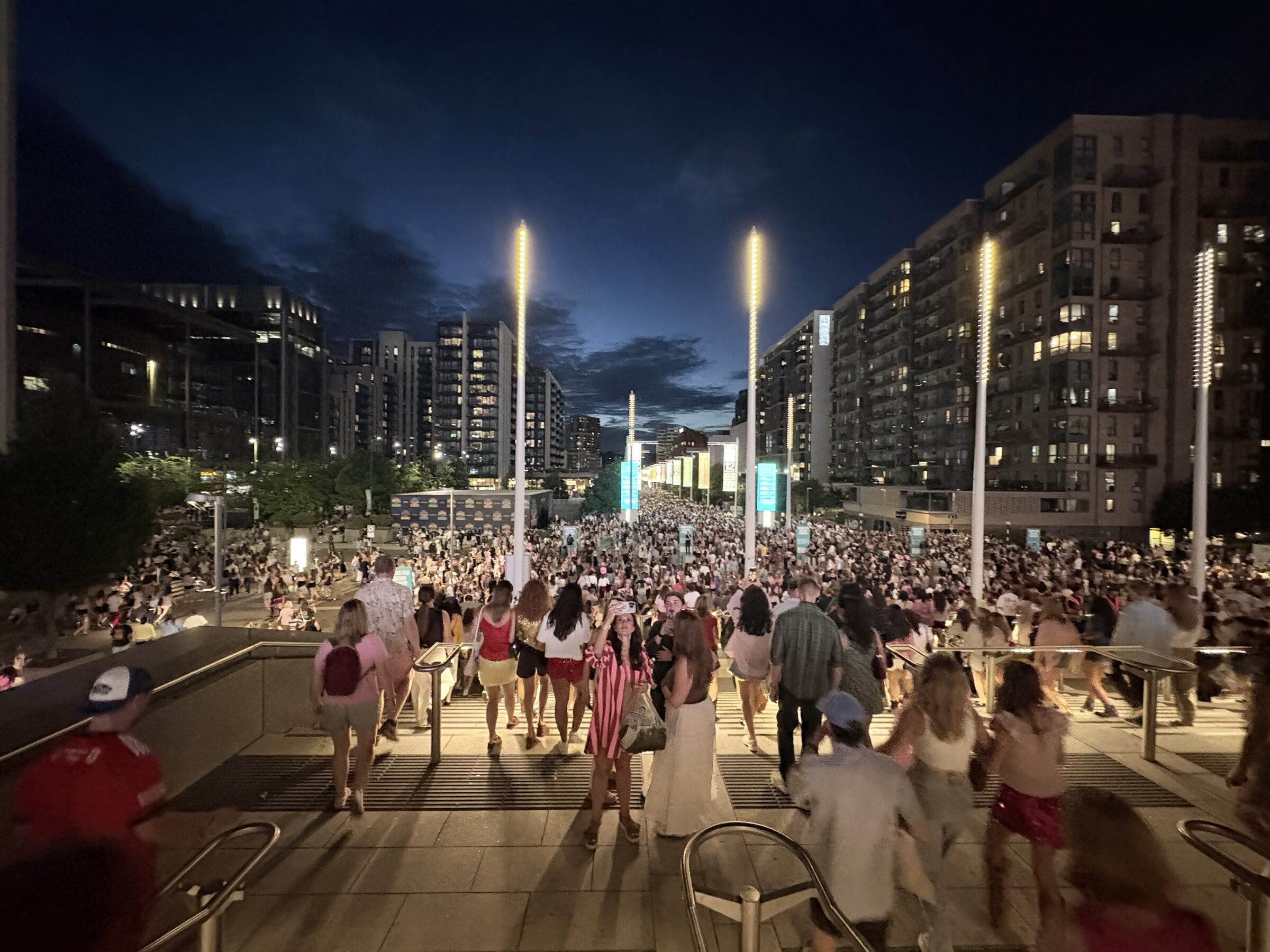
Thousands of people file out of a Harry Styles concert at Wembley Stadium in Wembley, U.K., on July 1. Annie Qimirpik travelled from Iqaluit for the show. (Photo courtesy of Annie Qimirpik)

Annie Qimirpik
For someone from Kimmirut, a community of roughly 450 people, travelling out of town means getting on a plane, just like everywhere else in Nunavut.
There are no roads connecting us to the rest of the territory, let alone the rest of Canada. If you want to go somewhere else, you leave by air.
I grew up surrounded by vast landscape and in a very small population where everybody knows everybody. Often, everybody knows everybody’s business. There’s comfort in that kind of familiarity but there are also limitations. The world can feel far away.
This summer, over the course of six weeks, I travelled from six places: Iqaluit, Ottawa, Toronto, London, U.K., Clyde River and Cancun, Mexico.
Each was different and they gave me another way of looking at home.
Iqaluit was the beginning. Although I’m from Kimmirut, Iqaluit has become familiar to me the way other places haven’t. It’s still Nunavut. You see people you know, still hear Inuktitut. Still surrounded by Arctic landscape.
But it’s also a city by northern standards.
Then there’s Ottawa: my first home away from home outside of Kimmirut. Moving there was my first real experience of being away from my community and having to figure things out for myself. It was strange being somewhere I couldn’t simply walk down the street and recognize most of the people I passed.
Then came Toronto, my first solo vacation destination when I was 18. The airport alone has more people than Kimmirut does. Toronto is a fast place and incredibly diverse but Canadian at the same time. The number of people, languages, cultures and communities was something I couldn’t help but notice.
Then I crossed the Atlantic Ocean to London. I went alone, during a heat wave, to one of the biggest cities in the world. It was terrifying. It was exhilarating. There were moments when I wondered what I got myself into, especially when I got lost, which was every outing. But there was also something liberating about realizing that I could navigate a completely unfamiliar place on my own.
I was a small-town Inuk woman from Kimmirut, thousands of kilometres from home, figuring it out as I went.
Clyde River was different. It’s where my biological daughter is from. Seeing her after four-to-five years and feeling the relationship become closer again gave that part of my trip a meaning that I can’t really measure in kilometres.

After travelling, I didn’t experiencing Nunavut in quite the same way anymore.
Then there was Cancun, Mexico. Once again, I was somewhere completely removed from the Arctic, with a different climate, language, culture and landscape. Yet I was still carrying the North with me. That became one of the biggest things I noticed during the six weeks.
When you’re from a small community, you can sometimes become accustomed to the idea that your way of life is simply the way life is. Travelling makes that assumption harder to hold. There are so many ways to live, so many different languages, cultures and ways of understanding family, community, land and identity.
I think Inuit should have the opportunity to experience more diversity because the rest of the world can help us understand our own place within it.
The North is its own world. It has its own realities, strengths and challenges, but somehow the further I travelled, the more I wanted to come home.

Annie Qimirpik is a writer living in Iqaluit who maintains a self-titled blog about life in the North.
Kudos to you for taking big steps and exploring the world! It could be scary or intimidating at first, especially coming from an isolated community like in Nunavut, compared to cities which are interconnected by roads, rails, boats, etc and travel is much more common. I wish for more people to have similar experiences like you have shared. I think exploring different countries and cultures can expand our thinking and help us put things in perspective (I know it has for myself!). Sometimes isolation can cause us, whether that be us as individuals, communities, cultures, or countries, to be self-focused, absorbed in our own problems and not thinking or open to other perspectives. Learning about other places helps combat this, and one of the best ways to learn is to travel and experience it yourself!
Of course Canada and Nunavut has its large share of problems. But compare it with other places, and we have many good things and freedoms that we can be appreciative of, that many people sadly do not have. Places have different strengths, like healthcare or public safety in Europe and East Asia. Learning about the strengths and weaknesses of different places and cultures can help ourselves by adopting the strengths of others and avoiding the weaknesses. Being balanced and thinking of different perspectives I think can help lead to good constructive conversations, rather than the more dogmatic self-focused rants that sadly seem too common today on social media.
I understand that not everyone can easily have the opportunity to travel from Nunavut due to the high costs of flights (it can be cheaper to fly to the other side of the world than within Nunavut!). I’d highly encourage being able to take advantage of travel opportunities that may arise from other means if cost is an issue, such as for work, being a member of a sports team, or an exchange program in school. Saving up rewards points like Aurora Rewards and/or Aeroplan can help too.
I’d personally recommend another northern city if you’ve never left Nunavut before. Iqaluit, Yellowknife, or now even Nuuk (which is somehow strangely cheaper to fly to than anywhere else from Iqaluit) would all be great options, as they share some similarities to communities in Nunavut but are also larger and have differences (especially Greenland with their European influence). After that, perhaps explore a larger city in Canada. After you’re comfortable traveling, you can try a new country, like Annie! Go visit more of North America, Europe, South America, Asia, Africa, or Australia! Find a place that interests you! If none appeal to you, learn more, or ask others for what places interest them for ideas!
Have fun trying new food, meeting new people, learning history of different places and people, and experiencing new things! It doesn’t just have to be learning either; share with others about your life and culture back home! You don’t need to move to these places forever, but just visiting can help give a new perspective to bring back home for yourself and those around you. They can also make for great memories which can last a lifetime!
For those who can’t travel, perhaps due to financial or health reasons, you can still “travel” thanks to technology! Learn about places online. Watch videos about different cultures and countries, what makes them unique, what strengths they have, what problems they struggle with. Read about their history. Do a language exchange with a friend online!
Thanks again for sharing your story Annie! You’re a real inspiration for others!