


NTI president extols the power of an ‘informed Inuk’ at Kivalliq Trade Show
Gloria Uluqsi borrows trade show theme to talk about what it means for Inuit to listen and to be heard
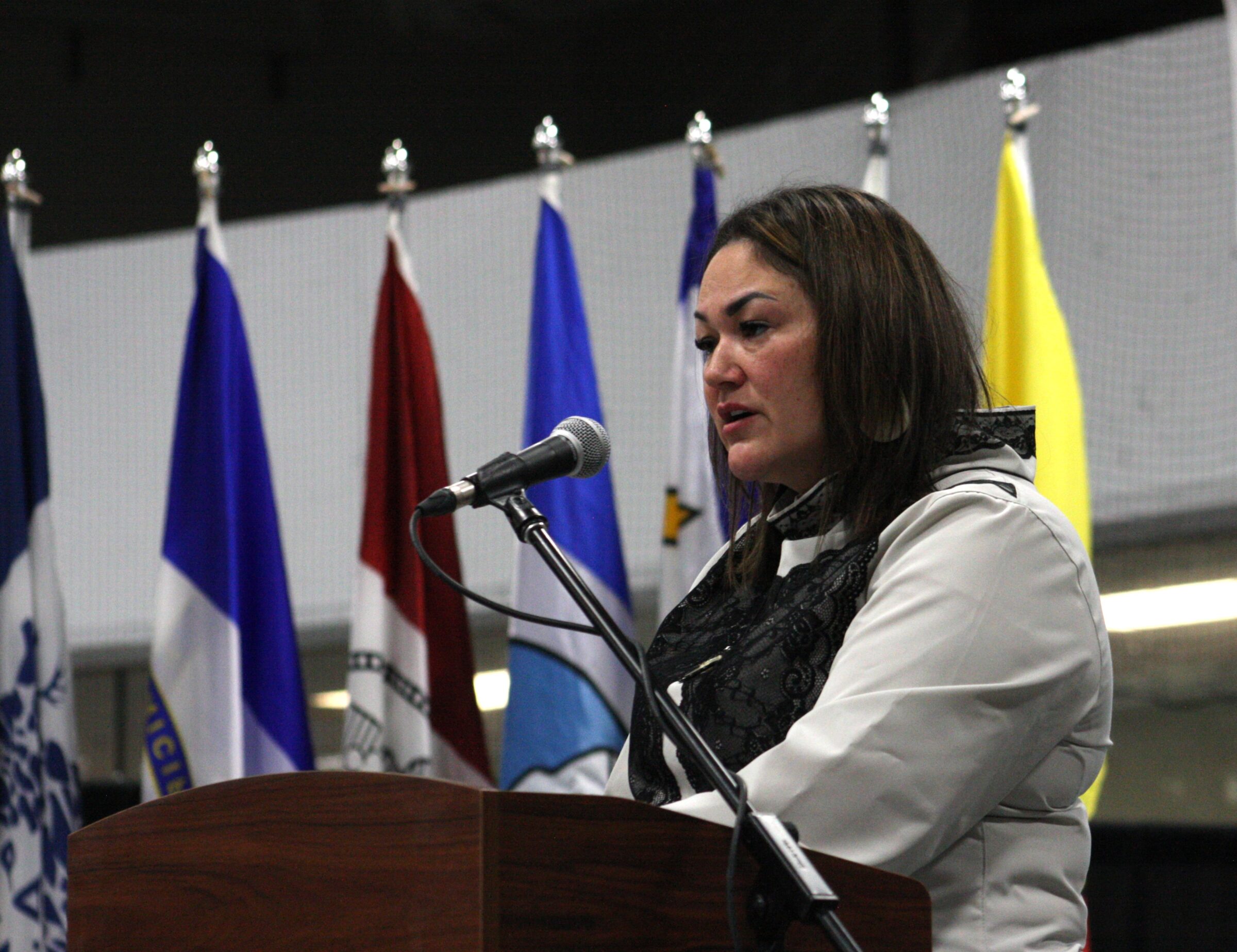
Nunavut Tunngavik Inc. president Gloria Uluqsi speaks to a crowd at the Kivalliq Trade Show in Rankin Inlet on Tuesday. (Photo by Corey Larocque)

The world is changing fast, as are interests in the North. There’s pressure to mine Nunavut’s natural resources and to develop infrastructure projects that support Arctic security and sovereignty.
That’s why Inuit need to listen to each other, to their communities and to their youth, says Nunavut Tunngavik Inc. president Gloria Uluqsi.
Big decisions lie ahead about the impacts of future economic activity.
“An informed Inuk is much harder to leave out of a decision that affects them,” Uluqsi said Tuesday in a speech to the Kivalliq Trade Show in Rankin Inlet this week.
She didn’t mention any projects by name. But there has been talk at the trade show about Agnico Eagle Mines’ gold mining and exploration, as well as the four nation-building projects going through the federal government’s Major Projects Office.
Those projects are the Kivalliq Hydro-Fibre Project, the Grays Bay Road and Port Project, a hydroelectricity generator near Iqaluit, and a deepsea port in Qikiqtarjuaq.
Uluqsi leaned into the trade show’s theme — Naalagit, or “Listen” in English. She spoke about what it means to listen and what it means to be heard.
As projects move forward, Inuit need to be heard by government and developers, she said. It has to be a true consultation.
“We need to be involved early enough to really help define the problem, identify the opportunities, consider the risk, and shape the options,” said Uluqsi, a former Government of Nunavut public servant who won the NTI presidency in a May byelection.
“Being asked what we think after the decisions have been made is not meaningful participation.”
NTI advocates for the rights Nunavut Inuit are entitled to under the Nunavut Agreement, and Uluqsi said her organization has a responsibility to ensure Inuit beneficiaries understand those rights.
She also talked about the importance of encouraging young people to have confidence in themselves and about inspiriting Nunavut’s Inuit.
Trade shows are traditionally where businesspeople come together with a goal of making deals with each other. But Uluqsi encouraged participants to do more than exchange business cards and contracts.

She called on participants to exchange knowledge and ideas.
Listening doesn’t always mean agreeing or being liked. But it leads to a better understanding.
“If I understand why you hold your position, and you understand why I hold mine, we have a much better place to begin. That is how relationships are built. That is how trust is built, and that is how better decisions are made.”
The Kivalliq Trade Show ends Wednesday.
The direction the Inuit organizations are going in is extremely concerning and Inuit are not taking notice.
The Nunavut Land Claims Agreement gave Inuit two things. A right to harvest, with guidelines on how to manage wildlife, a right that is protected and upheld under Article 5. It also gave Inuit more land than many countries and the power to control the speed at which these lands are developed, all through processes outlined between Articles 9 through 13.
The rest of the land claim gives Inuit mechanisms intended to be used to control the speed of development and extraction.
Instead of developing a long-term strategy for extraction that meets the economic needs and capacity of Inuit, the Inuit orgs have opened up our lands, including sensitive wildlife habitat, to the first groups of developers that flash a bit of money at them.
More than 90 percent of the money being generated through these current projects is leaving Nunavut. Third world countries get more out of resource development than the Inuit orgs are getting out of ours.
When will the course be corrected?
What about an “Educated” Inuk
Am I missing something here? When exactly does the listening stop and the action start? Quote, “We need to be involved early enough to really help define the problem, identify the opportunities, consider the risk, and shape the options,”. Tell me. Is NTI NOT aware of ALL the existing issues permeating throughout the Territory? You know. The problems, risks and challenges of the unrelenting issues in Housing, Health, Social Services, Food Insecurity, Education? Have they and the politicians not been “listening”. It’s not like there have not been enough reports, studies and analyses done since 1999.
In Auditor General Reports alone there have been Twenty (20) since Nunavut became its own territory. How many Nunavut governments have there been? Seven (7). How many Premiers? Seven (7). How many NTI Presidents? Six (6). How many ITK Presidents have there been? Five (5). Imagine the number of reports, studies and all the dollars spent to date and the same problems that everyone has been “hearing” and seeing, remain the same 20 years later. No one has to imagine. They just have to look around.
So, who exactly has been listening? Or more importantly who has failed to ACT on all the listening? So, now the NTI President would like Inuk’s to “listen” some more. Wants those with the dollars and the projects to listen some more. Let all “Listen”. Sorry, the “Listening Train” left the station bound for “Nowhere”. The slogan like this are old, tired and unnecessary. The time to listen has passed. The time for action was years ago. How about focusing on fixing what is wrong before you try anymore listening. Try action!
Listening only matters if the information heard, is understood and then turned into actual results for Nunavummiut. Other than that. It’s simply listening while ignoring.
PSC