


Nunavut recovery centre rooted in Liberal push to legalize cannabis
Arctic Matters | How a last-minute threat to delay Bill C-45 led to a federal commitment to treat addiction in territory
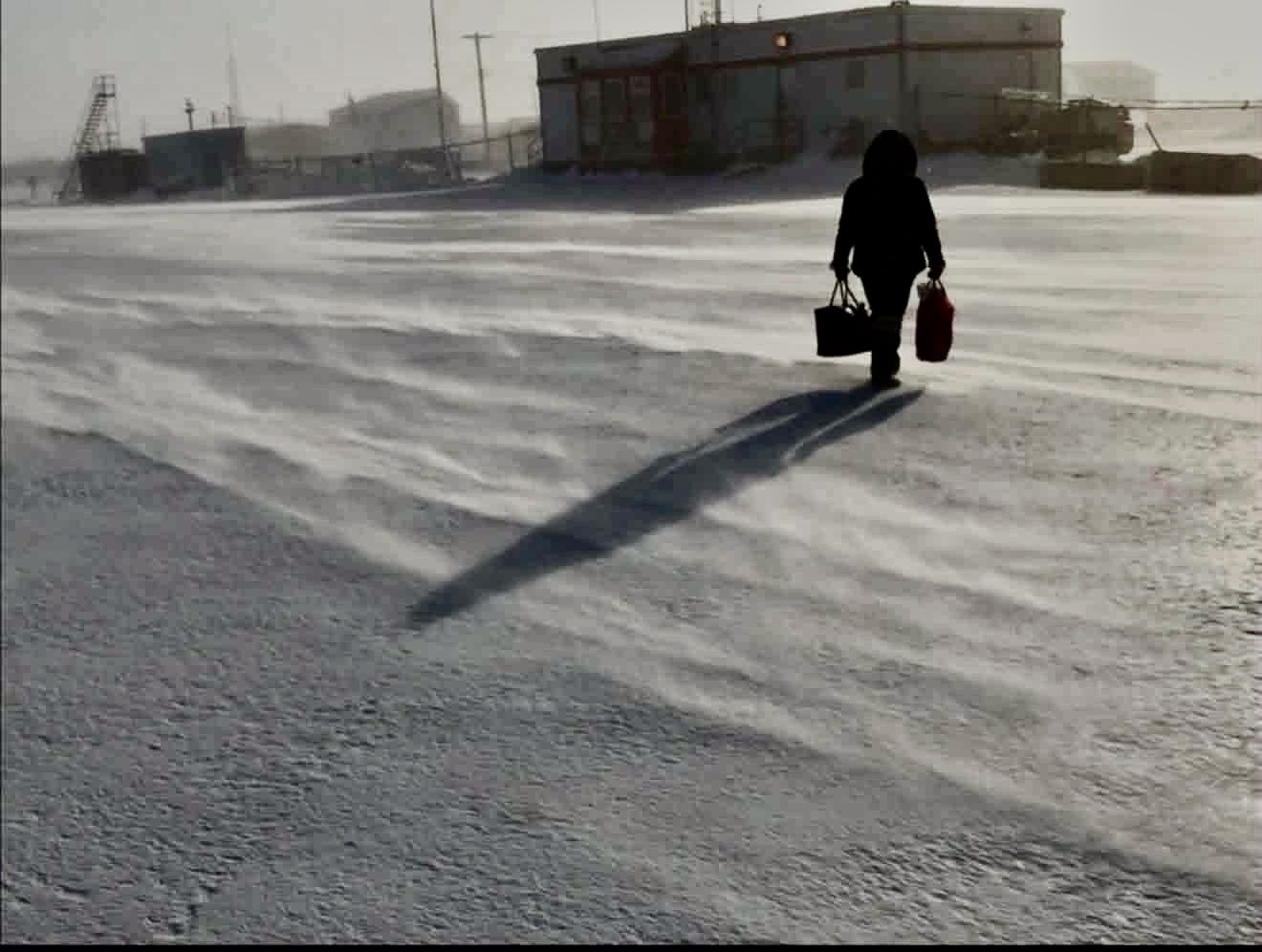
The late Leetia Nowdluk, executive assistant to then-senator Dennis Patterson, trudges to the Naujaat Airport as a winter blizzard builds momentum. (Photo courtesy of Dennis Patterson)
Dennis Patterson
On Nov. 13, the Aqqusariaq Recovery Centre in Iqaluit will officially welcome the public in for the first time as part of an open house.
The striking facility overlooking the Apex River valley, for which local Stantec architect Joshua Armstrong was the team lead, is designed for healing in a traditional, trauma-informed way and has space to receive and prepare country food.
How did this building come to be? The drivers were the Senate of Canada, consultations in every Nunavut community and a last minute threat to delay the legalization of cannabis while eager investors salivated on Bay Street.
To understand the Senate’s pivotal involvement in this new facility, we have to go back to April 2017, when Bill C-45, to legalize cannabis, was introduced in Parliament, and the Senate Indigenous Peoples’ Committee was mandated to study the impact of the bill on Indigenous people.
As Nunavut’s representative in the Senate and a member of that committee, I visited every community in Nunavut to find out what people thought about the bill. We travelled in winter conditions in a single engine Pilatus PC-12.
My faithful and very capable work colleagues at the time were the late Leetia Nowdluk, who became interpreter/translator (although that was not in her job description as my executive assistant), and Claudine Santos, my director of parliamentary affairs. We went to schools, hamlet councils, and undertook consultations on community radio.


The Cannabis C4-5 Consultation Tour in February and March of 2018 visited all 25 Nunavut communities (Graphic by Claudine Santos)
As I told the committee in testimony during consideration of the bill, I heard concerns everywhere from the public that for those who needed treatment for addictions, there was no facility in Nunavut.
Expert evidence in the committee showed that some people who are exposed to cannabis can develop serious disorders that require treatment: depression, anxiety and, in rare cases, schizophrenia.
Our committee report to the Senate highlighted the lack of access to culturally sensitive mental health and addictions services and that there was no treatment centre in Nunavut.
We quoted testimony from Arctic Bay elder Isaac Shooyook, who expressed fears about the lack of traditional knowledge-based prevention services in Nunavut. He recommended having “everything in place before you legalize it up there. There’s nothing in place to legalize cannabis in Nunavut.”
As a result of these and other concerns, our committee recommended to the Senate that the bill be amended to “delay the coming into force … for up to one year to allow time for: establishment of residential addictions treatment centres that are culturally and linguistically appropriate and in the vicinity of Indigenous communities” in the Yukon, N.W.T. and Nunavut.

This recommendation landed in the Senate during what investment experts called “cannabis mania,” driven by the opportunity that Canada would become the first major G7 nation to legalize recreational cannabis.
Interest peaked through a mix of retail investor frenzy. New companies like Canopy Growth and Aurora Cannabis forecast quadrupling of their sales, and a Canadian company called Tilray Inc., which the Government of Nunavut later enlisted to sell mail-order cannabis through the Nunavut Liquor and Cannabis Commission, saw its stock price soar, giving it a temporary higher value than Loblaws or Rogers.
Although the Trudeau government insisted that legalization of cannabis was not an economic initiative, it was about reducing social harm from black market drug dealers by improving regulation and quality control.
I believe that the government was also keenly aware of the excitement of investors in profiting from a new market.
At any rate, it was clear that a recommendation to delay Bill C-45 was not something the Trudeau government wanted to see happen. So on June 6, 2018, the bill came before the Senate for third and final reading.

I had prepared and was poised to introduce an amendment to delay it. But the day before the final vote on Bill C-45 in the Senate, a letter came to the Indigenous Peoples’ Committee signed by two cabinet ministers committing $200 million for addiction treatment services and the promise of a report within 12 months of royal assent of the bill. As a result of that commitment, I withdrew my amendment and Bill C-45 passed.
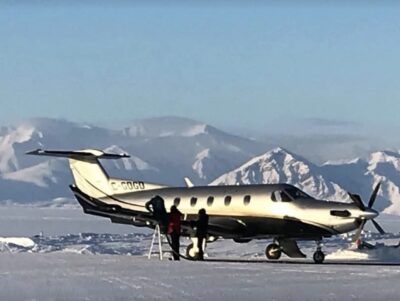
Consultations on Bill C45 in Nunavut communities were undertaken in a single engine Pilatus PC 12 chartered aircraft, shown here in Pond Inlet during the tour. (Photo courtesy of Dennis Patterson)
On Oct. 3, 2018, former health minister Jane Philpott told the Indigenous Peoples’ Committee that she supported a wellness centre in Iqaluit.
Budget 2019 committed money for the design and building of the facility and annual operating funds. The GN offered to contribute 30 per cent towards capital costs and fund community based programming. Then-Nunavut Tunngavik Inc. president Aluki Kotierk committed money from Makigiaqta to fund Inuit counselling training. So the recovery centre became a three-way capital and operating funding partnership.
To make a difference in politics requires patience. Things don’t happen in a hurry. Nine years have passed since the Trudeau government announced the plan to legalize cannabis for recreational use.
It took pressure from Nunavut communities and some last-minute arm twisting in the Senate, a threat to delay the bill in order to trigger a federal commitment to build the much needed Aqqusariaq Recovery Centre.
The Hon. Dennis Patterson represented Nunavut in the Senate from 2008 to 2023. He was premier of the Northwest Territories from 1987 to 1991 and played a key role in the Nunavut land claim agreement.
(0) Comments