


Pirutsiagutiit ends Inuit Child First Initiative uncertainty
Removing ‘real frustration’ about what was eligible will improve program to provide health, education and social supports for Inuit children
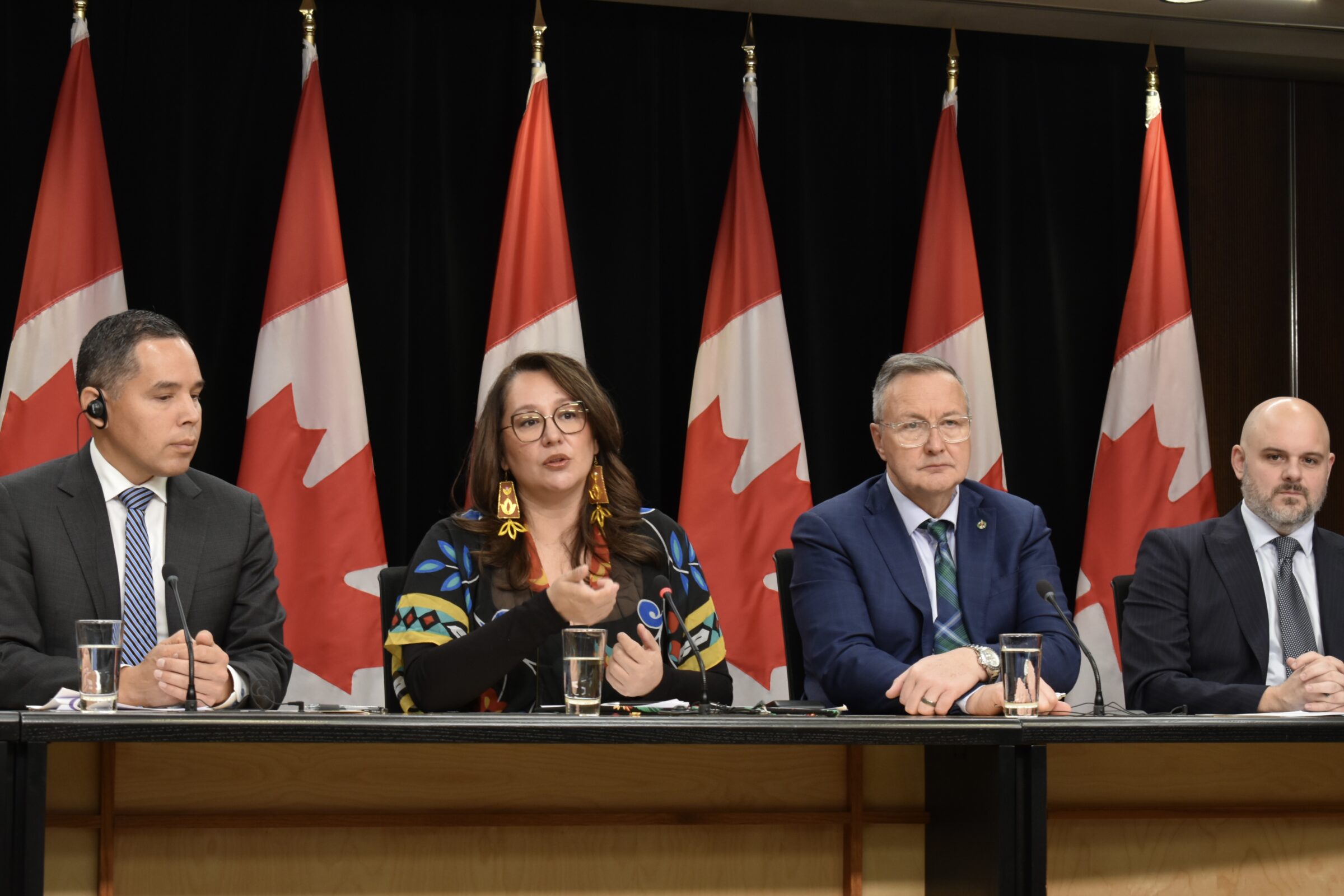
From left, Inuit Tapiriit Kanatami President Natan Obed, Indigenous Services Minister Mandy Gull-Masty, Labrador MP Philip Earle and Julien Castonguay, assistant deputy minister at Indigenous Services Canada, announce a new Inuit-led children’s support program in Ottawa on Wednesday. The federal government says the Inuit Child First Initiative backlog has fallen by 57 per cent, while a previous Nunavut-wide food voucher program will not return under the new initiative. (Photo by Nehaa Bimal)

It’s welcome news the federal government has finally ended the uncertainty around its Inuit Child First Initiative that has existed for two years. But there’s still a lot of work to be done to see how its $115-million-a-year replacement will work as Ottawa transfers responsibility to four Inuit treaty organizations.
On Wednesday, Indigenous Services Minister Mandy Gull-Masty and Inuit Tapiriit Kanatami president Natan Obed unveiled details about the new Pirutsiagutiit program the federal government unveiled in its recent budget.
The government created it to provide health, social and education products, services and supports to address what Obed called the “profound inequities” Inuit children face. It has been nearly a year since Indigenous Services Minister Mandy Gull-Masty pledged to retool the old program.
The Liberals had stumbled along since 2025 when funding for the Inuit Child First Initiative dried up. Ottawa provided two temporary extensions to keep the program going while it worked on a long-term replacement.
Pirutsiagutiit, which means “resources for growing well” in Inuktut, hands the responsibility for managing the five-year, $575-million funding to Inuit treaty organizations — Nunavut Tunngavik Inc., Makivvik, Inuvialuit Regional Corp., and the Nunatsiavut government.
It’s rooted in the idea that community-based decisions are better than Ottawa-based decisions.
“Inuit are best-placed to understand the needs of our children,” Obed said.
Many Nunavummiut will remember Inuit Child First Initiative as the program that funded universal food vouchers in most of the territory’s communities in 2024 and 2025. It helped feed 15,000 Inuit children over the two years it was in place.
In most communities, Inuit families were eligible for a $500 grocery store voucher for each child under the age of 18 and an additional $250 a month for each child under four.
But Ottawa ended that universal program, plunging thousands of families who had come to rely on the vouchers into financial uncertainty. The government replaced it with a scheme that required families to make individual applications for money to pay for groceries.
A return to a universal food voucher program “is not the path we have chosen,” Gull-Masty said during Wednesday’s news conference. It will be up to each treaty organization to determine the terms and conditions for all the supports it will provide.
Pirutsiagutiit should provide more certainty about what supports will be eligible for funding. There had been what Obed called “real frustration” caused by the federal Indigenous Services Department’s changing terms and conditions about what was previously eligible.
Pirutsiagutiit will take effect on April 1, 2027 — the start of the government’s next fiscal year. Even then, the Inuit Child First Initiative will remain in place until each treaty organization works out terms and conditions of the new program with Ottawa.
With each treaty organization responsible for making decisions about how to use its share of the money, it sounds like the supports that will be eligible for funding might vary from one part of Inuit Nunangat to another.
One of the problems with the Inuit Child First Initiative was the lack of clarity about what was eligible for funding. To make Pirutsiagutiit more effective in helping Inuit children, the important task will be to make it clear what health, education and social supports are eligible to be funded.
(0) Comments