


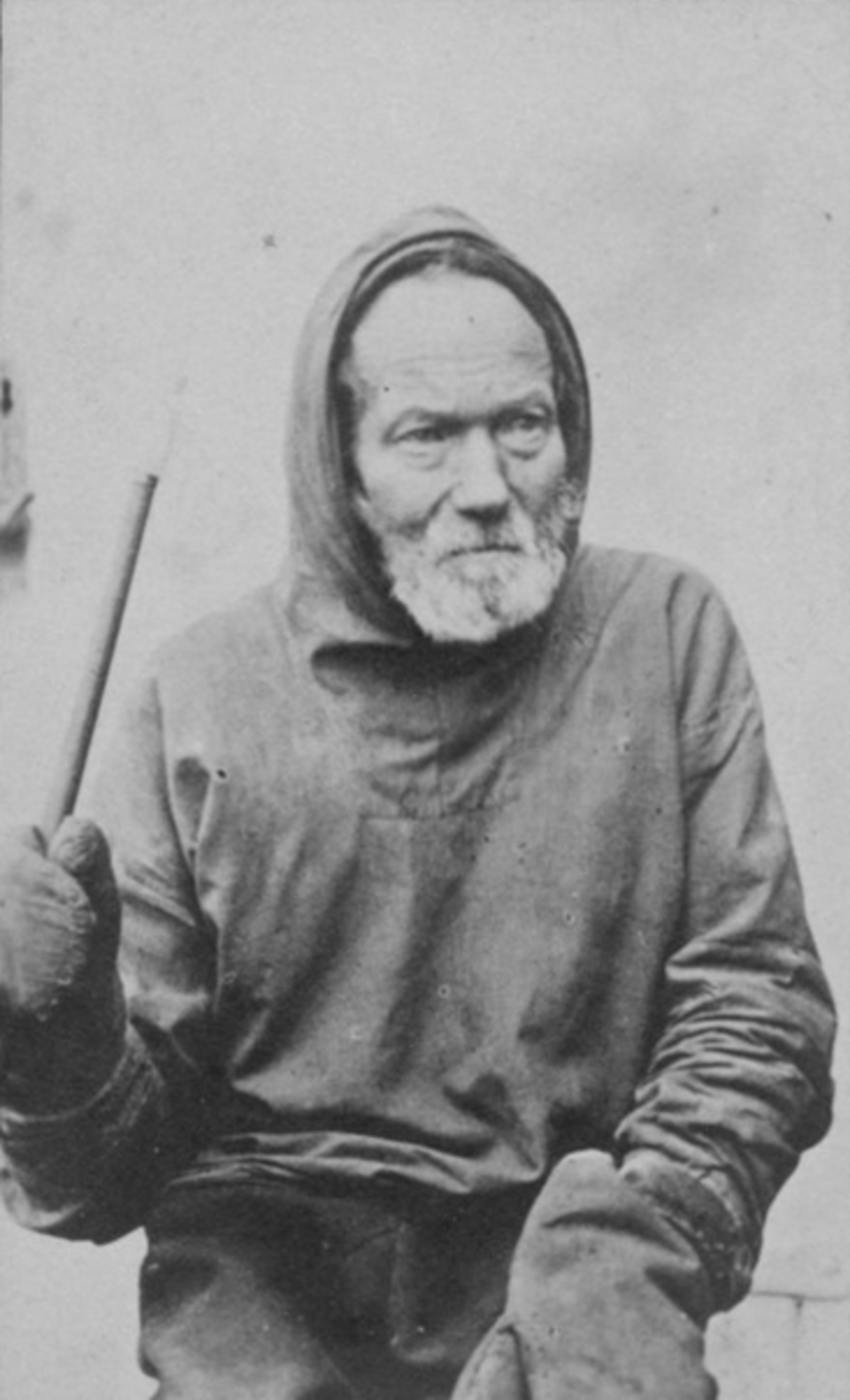
Photograph of Samuel Kleinschmidt taken around 1884–1885, as photographed by J. A. D. Jensen. (Image courtesy of Lisbeth Valgreen, Danish Arctic Institute)
Blubber for bibles
Greenlanders were the first Inuit to have the Christian Bible translated into their language.
Between 1750 and 1850, Danish and Norwegian ministers of the Lutheran Church and German Moravians worked to translate the scriptures into Kalaallisut. They were aided by the Danish Bible Society and the London-based British and Foreign Bible Society.
By 1850, there were at least 20 versions of the Bible in existence. Some were more accurate than others. As missionaries’ knowledge of the language progressed, the translations became better.
The writing systems used also posed a problem. The Greenlandic orthography had not yet been standardized. It would remain for Samuel Kleinschmidt, son of a Moravian missionary, to undertake that task in the 1850s.
The Qallunaat ministers could not, of course, have taken on the monumental task of translating into a language new to them without the assistance of Inuit converts to Christianity who were willing, and usually eager, to help them.
Before 1800, the New Testament and some psalms had been translated by Paul Egede, son of Hans Egede, who had established the first mission in Greenland in 1721. Paul Egede had the advantage of having grown up in Greenland and therefore spoke Greenlandic much better than his father did.
Paul Egede did not mention the names of his Greenlandic assistants when his first translations were published in 1744. We only learn their names through his journal, published more than four decades later, in 1788.
His main assistants were a woman, Arnarsak, baptized in 1737, and a man, Pungiok, who took the Christian name of Hans.
The two made an unusual request of Egede. They did not want the translations, for which they were in part responsible, to be shared widely among the Kalaallit.
Egede explained their reasoning: “It would not be useful for their unbelieving compatriots to be made aware, for example, that Cain, one of God’s first rational creations, was so wicked, or of Jacob’s deception of his father and brother, [or] the polygamy of the patriarchs.”
The two Greenlanders suggested that, instead, only certain selections from the translations should be distributed and that the more lurid parts be omitted. Nonetheless, the translations were published in their entirety.
The Moravians in Greenland were off to a slower start with biblical translations. In the late 1700s, they expended their mission efforts to Labrador where they built on the strengths of missionaries to that coast who brought with them the knowledge they had acquired in Greenland.
In 1804, the British and Foreign Bible Society was formed, with a daunting mandate to translate the Bible into all the languages of the world. Within a century, their publications were available in over 1,000 languages.

In Labrador, the Inuit Moravian converts eagerly accepted the British and Foreign Bible Society’s publications of the Gospel, as translated by their missionaries, who usually worked by revising Greenlandic publications into their understanding of the local dialect.
Grateful Inuit wrote letters of thanks to the society. Brother Benjamin Kohlmeister sent some of these letters from Nain to Rev. C. J. Latrobe, who provided them to the society.
The Labrador Inuit, unprompted, decided to make a collection of seal blubber to send to the society to help in the costs of its work. They knew that blubber was a valuable trade commodity at the Moravian stores — the Moravians supported the costs of their missions through trade with the Inuit.
Kohlmeister wrote: “Some brought whole seals, others half a seal or pieces, as they could spare it. Some brought pieces of blubber in the name of their children, requesting that their poor gifts might be accepted.”
The Inuit had learned that the society’s work was supported through donations from pious people, who were often poor.
They explained, through Kohlmeister: “We have indeed spoken together, and observed, that these many books, given to us without pay, must be very dear somewhere, but we never have known before now, that even poor people bring their money, out of pure love, that we may get these comfortable words of God. We are indeed poor, but we might bring now and then some blubber as a contribution.”
The blubber yielded 30 gallons of oil. Kohlmeister went on: “They now begged me to send this collection of blubber to those generous friends who printed the Bibles for them, that more heathen might be presented with that book.”
A careful reading makes it clear what the Inuit intended. They were not offering the blubber to pay for the books they had received “without pay.”
Rather, they were offering to support the society in its translations of the Bible into other languages far removed from the Moravian missions to the Inuit.
The Inuit in Labrador saw themselves as part of a worldwide community of Christians.
[Note: I owe the title to a scholarly paper by Hilary Mary Carey of the University of Bristol. It was too good a title to pass up.]
Taissumani is an occasional column that recalls events of historical interest. Kenn Harper is a historian and writer who lived in the Arctic for over 50 years. He is the author of Give Me Winter, Give Me Dogs: Knud Rasmussen and the Fifth Thule Expedition, and Thou Shalt Do No Murder, among other books. Feedback? Send your comments and questions to kennharper@hotmail.com.
(0) Comments