

Iqaluit students stand face-to-face with history
“This will give us insight in many ways.”

A photograph of Anne Frank in 1942. In 1945, she died at the Bergen-Belsen concentration camp. Iqaluit students were to have visited the Anne Frank House in Amsterdam this week. (PHOTO COURTESY OF ANNE FRANK HOUSE)
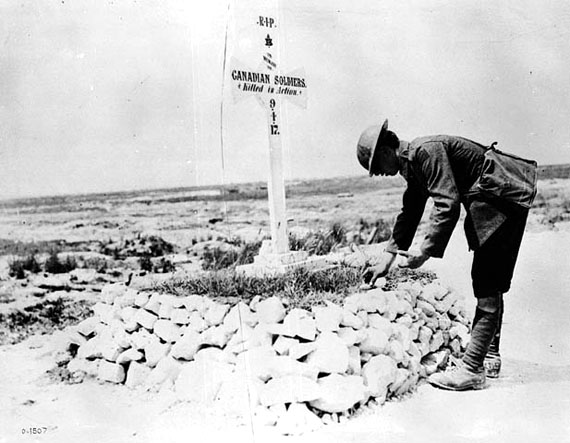
A gravemarker for Canadian troops killed at the Battle of Vimy Ridge in April 1917. Iqaluit students will visit the Vimy Memorial in northern France later this week. (LIBRARY AND ARCHIVES CANADA)

Paul Bychok, who works as a Crown prosecutor in Iqaluit, with daughters Anika and Kira, will lay a wreath this Remembrance Day at the Menin Gate Memorial in Ypres, Belgium in honour of Paul’s grandfather, who was gassed in 1915 while serving with Lord Strathcona’s Horse near Festubert. (PHOTO BY JIM BELL)

These Inuksuk High School students from Iqaluit are now in the midst of an extensive European tour, where they will visit numerous sites and memorials associated with the First and Second World Wars and the Holocaust. (PHOTO BY JIM BELL)
A dozen Inuksuk High School students will stand face-to-face with history this month, on a 10-day tour of Europe where they will view scenes from some of the 20th century’s worst catastrophes.
“I’m looking forward to seeing the Anne Frank House,” said Kira Bychok, referrring to the Jewish girl who for two years hid with her family inside a secret attic in Amsterdam.
German authorities captured Frank in 1944 and transported her to the Bergen-Belsen concentration camp, where she died of typhus in 1945 at age 15.
The apartment house in Amsterdam where she recorded her thoughts in a classic book, called Diary of a Young Girl, is now a much-visited shrine.
“It made be really sad, to hear all these stories about Jewish people being sent to concentration camps, to actually see the way there were hiding and everything,” Bychok said.
That’s just one of many sombre historic sites the group will view this week.
They touched down in Berlin this past weekend, where they were to have visited the Sachsenhausen concentration camp and Checkpoint Charlie, the once-famous Cold War crossing point through the Berlin Wall.
Next, they were to have taken a train to the Netherlands, where they’ll visit Amsterdam and the Groesbeek Canadian War Cemetery.

On Remembrance Day, they’ll visit the Ypres region of Belgium, where tens of thousands of Canadians died during the First World War.
There, they’ll vist the Menin Gate Memorial.
For Kira Bychok, her sister Anika and father Paul Bychok, this is a special place.
In 1915, near a place called Festubert, the Bychok girls’ great-grandfather, then serving with Lord Strathcona’s Horse, was poisoned during a gas attack.
In less than a week, the Canadian division suffered 2,468 casualties, including 661 dead, and gained only 900 metres of ground.

About 65,000 Canadians died in the First World War, a number nearly equal to about one per cent of the small young country’s population.
On Nov. 12, the young Nunavummiut will visit the Vimy memorial at Vimy Ridge, scene of a great battle that many historians regard as a nation-building exercise for Canada.
Between April 9 and April 12, 1917, 100,000 Canadian troops captured Vimy Ridge, an important piece of strategic high ground, suffering 3,598 dead and 7,004 wounded.
“It was the first show of Canadian military power that the Canadians were able to fight in a war. It was a great sense of national pride, I think, and showed that we can do what other countries weren’t able to do,” student Levi Strauss-Enuaraq said.
Also that day, the students will visit the Beaumont-Hamel Newfoundland memorial. There, on July 1, 1916, the 1st Newfoundland Regiment was obliterated. Of 801 troops who arose that day, 733 were killed or wounded.
In Newfoundland and Labrador, that event is still marked every July 1 as Memorial Day.
Renata Solski, the Inuksuk High School teacher leading the group, said the tour is part of a cross-curricular theme called “Survival of the Human Spirit.”
“It’s about how certain people can survive things. The tour really coincides with our curriculum,” Solski said.
As part of that work, students have read the book “Night” by Elie Wiesel, the celebrated writer, speaker and survivor of the Auschwitz and Buchenwald death camps.
“When we looked at it [Wiesel’s work] we saw atrocities that you can’t even imagine. He said if you are an alcoholic, you are suffering; if your parents are alcoholics you are suffering. So we’re trying to use the past to make sense of the present and plan for our future,” Solski said.
“And, of course, being in Nunavut, right, we have so many hurts we have to get past. So hopefully this will give us a little bit of insight in many, many ways.”
The goal of such studies is to help the young plan for the future by giving them a better knowledge of the past.
“We hopefully have young people who can go out into the world, they can take risks but make decisions, maybe the right decisions for us all,” Solski said.
“It’s a lot more than that though, it’s about who we are as human beings.”
On the final days of their tour, the students will tour Juno Beach, were Canadian forces landed on June 6, 1944, D-Day, and then enjoy a guided tour of Paris, where they’ll see Place de La Concorde, Champs-Élysées, l’Arc de Triomphe, Notre Dame Cathedral and the great palace at Versailles.
“I want to see Versailles, like, where all the old meetings happened and all the important things, where Louis XVI locked people out of his palace and made people sure the third estate had no voice. It was a big thing,” Strauss-Enuaraq said.
The students will return to Iqaluit after Nov. 15.
(0) Comments