


Child rapist free
Hikoalok forbidden to contact children
JOHN THOMPSON
Iqaluit RCMP released Jason Hikoalok, a convicted child rapist considered to be at a high risk to reoffend, from custody last week after a week-long hearing aimed at imposing conditions on his release.
The conditions, imposed by Justice Earl Johnson, forbid Hikoalok, 26, from being near children, or any place where children may be expected to gather, such as school playgrounds, the swimming pool and the public library.
As well, Hikoalok must report to a probation office once a week, and to attend any recommended counselling, among other restrictions.
Justice Earl Johnson criticized Corrections Canada for their rushed release of Hikoalok. Johnson said this would never have happened if corrections officers in Iqaluit were “more proactive.”
“This kind of problem will not go away. There are other felons who would be a risk to the public, who will be coming to Nunavut in the future,” Johnson said last Friday afternoon.
Hikoalok’s release leaves him homeless and without a job, in a community where many residents have made it clear that he’s not welcome.

A petition started by fearful parents calls for Hikoalok to leave, and has collected more than 1,200 signatures.
Natsiq Kango, who helped start the petition, said she fears for the safety of her 13 grandchildren, and for other kids in Iqaluit.
“I don’t think it’s right for him to live here,” she said of Hikoalok. “We don’t need anyone like that in our town.”
She pointed out that while Hikoalok is banned from public places, children often wander Iqaluit’s streets without adult supervision.
“You can’t stop kids from walking on the streets,” she said. “It’s scary.”
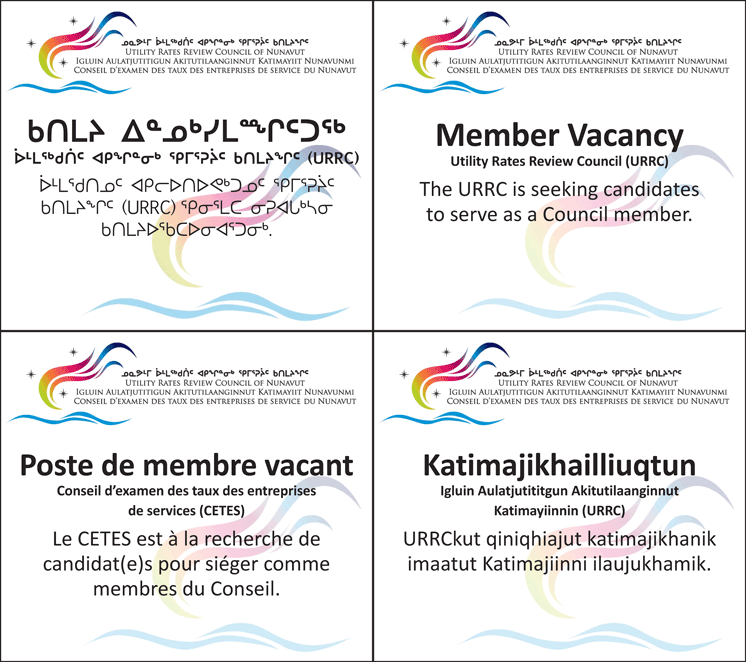
Meanwhile, posters featuring an RCMP-issued photograph of Hikoalok and a warning have spread through most of Iqaluit’s stores, schools and other public buildings.
Hikoalok recently served eight years in federal prisons for raping two young girls, four and five years old. The five-year old spent three days in the hospital recovering from her injuries, the court heard last week.
As a child, Hikoalok was beaten and sexually abused, and he may have watched his father kill his mother, Johnson said. Shortly afterwards, Hikoalok lit himself on fire.
Hikoalok served out all eight years of his sentence without parole because he refused any treatment or counselling normally offered to sexual offenders. The National Parole Board found that he showed no remorse for his actions.
He did show some interest in treatment when he applied for Tupik, a program that takes Inuit sex offenders out on land trips, but he became frustrated with the application process.
After bouncing around several federal prisons, he was moved eventually to a segregated cell, away from other prisoners.

But Hikoalok’s lawyer, Chris Debicki, said his client now wants counselling.
Nunavut’s John Howard Society and the Salvation Army have volunteered to help with Hikoalok’s release plans.
After his release from custody last Wednesday afternoon, Hikoalok spent one night in a hotel, at the expense of legal aid. He spent the following evenings at the homeless shelter.
In court, Debicki suggested that Corrections Canada officials pressed Hikoalok into travelling to Iqaluit against his wishes.
Hikoalok has said he wants to return to Kugluktuk or Cambridge Bay, where he grew up. But relatives in those communities have made it clear they don’t want him there, and community officials have said they have no resources to monitor him and provide proper counselling.
Debicki said that Hikoalok was in no position to question authorities and make an independent decision about the location of his release after spending eight years in jail.
“That was what she conveyed to him: You can’t go home,” Debicki said. “He’s telling authorities what he wants. He wants to go home.”
“I think it’s clear that federal authorities waited too long, and did too little, too late,” Debicki said.
Restrictions similar to those handed down in Iqaluit by Johnson had already been imposed by a court in Yellowknife. But the law is not clear on whether such peace bonds are transferable from one territory or province or another, said Crown lawyer Judy Chan.
To be safe, she said, police arrested Hikoalok when he arrived in Iqaluit and held him in custody Monday and Tuesday evening on a public interest warrant.
Debicki said that police demonstrated “serious misconduct” when they arrested Hakoalok, and that treating his client as a criminal would only encourage him to reoffend.
“Frankly, if I constantly remind someone that he’s a criminal… he might become one,” Debicki said.
Hikoalok’s case is unusual for a number of reasons, the judge said. He was first released in Yellowknife, the place where he was tried and convicted, because when Hikoalok committed his crimes, Nunavut did not exist and Cambridge Bay was part of the Northwest Territories.
When Hikoalok was released in Yellowknife, corrections officers took him to a bush camp outside Fort Smith.
That’s where he said he wanted to return “home,” which led corrections officers to suggest Iqaluit as a release destination.
(0) Comments