

Northern contaminants expert wins lifetime achievement prize
Derek Muir uncovered how pollutants “fly, swim and hop” to the Arctic

Much of what we know about contaminants in the Arctic comes from the research of Derek Muir, this year’s recipient of the the Weston Family Prize for Lifetime Achievement in Northern Research from the W. Garfield Weston Foundation. (PHOTO COURTESY OF THE GARFIELD WESTON FOUNDATION)
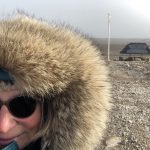
An expert in tracking chemical contaminants in the North received today the Weston Family Prize for Lifetime Achievement in Northern Research at the ArcticNet annual scientific meeting in Ottawa.
Derek Muir with Environment Canada is recognized as one of the first to discover high concentrations of chemical contaminants in Arctic food chains, and his work has led to local, national and global policies to manage toxic chemicals.
“Dr. Muir has been instrumental in advancing our understanding of the greater implications of chemical contaminants, resulting in strengthened policy that protects the environment and raises awareness of human risk associated with exposure,” said Geordie Dalglish, director of the W. Garfield Weston Foundation, in a news release.
Over a research career of more than 35 years, Muir uncovered how pollutants “fly, swim and hop” in the environment, ending up in Arctic plants and fish, and working their way up the food chain to seals, whales, polar bears—and people.
His early work in the 1980s with the Department of Fisheries and Oceans showed how pollutants from industrialized areas of the world travel thousands of kilometres north to settle in the Arctic: storms, warming air temperatures and ocean currents enable these toxic chemicals to make their way into the Arctic.
In a recent interview with Nunatsiaq News, Muir said he began tracking contaminants in the Arctic because the federal government wanted to know why Inuit had potentially harmful amounts of mercury and polychlorinated biphenyl (PCB) in their blood and wondered about whether military and radar sites could be responsible.
What he and other scientists discovered is these toxic substances were mainly carried to the Arctic from far away. “The big picture was emerging for the first time that this was a global phenomenon,” Muir said.

That was taken seriously, he said, because the contaminants were ending up in the bodies of Arctic people, who were not responsible for producing the pollution themselves. This created a push for a global agreement on contaminants, Muir said.
Muir’s work largely helped develop protocols to manage long-range trans-boundary air pollutants and contributed to the 2001 Stockholm Convention, an international treaty that aims to eliminate or restrict the use of persistent organic pollutants, like PCBs.
In Canada, his research contributed to the development of new legislation and regulations to control toxic chemicals under the Canadian Environmental Protection Act.
His work also resulted in changes to policies—and prompted public health warnings to northern residents, such as when in 2012 the Government of Nunavut issued an advisory to women of child-bearing age to limit their consumption of ringed seal liver to protect them from elevated mercury exposure.
Muir has co-led four assessments on contaminants under the Arctic Council’s Arctic Monitoring and Assessment Program.
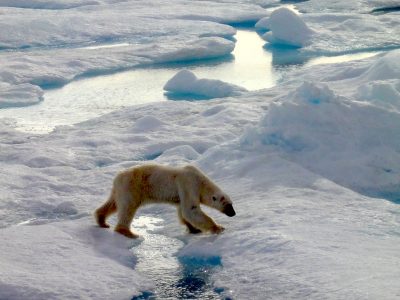
Polar bears, at the top of the Arctic food chain, continue to carry a huge load of toxic contaminants, although the production and use of many of these substances has been banned. (PHOTO BY JANE GEORGE)
The most recent report found there are also a number of new chemicals, which have been found in air, water and wildlife throughout the Arctic, while levels of mercury and PCBs remain “a significant exposure concern” for Arctic wildlife, including polar bears, killer whales, pilot whales, seals, and various seabirds, shorebirds and birds of prey.
“It’s a never-ending story, quite frankly,” said Muir about the presence of contaminants in the Arctic, and one that’s been somewhat overshadowed recently by Arctic climate change.
“Climate change impacts have gotten more publicity, and rightly so. It’s a catastrophic thing potentially, so I don’t have any problem with that,” he said.
Muir and others continue to work with the federal government’s northern contaminants program, looking at new contaminants and emerging chemicals in the Arctic.
Some of his recent research has offered new insights into the global spread of contaminants through the world’s oceans and waterways.

Muir said that in the 1980s he and other scientists assumed contaminants only came north through the atmosphere. Then came the discovery of the widespread presence of a stain protection chemical, from a group of chemicals known as polyfluorinated compounds, used in furniture, carpets, textiles, non-stick cookware, paper coatings, and fire-fighting foams.
In 2001, after travelling north in the water, these started to show in polar bears where they can cause a large number of health impacts, including cancer and hormonal abnormalities.
“It’s like putting salt in water: it dissolves, and it’s carried along, and it’s everywhere in the world, not just in the Arctic,” he said.
But in the Arctic, the impact is especially important, because these contaminants end up being passed to people who eat polar bears and other marine mammals.
Muir’s $100,000 prize includes $50,000 in cash and an equal amount that he can use for a research fellowship position to support ongoing work.
Muir said he planned to use that research money to bring on a younger researcher to look at freshwater quality and possible contaminants in lakes fed by melting permafrost in the Arctic.
Oh what, why didn’t they just ask an elder?
Congratulations- Derek so well deserved
I remember the guidance, advice you gave us at the Canadian Polar Commission on on this matter so long ago, and your never ending conviction and determination to protect the health of northern peoples and the wildlife they depend on.
I like to congratulate Derek Muir for the recognition he has received with the work he does. Good on him, to be instrumental in finding how the impact of contaminants end up being passed to people who eat polar bear meat and other marine mammals. More importantly, his work has contributed to policy changes and development of new legislation and regulations to control toxic chemicals. Keep up the good work!