


Debating Nunavut’s capital ahead of Monday’s council byelection
A handful of civic-minded Iqaluit residents attend ad-hoc debate at soup kitchen
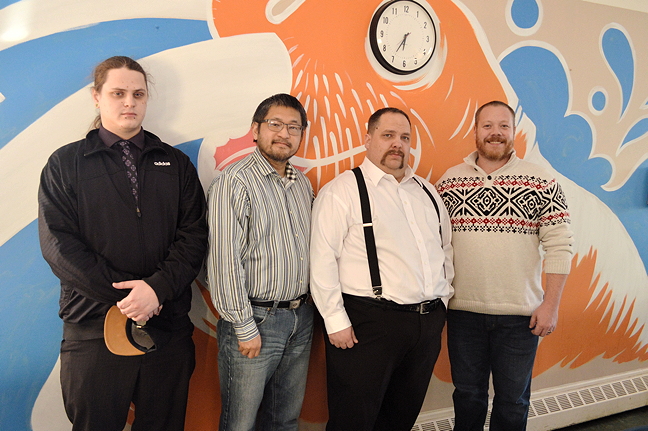
Six candidates are vying for two positions on Iqaluit city council in an April 10 byelection. They met April 5 for an ad-hoc debate at Iqaluit’s soup kitchen. From left: Jean-Luc Nevin, Sutheat Tim, Stephen Leyden and Kyle Sheppard. Candidate Noah Papatsie was present at the debate but arrived after this photo was taken. Candidate Dushyenth Ganesan attended the debate by phone. (PHOTO BY STEVE DUCHARME)
Iqaluit byelection candidates and voters found plenty of common ground while questioning the city’s spending habits and aging infrastructure during an ad hoc debate held four days before Iqalungmiut head to the polls April 10.
Only about a half dozen city residents dotted mostly empty tables in Iqaluit’s soup kitchen as the candidate-organized debate got underway shortly after dinner time, April 7.
But as the night wore on, attendance grew to nearly two dozen at one point, as candidates fielded Facebook questions drawn at random by attendee-turned-moderator, Janet Armstrong.
“From what I can tell about city finances, it’s broke,” said municipal candidate Stephen Leyden, who advocated heavily for city spending that stayed within the local economy. “There’s a lot to be said about doing things in-house and not contracting or consulting.”
Candidate Sutheat Tim agreed, hammering home his earlier comments against knee-jerk spending that leaves the city with bigger bills for services that could have been planned more strategically.
“What can we cut internally that won’t affect services?” he asked, adding that the “arrogance of the administration” spurred him to run for council.

“Lots of issues have simple fixes, why are they not being implemented?”
All candidates recognized the need for more land development that addresses Iqaluit’s already dire housing crises—an issue that will only gets worse as the city’s population continues to increase.
Candidate Kyle Sheppard argued for an overhaul of the city’s land bylaws that hands off initial investment costs to developers so the city doesn’t have to tie up its money.
“I’d like to see larger parcels of land given to developers,” he said. “We can still control what gets built, how it gets built.”
Tim agreed, citing the city’s recent partnership with the Qikiqtaaluk Corp. to develop lands off Federal Road as a possible benchmark for future private-public partnerships, or PPPs.
And much like the QC partnership, which is relying on the city to provide utilidor connections, Tim said the city could use utilidor expansion as leverage to force developers to construct a percentage of lands for low-income or “micro-housing” for young homebuyers.
“If the city is supporting and investing in the infrastructure you need to develop that lot—here’s my condition,” Tim said.
Candidate Dushyenth Ganesan, who attended the debate by phone, also said he likes the idea of PPPs for land development in the future, but added that Iqaluit needs to ensure it isn’t left holding the cheque down the road.
But Ganesan criticized the PPP developed for Iqaluit’s new airport, which he said sends too much money south for developers that have no vested interest in Iqaluit.
Candidate and former-councillor, Noah Papatsie, said the city needs to catch up with building codes for accessible access for the disabled.
“We need to keep places safe, we need to show our strength as a community city,” he said.

While most of the night’s questions focused primarily on city spending, many Iqalungmiut took the opportunity to criticize the cleanliness of city taxis and toothless enforcement of municipal infractions.
Candidate Jean-Luc Nevin responded that the city should be more proactive with taxi operators and conduct more inspections.
“The conditions of the tires are more important than the cleanliness,” he suggested.
“As a community and a government we need to step up and make sure we’re following them and they’re actually enforced,” Tim said on municipal bylaws.
Election day polling stations will be open from 10 a.m. until 7 p.m. April 10, at the Cadet Hall in Iqaluit and Abe Okpik Hall in Apex.
Eligible voters must be at least 18 years old, a Canadian citizen and have resided in Iqaluit for at least the past 12 months.
Nunatsiaq News published a two-part series profiling the six candidates in the upcoming election; you can read them here and here.
(0) Comments