


Kangirsuk centre helps offenders make a comeback
”We give them all the tools”
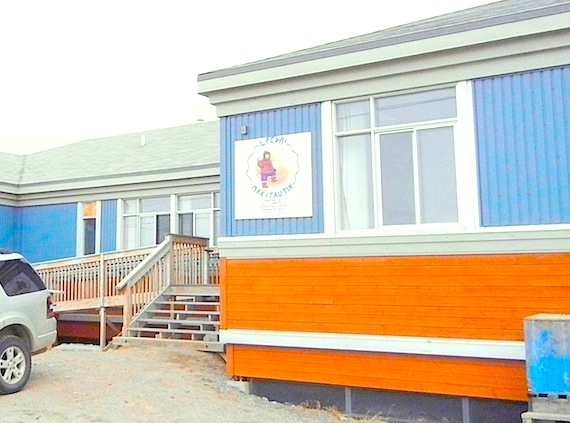
The Makitautik’s halfway house in Kangirsuk moved into its $3-million home in 2006. (PHOTO BY JANE GEORGE)
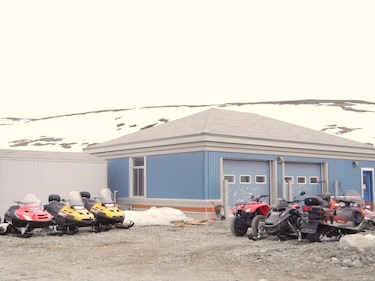
Residents at the Makitautik halfway house in Kangirsuk make use of these snowmobiles and all-terrain vehicles parked outside the centre’s garage to go on hunting and fishing trips around the community. (PHOTO BY JANE GEORGE)
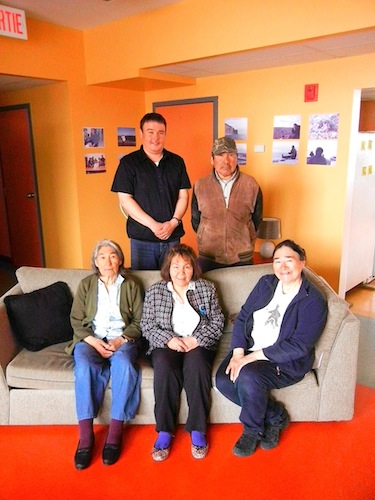
The staff at Makitautik’s halfway house in Kangirsuk includes (bottom row)Minnie Airo, elder counselor, Mary Thomassie, counselor, Jeannie Nungak, clinical co-ordinator, and (back row) executive director Zebedee Annahatak and animator Willie Thomassie. (PHOTO BY JANE GEORGE)
KANGIRSUK — When you walk into the Makitautik halfway house in Kangirsuk at 9 a.m., you shouldn’t expect to see any residents around.
That’s because on a typical morning, the centre’s seven residents are out working at jobs around town or attending training courses.
So, your first sight of what Quebec calls a “reintegration’ or “Inuit residential” centre are freshly-mopped floors and the welcoming figure of its current executive director, Zebedee Annahatak.

Since its 1999 opening in this Ungava Bay community of 470, Makitautik has moved — in 2006 from a former construction worker’s lodge into this new $3 million, 14-bed facility — and it’s grown.
In 2006, when Annahatak, 32, a former police officer with the Kativik Regional Police Force arrived, the centre, plagued by low referrals and staff turnovers, was closed.
Since then, with the help from the centre’s board of directors and the legal department of the Kativik Regional Government, Annahatak has put Makitautik back on its feet.
He’s worked closely with Quebec’s public security and justice departments to see that provincial detention centres and judges refer eligible offenders to the centre.
“Referrals are way up,” Annahatak said.
To be referred to Makitautik, an offender must be on parole or serving a conditional sentence of less then two years.

And, most importantly, you have to want to be at Makitautik, Annahatak added.
That’s because Makitautik’s program — delivered in Inuttitut by its all-Inuit staff — is demanding.
From the 8 a.m. wake-up to lights-out at 11 p.m., residents face a packed schedule.
After morning chores, like mopping and laundry, they head out to their work or training programs.
Residents also cook their own breakfast. On the weekends, they take over all the cooking in the large kitchen, where a plate filled with fresh Canada goose eggs sits on the counter.

You’ll usually find one resident next door working in Makitautik’s well-equipped garage, with his head buried in the snowmobile that he’s repairing.
Its owner supplied the new parts — and, using his skills, this much-in-demand resident plans to get the machine back in working condition.
After lunch, residents participate in counselling sessions.
These include therapy, both one-on-one and in groups, anger management, parenting skills, understanding trauma and grief and Inuit language skills and history.
“Everyone’s local, everyone’s Inuit,” said Annahatak of his staff who meet in the morning to discuss the day’s activities or look at a referral for a new resident.
Makitautik’s staff includes Jeannie Nungak, clinical co-ordinator, Minnie Airo, elder counselor, Mary Thomassie, counselor, Elena Airo, secretary, Willie Thomassie animator and rotating night staff.
They’re all quick to tell Nunatsiaq News that the success of Makitautik is due in large part of the support of Kangirsummiut who voted in the late 1990s to host the halfway house— Nunavik’s first.
After counselling, residents head back to work until supper — unless they’ve been out on the land for a day of hunting and fishing.
Evenings are free. There’s time to play sports, watch television or surf the Internet on the centre’s computer.
Visitors are allowed from 6:30 p.m. to 8 p.m..
Monday evening Alcoholics Anonymous meetings are open to residents and people in the community.
The centre’s curfew of 10 p.m. applies to all residents.
And, by 11 p.m., everything’s quiet as residents settle into their simple, but comfortable rooms.
Some stay at Makitauktik from three to 12 months — for those longer-term residents, the centre becomes like their second home.
When they “graduate” and get ready to return back to their home communities, the board of directors organize a small party.
Residents may also invite a local friend or family members to attend if they’re in the community.
“I’m grateful to the community because it shows support to the residents,” Annahatak said. “The guys help out and they’re helped out.”
No statistics are kept about whether, once out of Makitautik, the former residents — whose offences include assaults and drunk driving — stay out of trouble, Annahatak said.
“But we give them all the tools [for their release],” he said.
Sometimes former residents call, to say hello or ask for some advice, he said.
No offenders accused of sexual or violent crimes can attend Makitautik, which gets by on an $880,000 grant from Quebec.
Its clients are all offenders who’ve received sentences of less than two years, although there’s some interest from Corrections Canada to allow federal inmates also come to the centre before they head back home.
(0) Comments