


Nunavik says goodbye to elder Isaacie Padlayat
“Avataq will never be the same”

Isaacie Padlayat, shown here in 2009, served on the board of Nunavik’s Avataq Cultural Institute until his death last month at 76 years. (PHOTO COURTESY OF AVATAQ)
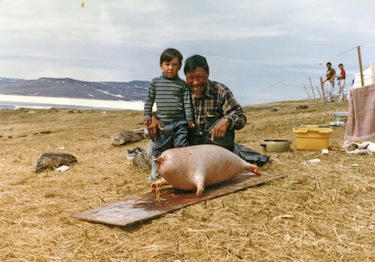
Isaacie Padlayat stands with his young son in this photo taken in Salluit in 1968. (PHOTO COURTESY OF AVATAQ)
The Avataq Cultural Institute and the region of Nunavik have lost a great storyteller.
Isaacie Padlayat, Avataq’s vice-president and a life-long promoter of Inuit culture, died Sept. 26 at the age of 76.
One of Avataq’s founding members when the organization formed in 1980, Padlayat was continually re-elected to its board of directors and remained on the board until his death last month.
“To tell you the truth, Avataq will never be the same,” said Charlie Arngak, Avataq president and Padlayat’s long-time family friend. “There’s nobody like Isaacie — he was a really interesting guy.”

Padlayat was born March 26, 1933 at Deception Bay, southeast of today’s community of Salluit, Arngak said.
For many years, Padlayat refused to settle in the settled community at Salluit and instead made his home at Deception Bay with his wife and six children.
Arngak said many jokingly referred to Padlayat “the mayor of Deception Bay.”
In the late 1950s, Padlayat went off to Kingston, Ont., where he and other Inuit men were sent for training in mechanics and instruction in the English language.
Later Padlayat worked at the Raglan mine, looking after Inuit staff there and monitoring ice conditions.
Padlayat also assisted archaeologists and other visitors to the area.

Throughout his association with Avataq, Padlayat continued to promote Inuit language and culture, Arngak said.
Padlayat always advocated for Inuktitut-language education in Nunavik schools as well as traditional land skills training.
“He knew so much about traditional survival,” Arngak said. “He really had the most experience.”
However, Padlayat also travelled south often and fit well into Avataq’s corporate setting in Montreal – with Arngak’s help.
“People said that he was like a father to me, and I was like a father to him,” Arngak said. “I always had to travel with him to Montreal. I took care of him, and he took care of me.”

Those at Avataq say Padlayat would often interject at a board meeting to tell a story or to share a part of his culture for the benefit of non-Inuit at the table.
When the Montreal Botanical Gardens created their First Nations garden, Padlayat shipped rocks from Deception Bay to build an authentic Nunavik inuksuk, which still stands there today.
Padlayat also leaves several transcribed interviews with Avataq, in which he shared his traditional knowledge and stories from his life.
“To lose one of our elders is always a big loss; they know the language, the traditions and the culture,” Arngak said. “But at the same time, this means it’s our turn.”
Argnak travelled to Salluit in late September for Padlayat’s funeral, a service he said was well-attended by friends, family and colleagues from across the province.
There, Arngak said he was asked to choose Padlayat’s final resting place. He used a shovel to open a grave right next to Padlayat’s brother Paulusie, who had passed away only weeks before.
“It really touched me,” Arngak said. “But it made me look forward to doing more of his work.”
(0) Comments