


Nunavik’s new cash should pay for vets: musher
“They could neuter a lot of puppy mills here”
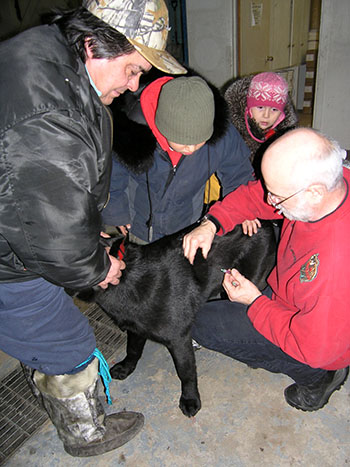
Veterinarians from Quebec’s agriculture department vaccinate about 600 dogs a year in Nunavik, but the vaccination program isn’t extensive enough to eliminate rabies from Nunavik, and these vets don’t neuter and spay any animals. (FILE PHOTO)
Providing veterinary services would be a good way to spend some of the $3 million that Quebec will pay Makivik Corp. as compensation for dog slaughters that took place in Nunavik during the 1950s and 1960s, says a long-time dog team owner in Kuujjuaq.
As the popularity of dog sledding grows across the region, Kuujjuaq musher Allen Gordon said he would have like to see money earmarked for veterinary services, such as vaccinations and neutering, for dogs.
Just like week, Gordon lost a puppy to parvovirus, a serious disease that affects the gastrointestinal or cardiac systems of dogs.
Last year, he paid more than $1,000 to have his lead dog sent south after the animal was seriously injured.
A permanent or mobile veterinary service could provide regular care and cut down on the overpopulation of dogs by regularly neutering female dogs, Gordon said.
“They could neuter a lot of puppy mills here,” he said. “These female dogs can have puppies every six months.”

The Aug. 8 agreement recognizing the dog slaughter stemmed from the 2010 report by retired Quebec Judge Jean-Jacques Croteau.
His research concluded that Nunavik society suffered damage from the actions, attitudes and actions of federal and provincial officials who killed at least 1,000 dogs in Nunavik during the 1950s and 60s.
Among his recommendations, Croteau suggested that the governments pay compensation to regional organizations to use to promote Inuit art, culture and language as well to organize dog team races, such as the annual Ivakkak race, which Makivik launched in 2001.
“For a modern day musher, I have no idea what it was like to lose your form of transportation,” he said. “But I’m happy that the government has at least acknowledged there were problems.”
Gordon can see how the revival of dog-sledding in the region has helped reconnect Nunavimmiut to a part of their past.
“I’ve passed through communities where people are crying, their hearts have been touched seeing how their father or grandfather lived,” said Gordon, whose team placed third in the 2010 Ivakkak. “It’s a really good thing that Makivik started that race.”

While Quebec sends veterinarians to vaccinate animals on an annual basis, there is no regular care available in Nunavik.
(0) Comments