

Nunavut should expect decade of record mining growth: economist
“The next few years are going to be golden.”
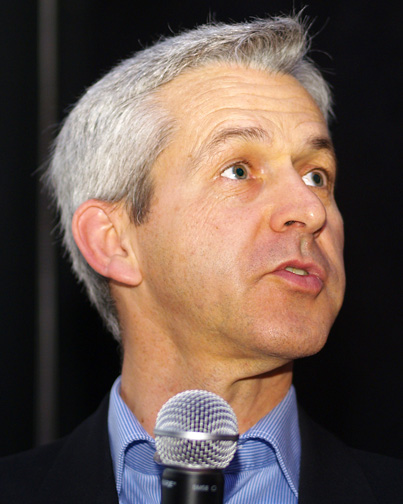
Francois Picotte, the senior economist with the Nunavut department of economic development and transportation, speaks to the Nunavut Mining Symposium in Iqaluit April 13. Picotte’s forecasting a decade of significant growth in Nunavut’s mining industry. (PHOTO BY CHRIS WINDEYER)
Nunavut’s senior economist says the territory should get ready for a decade of record-level mining activity.
Francois Picotte told the Nunavut Mining Symposium Tuesday that 2008 was a record year for Nunavut’s mining industry, with almost $1.3 billion in capital investment and exploration work.
By contrast, 2009 was a year when Nunavut’s mining industry, along with mining around the world, fell flat on its face thanks to the economic downturn.
But Picotte said years like 2008 “will almost become the norm” and he predicts billion-dollar levels of activity will likely occur “the equivalent of eight times over the next 10 years.”
Combine that with a forecasted $300 million worth of production from the Meadowbank gold mine near Baker Lake, and Picotte predicted boom times for Nunavut mining as the global economy continues to recover.
“The next few years are going to be golden,” he said.
All that mining activity means the old saying that government is Nunavut main economic engine isn’t really true anymore, Picotte said.
The industry is critical to the territorial economy. Put one way, mining exploration last year was worth $5,456 per capita in Nunavut, compared to $44 in Ontario and $55 nationwide.
Nunavut ranks fourth in mining exploration, with $240 million in spending projected for 2010, said John Kearney, president of the Northwest Territories and Nunavut Chamber of Mines.
That’s about equal to British Columbia and much larger than the Northwest Territories or Yukon.
But Kearney said there needs to be more action to get more proposed mining projects into production.
He called for the completion of the long-delayed Nunavut land use plan, and the passage of the Nunavut Planning and Project Assessment Act, which was to have simplified some of Nunavut’s notoriously convoluted regulatory systems.
In October, 2009, Chuck Strahl, the Indian and Northern Affairs minister, told a parliamentary committee he was planning forward a proposal for that bill, but there’s no sign of any work on the bill since the Conservative government prorogued Parliament this winter.
“It is critically important that Canada’s governments — federal, territorial and aboriginal — maintain and enhance their dedication to economic development,” Kearney said.
“Advocacy for northern resource development, for more open access to minerals, for infrastructure projects and for tax incentives to encourage increased investment, should remain a fundamental mandate at all levels of government.”
Meanwhile, economic development officers took to the microphone Tuesday to pitch the merits of their hamlets to a theatre full of mining industry types.
John Main, Arviat’s economic development officer, said “mining has opened a whole new door” for his community.

Sixty years of on-and-off mining in the southern Kivalliq has created a base of trained workers. Arviat’s booming population — it’s now Nunavut’s third largest community — means there’s a high demand for good-paying jobs.
“It’s a bit hard to understand if you haven’t experienced 60 to 80 per cent unemployment,” Main said.
“People want to work. You find them a job, they will work. You find them a training opportunity, they will get themselves trained.”
Colin Saunders, economic development officer for Pond Inlet, said that the massive Mary River iron ore project provided jobs for local workers and contracts for the local Toonoonik-Sahoonik Co-op.
During Mary River’s 2008 bulk sample project, as many as 44 Pond Inlet residents had jobs.
Saunders said that was great news for people trained as drillers or heavy equipment operators, but it also left the hamlet scrambling to fill some of its own jobs.
But as the project continued to grow, the co-op had a harder time meeting the terms of certain contracts. The co-op ended up having to sign a deal with the Qikiqtaaluk Corp. to save a catering contract, Saunders said.
Picotte said while Nunavut’s mining forecast is rosy, there’s a potential downside. Quick growth can lead to development bottlenecks and price inflation, he said.
And Nunavut society is also at risk of increased income disparity between people with jobs and “the people who don’t participate in that boom.”
“That’s why we’re inviting firms to get as many people involved as possible,” Picotte said. “If they leave people out it will come back to bite them.”
(0) Comments