


Nunavik elders enjoy safe, cozy havens
Training program improves care

Nurse instructor Nancy Piquette and northern-attendant trainee Annie S. Gordon say the Tusaaijiapik elders home would benefit from more Inuit workers— and visits from local residents.

The corridor at the Tusaajiapik elders home features photos from the past hung on the walls. By every room, there are also photos of the residents along with their names. (PHOTO BY JANE GEORGE)
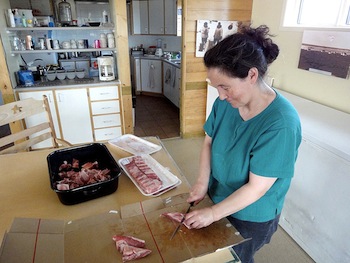
Harriet Saunders makes lunch at the Tusaajiapik elders home in Kuujjuaq.(PHOTO BYJANE GEORGE)

Elder Maata Tuniq works on a nassak at the Kangiqsujuaq’s Qilangnguanaaq assisted living centre. (PHOTO BY SARAH ROGERS)
If you want to see elders living in a safe and cozy place, just visit Nunavik.
Over the past few years, Nunavik built three elders’ homes, thanks to the Kativik Municipal Housing Bureau— the Uvatinut apartments in Puvirnituq, the Qilangnguanaaq assisted living centre in Kangiqsujuaq and the Tusaajiapik elders home in Kuujjuaq.

Elders who are able to manage on their own with assistance can live at Puvirnituq’s apartments or Kangiqsujuaq’s Qilangnguanaaq centre.
But the 14 elders who live at Kuujjuaq’s elders home are less independent.
Many have physical problems due to their age or suffer from conditions such as dementia, and need 24-hour care.
And you can see the elders who live at the Tusaajiapik home receive this care along with a big dose of love.
A recent visit to the home found several resident elders sitting in the home’s spacious, well-lit living room with a view over the Koksoak River.
Birds chirped away in a corner birdcage. A partly-finished crossword puzzle lay on a table, and tea and coffee were brewing in the kitchen.

One elder asked for cigarettes. He’s able to get up on his own and slowly head over to the specially-ventilated room for a smoke.
But there are also country food meals, daily activities, games and crafts to pass the time.
No just one sits around all day, staff say.
The building housing the Tusaajiapik dates back to 1995. In 2002, it opened as an elders centre, but then closed due to a lack of staffing in 2006, which sent all its residents to the Tulattavik hospital for care.
To improve the standards of care and reduce staff turnover, Tulattivik and the Kativik Regional Government’s employment and training department started a 900-hour “northern attendant” program to train workers for Tusaajiapik last year.

“We already see a big difference. We see they understand what’s involved, and they make suggestions to improve our services. That’s improving our service delivery,” said Yoan Girard, coordinator of the Tusaajiapik home.
The elders home still has problems finding and keeping workers— but not everyone can do this kind of specialized work with elders, Girard said.
For those who are cut out for the job, training in areas like basic care, physical illnesses and disability and client needs, provides needed support, he said.
The northern attendant course now has six students. They spend one week in class and the other week at work, where they’re given on-job training from the home and hospital’s team of practical and registered nurses.
In the future, Girard would like to see more prestige given to the home’s workers— as well as bonuses for those who complete the northern attendant program.
The long-term plan to see the home staffed by trained Nunavimmiut.
“Slowly but surely we’re getting there,” said nurse-instructor Nancy Piquette.
“I love working here. But we want more Inuit people working here,” said Annie Sequaluk Gordon, who has worked at the home for 10 years.
Gordon and Piquette urge more locals to drop by and visit the elders.
That’s the same message delivered by Bobby Snowball, president of Nunavik’s elders committee, to the KRG’s recent council meeting in Akulivik— not to neglect elders.
Next Tuesday, June 15, marks World Elder Abuse Awareness Day— an international day created by the World Health Organization in 2006 to draw attention to the mistreatment and neglect of elders.
Everyone in Nunavik is being urged to wear purple to recognize the day.
And throughout the region, there will be special events such as games feasts for elder as well as parades of police vehicles, elders vans, fire trucks. A call-in show is also planned on the Taqramiut Nipingat Inc. radio network from 9 am to 12 pm.
Elder abuse, a problem throughout the world, also exists in Nunavik, said Snowball, whose committee wants to improve the quality of life for elders.
Most elders in Nunavik live in overcrowded dwellings and are poorer than their peers in southern Quebec, a 2005 report, a Socio-economic Profile of Elders in Nunavik, found.
(0) Comments