


Iqaluit’s food bank remains busier than ever
“There’s been no drop this summer”
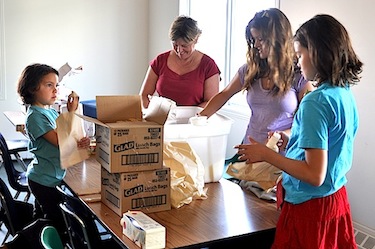
Volunteers help gather food items from Niqinik Nuatsivik’s storage and distribution facility, which is shared with the community’s soup kitchen. The food bank counts about 70 volunteers. (PHOTO BY SARAH ROGERS)
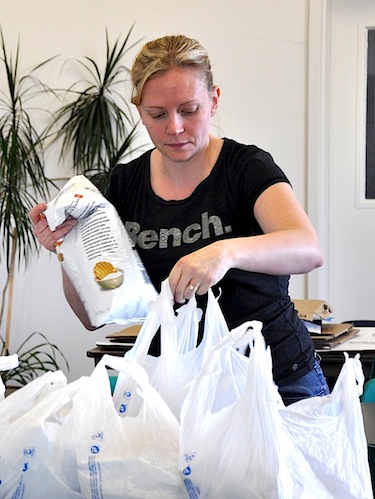
Jen Hayward, co-chair of Niqinik Nuatsivik’s board of directors, helps to pack food bags for distribution July 16. Hayward would like Iqaluit’s food bank to increase distribution to every week from every second week – but an increase in the number of users may make that difficult. (PHOTO BY SARAH ROGERS)
It’s Saturday morning at Iqaluit’s Niqinik Nuatsivik food bank and a half dozen volunteers are filling plastic bags with items like flour, rice, canned soup and fruit.
As they do every second Saturday, volunteers will hand out almost 200 bags of food to Iqalummiut in need.
In March 2011, the food bank served 562 people.
During the warmer months, those numbers tends to drop, food bank volunteers say.

But the number of summer users has risen this year – and they’re not sure why.
“We know the winter months can be a drain on finances,” said Jen Hayward, chair of the food bank’s board of directors. “But there’s been no drop this summer, when there usually is.”
In a food security survey conducted this past May by McGill University and the Qaujigiartiit Health Research Centre, researchers interviewed 94 food bank users.
Half of the respondents said winter is a tough time for people to get enough to eat, because less hunting means smaller amounts of country foods available in the community.
But, apart from the growing cost of living in the North, Hayward can’t suggest what’s keeping the numbers up into July.
The food bank relies entirely on donations to operate and for that reason, Hayward’s only wish is for Niqinik Nuatsivik to “stay open.”

“We’d like to move to a weekly distribution,” she said, “but if our demand goes up, I’m not sure we can.”
If the numbers remain steady, Niqinik Nuatsivik will likely serve more people in 2011 than the 1,062 individuals who used the bank last year.
While some of the statistics found in the McGill/-Qaujigiartiit survey might be cause for concern, they also reveal a clearer picture of who is going hungry in Iqaluit.
Most of Niqinik Nuatsivik’s users, about 97 per cent, are Inuit.
Almost three-quarterss are unemployed, while 60 per cent rely on social assistance as their main source of income.

And eight in 10 say they did not complete high school.
Misconceptions about what is behind poverty and hunger are common, Hayward said.
“People are sometimes quick to judge,” she said. “If someone at Northmart is buying junk food or cigarettes, some wonder why they’re visiting the food bank. But we’re in no place to judge.”
To meet the growing needs in Iqaluit, Niqinik Nuatsivik continues to gather support at its monthly collection table at Northmart and through other local and regional organizations.
Iqaluit’s Rotary Club has committed to giving the food bank $10,000 a year over three years.
A registered charity, Niqinik Nuatsivik recently entered into a three-year sponsorship deal with First Air that will see the airline offer discounts on shipping and other benefits.
Niqinik Nuatsivik hopes to share part of the $16,000 it received through Food Banks Canada with other food banks across the territory.
(0) Comments