

Author Michael Kusugak brings Inuit storytelling to Hawaii
“Traditional storytelling was the way we kept ourselves sane”
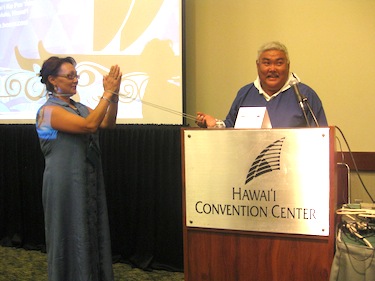
Children’s author Michael Kusugak of Rankin Inlet plays string games with Jessica Arngak of Kangiqsujuaq at a gathering in Honolulu, Hawaii called “Healing Our Spirit Wordwide.” Kusugak, in his presentation, talked about the importance of transmitting culture through storytelling during the conference which wrapped up Sept. 10. (PHOTO BY MARION JAMES)
Children’s author Michael Kusugak never wanted to go to a healing conference, let alone to such a tourist destination as Hawaii.
But when his wife convinced him to go to the “Healing our spirit worldwide” conference, Kusugak said he was greeted in Hawaii by aboriginal cultures from around the world, interested in sharing their own legends.
“A lot of these people have traditional stories that just aren’t being shared,” he said.
The Rankin Inlet-based author gave a half-hour long storytelling workshop to a full house during the conference, which took place in Honolulu Sept. 3 — 10.
Kusugak said he left Hawaii feeling like Inuit have much to share with other cultures.
“What I wanted to do was talk about how native traditional storytelling was the way we kept ourselves sane, by telling these stories that have been around hundreds and thousands of years,” he said.
Kusugak considers storytelling a vital part of guarding one’s heritage.
“When people from the outside would come, they wanted to make us like them,” he said. “We had to have something that’s helped us survive all these years, that’s allowed us to keep our history, our morals.”
Kusugak says he was inspired to tell stories by television – the source of stories for so many people, although one mostly void of content that is relevant to the Inuit culture, he adds.
While many aboriginal cultures share a storytelling tradition, Inuit stories seems to be more fluid, allowing the teller to adapt the story as they go.
“Many native peoples say their stories must be exact, told just as they are,” he said. “While Inuit storytelling is up to the storyteller – as long as you deliver the message, that’s all that’s important.”
Kusugak gives the example of the tale of a blind boy who meets two loons on a lake. In the version he heard as a child, the loons lick the boy’s eyes to cure his blindness.
In another version, the loons take the boy underwater where his blindness is rinsed away.
There are variations on this, Kusugak says, but the story always has the same ending.
Kusugak is currently touring the Kitikmeot region until the end of the month, giving public storytelling workshops.
As a future project, Kusugak says he would like to coordinate a group of storytellers to travel across the country to Canada’s aboriginal communities and encourage young people to tell their own stories.
(0) Comments