


The snow bunting’s spring tune-up
Arctic bird uses unique songs to attract mates
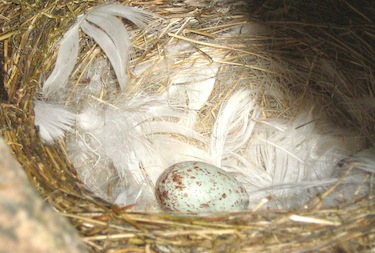
Mitivik Island, near Southampton Island, is an ideal place to study snow buntings, because up to 25 nesting pairs can be found there every spring and summer. (PHOTO BY SARAH GUINDRE-PARKER)
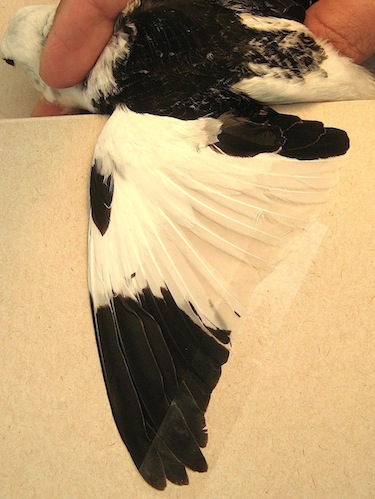
By studying markings on bunting wings researchers hope to learn what they say about the health of the bird. (PHOTO BY SARAH GUINDRE-PARKER)

These tiny snow bunting nestlings will be ready to fly within 14 days of hatching. (PHOTO BY SARAH GUINDRE-PARKER)
As the snow melts and the days get longer and warmer, you’ll be hearing the familiar sound “tee-sip-purr-tee-tee-sip-purr-twee-twit” outside again — the song of the familiar snow bunting, known as qaulluqtaaq, amautlik or ukiuqtaarjuk, in Inuktitut.
To us, a snow bunting’s song signals that spring is on the way.
But the song of a male snow bunting says something else to female snow buntings.
His song may include messages like “I’m a good provider,” “I know where to find lots of food,” “I have a great nesting site picked out” or “I’m a strong, powerful bird.”
A group of University of Windsor graduate students spend more than two months every spring and summer on Mitivik Island, not far from the Nunavut community of Coral Harbour, trying to better understand snow buntings, which number more than 29 million in North America.
The huge global population of 40 million snow buntings has apparently decreased by as much as 60 per cent, and no one knows exactly why.
Male snow buntings, arriving back north in late April or May, compete with other males for good nesting sites before the females arrive.
By the time Sarah Baldo, Sarah Guindre-Parker and Christie MacDonald return to Mitivik Island in early June, the male birds are belting out mating songs from rocky perches or as they swoop through the air.
Each male snow bunting has his own song, singing it at a special rate, with minor variations at the beginning and the end.

The songs are so distinct that the unique songs of certain snow buntings used to guide people in Greenland through the fog.
“Their songs tell about an individual quality that is unseen,” says Baldo, who studies male snow buntings’ songs.
This much is clear: birds who sing more rapidly appear to have better luck finding mates.
“These males are snatched up right at the beginning,” she says.
Their mates also produce eggs more quickly. They’re also better providers, feeding more insects and seeds to their nestlings, Baldo says.

Snow buntings nest in crevices between rocks, away from predators.
To keep the chill away, the male lines the nest with fur and feathers. There, the female sits on the eggs while they incubate for about two weeks, while the male feeds her.
Some female snow buntings also go beyond their own nest to mate — and about one in five nests contain eggs, which have been fertilized by more than one male.
Maybe these males have some sort of good genes, so their offspring turns out more healthy— and females may also pick additional mates from their attractive songs, Baldo suggests: these are some of the issues other researchers have looked at, but which she hopes to resolve with her study on Mitivik Island, which lies in the East Bay bird sanctuary.
It’s a tiny island about 400 metres by 800 metres, with up to 25 pairs of buntings nesting densely among granite rocks.
But it’s a perfect place to study snow buntings, which generally don’t nest in such large groups in the Arctic.
Baldo’s study relies on non-invasive methods: “I don’t think I could do a study where you’d have to sacrifice the species,” she says.
So, Baldo records songs and counts eggs. She also takes tiny samples of blood and leg-tags the birds.
To do this, adults are lured into traps with birdseed. As for nestlings, she’ll pick them up.
“The first time I was really nervous, but you just prick their leg and take a drop of blood on the paper,” she says. Most don’t even open their eyes.
Baldo also has a tiny scale — even an adult snow bunting doesn’t weigh much, about 35 grams.
Baldo hopes to see some of the birds she tagged last year return to see if the birds’ songs change over time.
Previous research from Europe shows snow bunting songs may be nature’s way of telling which males are best equipped to help the young snow buntings survive.
Baldo hopes to show these songs mean strong singers better feed their mates, too.
Survival is important because only half the breeding adults return to Mitivik Island each year, and less than one in 10 of the nestlings survive to the following year.
Snow buntings’ plumage also seems to be related to a snow bunting’s reproductive success.
The breeding male has showy white feathers and a black back, while the breeding female’s back is grey-black.
Snow bunting feathers are grad student Sarah Guindre-Parker’s passion. She catches birds, takes photos of their wings, notes the proportion of white feathers to black, looks at their tails and takes a few feathers for study.
Black and white male snow buntings with whiter breasts have more fledglings at the end of the season, she’s found.
But, there’s even more to learn about snow buntings, like where do they go in the winter?
No one knows where Mitivik Island’s snow buntings go in winter, says grad student Christie Macdonald.
That’s why last summer she attached tiny, .8 gram units on some birds’ back, which can measure sunlight.
When the snow buntings with the mini-backpacks return, she’ll download that data and see where “our birds” wintered over to learn more about the route they took.
By autumn, the snow buntings start flocking together for the long journey south from Mitivik Island again, a sign that winter isn’t far off.
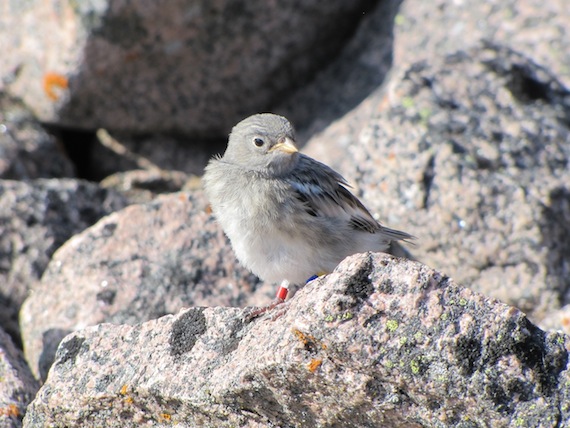
Soon this snow bunting fledgling will start its long journey south. Only about 10 per cent of fledglings survive the first year. (PHOTO BY SARAH BALDO)
(0) Comments