


Ambassadors view Iqaluit on northern foreign affairs junket
“They’re basically exposed to the big issues of the day”
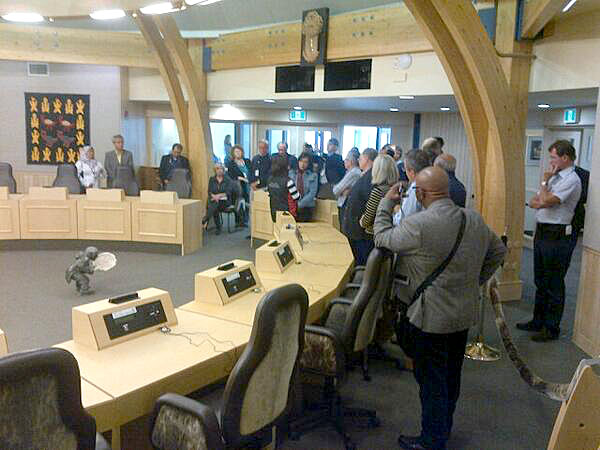
Ambassadors to Canada visit Nunavut’s Legislative Assembly, Sept. 3. (PHOTO COURTESY OF PATRICK BORBEY)
A group of ambassadors to Canada dropped in on Iqaluit Sept. 3, for their first stop on a tour of the three northern territories organized by the Department of Foreign Affairs.
Patrick Borbey, chair of the Arctic Council’s senior Arctic officials, helped guide the annual tour, which this year takes 22 ambassadors of various countries on an eight-day tour of all three territorial capitals and other major northern communities.
“They’re basically exposed to the big issues of the day, whether they’re economic, social, governance,” Borbey said.
This year’s tour is the first held during Canada’s chairmanship of the Arctic Council, which is headed by Nunavut MP Leona Aglukkaq for the next two years.
The ambassadors include four from member states of the Arctic Council and eight from Arctic Council “observer states,” Borbey told Nunatsiaq News, without giving further specifics for security purposes.
Twelve “non-Arctic” countries, which are not Arctic Council member states, hold observer status.

The council granted observer status to six of these in May, including China, India, Japan, South Korea, Singapore and Italy.
Ambassadors from other countries not involved with the Arctic Council are also on the tour, including Indonesia and some from South America, Africa, and Asia, Borbey said.
Usually scheduled for late spring, the tour was called off last year due to budget cuts, he said.
“There was a late decision to reinstate it this year,” Borbey said.
As in previous years, the touring officials will visit “various locations in Nunavut, Northwest Territories, Yukon, and finish in Churchill,” he said.
After their day-long visit in Iqaluit, the group will include Cape Dorset, Rankin Inlet, and Cambridge Bay on the Nunavut leg of their tour, followed by Inuvik and Tuktoyaktuk in the Northwest Territories.

Their Iqaluit visit included briefings with the Government of Nunavut and Nunavut Tunngavik Inc., Borbey said, highlighting the importance of the land claim agreement that gave rise to the territory.
The tour is a learning opportunity for state representatives, said Borbey, who is also president of the Canadian Northern Economic Development Agency.
“We take them to the capitals as well as to some of the smaller communities, and try to expose them to all of the different elements,” he said, pointing to a scheduled visit of the Meadowbank gold mine in the Kivalliq region as an example.
“They’ll get to see what are the challenges and of operating and developing a mine in Canada’s North, and try to impress upon them the importance of the relationship with aboriginal people in the North, with the land claim and how that makes things different,” he said.
“And the importance of working with local communities in ensuring that benefits accrue to the people of the North.”
Ambassadors cover their costs for the tour, Borbey said, adding he hopes it will continue on a yearly basis.
(0) Comments