


Arctic governments stand by as deadly pollution spews from Russia’s Nikel mine
“More profitable to keep polluting the region than modernize the production”
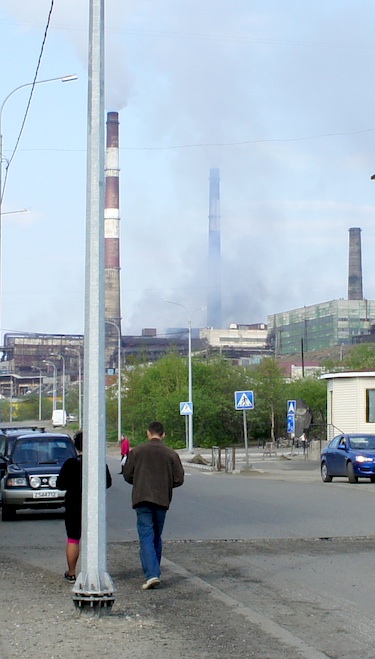
The stacks from Norilsk Nickel’s nickel plant loom large over the town of Nikel, in western Russia’s Arctic Kola Peninsula. (PHOTO BY ALEX BOYD)
ALEX BOYD
The nickel mine in the aptly named town of Nikel in northwestern Russia is usually notable for three things: it’s big, it’s a massive source of pollution, and, for more than 20 years, it’s defied all attempts to change.
Controversy is as constant in Nikel as the clouds of sulphur dioxide; the mine here is equal parts economic powerhouse and environmental scourge.
Yet, criticism has kicked up a notch in recent weeks after European leaders met to discuss issues in the region — and failed to mention Nikel.
Last week’s Barents Summit in Kirkenes, Norway brought together leaders from all over northern Europe, but despite old promises to deal with the mine’s pollution and new commitments to environmental sustainability, the mine located just 50 kilometres away went unmentioned.
Amid the international hoopla over the Arctic, it’s easy to forget that the region is a relatively small place, with a small population. The presence of organizations such as the Arctic Council and the Barents Council means countries are increasingly trying to tackle Arctic issues as a group, but disagreements still arise.
And, as more mining occurs in the Arctic, the actions of a neighbouring country can quickly become your business.
Nikel is a prime example. The community sits on the Kola Peninsula, a gently rolling land of rock and scrub and endless sky. Driving into Nikel, however, means entering a barren moonscape, where the mine and accompanying smelter have turned the ground black as giant stacks pump smoke into the sky—a mere seven kilometres from the Norwegian border and less than 100 km from Finland.
Russia produces more nickel than any other country, the vast majority of which is mined by Norilsk Nickel, one of the country’s most profitable non-oil-based companies.
But Russia has the emissions to match: according to Norwegian internet news site, the BarentsObserver, the Nikel plant alone produces about 90,000 tonnes of sulphur dioxide every year, which is about five times the total amount of Norway’s emissions.
Sulphur dioxide, which smells like burned matches, is a major air pollutant. It leads to higher rates of respiratory and cardiovascular diseases and speeds up the acidification of waterways and erosion of buildings — all of which you can find in Nikel and its surroundings.
Anna Kireeva, from the Murmansk chapter of the Bellona Foundation, an environmental organization based in Norway, says Nikel’s impact is particularly harmful in the fragile Arctic ecosystem.

But the mine has successfully evaded international efforts to clean it up, she said in a recent interview.
“It’s hard for Norway, because [Norilsk Nickel] is a Russian private company, and it follows Russian rules,” she said. “For Russians, it is hard to work with because regional environmental authorities can do nothing, because the company reports to federal controlling institutions.”
And it’s not for lack of trying.
Norway has offered financial assistance on and off since the 1990s to clean it up. The Arctic Council’s Arctic Monitoring and Assessment Programme named the mine one of the Arctic’s worst environmental issues in 2003.
And, in 2007, Nikel made the Blacksmith Institute in New York’s annual list of Most Polluted Places.

Russia has responded; on a visit to Oslo in 2010, Russian Prime Minister Dmitry Medvedev said Russia would contribute to reducing emissions.
But Nikel is just too profitable, Kireeva said,
“The company has special permission for more emissions,” she said, and even pays fines when it goes over its allowable amount, but the fines are so low “it’s more profitable to keep polluting the region than modernize the production,” she said.
According to AMAP, which keeps track of general trends in air quality in the region, the concentration of sulphur dioxide in the air has actually declined since the early 1990s, but it’s still very high.
The Murmansk Hydrometeorological Monitoring Authority monitors emissions on a day-to-day basis; one day last week it recorded sulphur emissions that were four times the allowed amount.
Still, the end of the Soviet system allowed citizens more mobility, and Russia has struggled to convince people to remain up north ever since.
The 2010 census shows that Nikel’s population — at almost 13,000 people — is just over half of what it was the year the Berlin Wall fell in 1989.
Nowadays, the mine is one of the few things anchoring people to the town.
That’s not much consolation to Russia’s nearby neighbours. As Kireeva said, “it’s not only a immediate threat — it’s the ongoing destruction.”
(0) Comments