

DFO partially lifts trade restrictions on narwhal tusks
But changes in the management system may lie ahead
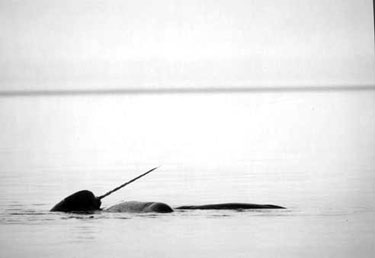
“Inuit in Arctic Bay, Clyde River, Qikiqtarjuaq, Pangnirtung and Iqaluit can now resume international trade in narwhal tusks and are no longer going to be economically penalized by DFO’s former data,” said Nunavut Tunngavik Inc. vice-president James Eetoolook Dec. 19. (FILE PHOTO)
“Excellent news” is how Nunavut Tunngavik Inc. described a recent move by the Department of Fisheries and Oceans to partially lift international trade restrictions on narwhal tusks.
“This is excellent news,” said NTI vice-president James Eetoolook in a Dec. 18 news release.
“When DFO imposed the narwhal tusk trade ban on 17 Nunavut communities last year, the decision was based on questionable scientific data derived from partial aerial surveys in 2003. The reversal of that decision is based on an aerial survey done in Admiralty Inlet near Arctic Bay in 2010. This means Inuit in Arctic Bay, Clyde River, Qikiqtarjuaq, Pangnirtung and Iqaluit can now resume international trade in narwhal tusks and are no longer going to be economically penalized by DFO’s former data,” he said.
But restrictions will continue on tusks harvested from summering stocks of narwhal in the Jones Sound and the northern Hudson Bay-Foxe Basin populations.
The next step involves developing a management plan for narwhal.
And this could see changes in how narwhal quotas are set.
DFO has said it wants to see quotas distributed and managed according to population stocks rather than by community, the way it’s now done.
In these “management units,” DFO wants new quotas set according to “science advice” — as soon as possible — “to reduce the likelihood of local depletions.”
In 2010, DFO said the take in Admiralty Inlet was five times more than recommended and that “current harvest levels are considered unsustainable (a judgment now revised due to the aerial survey results).”
Then, DFO also identified conservation concerns in:
• northern Hudson Bay and east Baffin Island, where the take was more than recommended; and,
• in the Parry Channel, Jones Sound, and Smith Sound, where there’s too little information about narwhal takes, so “the sustainability of current harvest levels cannot be verified.”
Around Somerset Island and Eclipse Sound there were “no apparent conservation concerns at the present time,” it said.
DFO and NTI have disputed the data on narwhal populations since December 2010, when DFO decided not to issue a special type of report called a “non-detrimental finding” on the export of narwhal parts from four narwhal management regions in the eastern Arctic.
Narwhal have been listed since 1979 on Appendix II of the Convention on International Trade in Endangered Species. Under the CITES agreement, Canada must show that allowing the export of an Appendix II species is not detrimental or harmful to the survival of the species.
Canada’s decision not to issue a non-detrimental finding last December on the export of narwhal parts effectively amounted to an export ban throughout Nunavut.
In a court application, filed last January and then dropped in June, NTI argued that DFO ignored the authority of the Nunavut Wildlife Management Board to regulate hunting in the territory.

NTI also argued that DFO acted unfairly by not consulting Inuit groups before issuing the decision and “deprived Inuit of the opportunity to respond and make submissions on a matter that directly affected their interests.”
But DFO maintained some narwhal populations were at risk and the ban was needed to comply with the terms of the CITES.
NTI and DFO finally agreed to an alternative resolution agreement, signed last June, and since then the two parties met several times, most recently this month in Iqaluit.
As a result of the talks, DFO decided to partially lift the trade restrictions after releasing revised positive non-detrimental findings reports on four of the six summering stocks of narwhal in Nunavut.
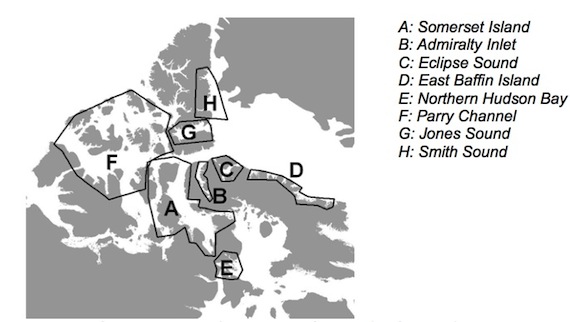
This map from a December 2010 DFO report shows the new narwhal management units which DFO wants to use as a basis for a new narwhal management plan.
(0) Comments