

Durban deal done — for now
Future remains uncertain
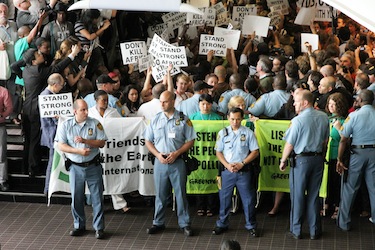
These protesters at the United Nations climate change conference in Durban, South Africa, wanted to see stronger action taken to curb climate change. (PHOTO BY FRANK TESTER)
MIKE DE SOUZA
Postmedia News
A historic climate-change deal faces several hurdles, including criticism from Canada, which says it will drive a hard bargain on new international laws to slash all major global sources of heat-trapping pollution.
The Canadian government left the climate-change conference in Durban, South Africa, saying that the deal brokered early Sunday was fair and provides a framework to develop yet another binding agreement on reducing greenhouse gas emissions and global warming.
But Environment Minister Peter Kent criticized some aspects of the deal, including the extension of the Kyoto Protocol and a green fund to help developing countries, sparking fears that Canada was standing in the way of real progress.
The 195 members of the United Nations Framework Convention on Climate Change finished a recordbreaking, marathon session two days behind schedule and charted a course toward a new regime to be finalized by 2015, in an effort to stave off dangerous human interference with the atmosphere.
“Although these negotiations will be difficult, we are cautiously optimistic that we will reach a new agreement by 2015,” said Kent.
The Kyoto agreement, signed and ratified by virtually all of the countries except the U.S. in 1997, will be extended but will not have the participation of Canada, Russia and Japan, who all said they wanted the other large emitting countries, including China and India, to take on their own commitments.
“We want to avoid another Kyoto-like pact at all costs,” said Kent. “Kyoto was not effective and was not good for Canada. The previous government should not have ratified it.”
Although countries agreed on terms to make a new global green climate fund to support efforts in developing countries to adapt to climate change and promote clean energy growth, Kent said Canada would not provide any new money for the fund until the recipients committed to targets and transparent reporting of their efforts.
Steven Guilbeault, co-founder of Equiterre, a Quebecbased environmental group, credited the European Union, the Alliance of Small Island States and the least-developed countries for leading the summit to its final package. He said the deal could have been much stronger if the Canadian government and its allies had shown more ambition.
“A historic agreement was within our grasp in Durban, but the combined efforts of the U.S., Canada and Japan have undermined a positive outcome here,” said Guilbeault. “We leave with an agreement that does not do enough to take us away from the current path of four degrees Celsius of warming, and towards dangerous climate change.”
Countries have agreed that they must limit global warming to two degrees Celsius of average global temperatures above pre-industrial levels to avoid serious damage to ecosystems and the economy.

The UN’s top climate change official said the new regime would compel countries such as Canada to show leadership and do more.
“They will now engage over the next few years in a very constructive conversation about how the responsibility that lies on every single shoulder is going to be taken forward,” said Christiana Figueres, executive secretary of the UN’s climate change secretariat.
“Of course developed countries will have to take the lead, and they will have to continue to provide funding and technology to developing countries.”
At home, the NDP environment critic was skeptical about whether Kent’s prediction of successful negotiations would come to fruition. Megan Leslie said that although she was pleased to see a deal get done, she didn’t think Canada would have a strong voice in negotiations over the coming years.
“Any step forward, even as small as it is, is a step forward,” Leslie said. “I’m worried it’s too little, too late.”
She said the government’s actions at the conference and Kent’s change of tune as talks went on would marginalize Canada leading up to the 2015 timeline for a binding agreement. The agreement means that over the next four years, the Conservatives don’t have to do much about climate change and get off “scot-free.”
Liberal environment critic Kirsty Duncan was equally skeptical about the deal itself, saying the government’s actions at the conference helped to delay any real action on climate change until 2015.
The longer negotiations drag on, the worse the situation will get, Duncan said.
“The agreement does nothing to reduce emissions,” Duncan said. “The reality is the government continues to ignore the science of global warming.”
The deal was brokered after the European countries used a pledge for a second round of Kyoto commitments as a bargaining chip to get the rest of the parties to accept a mandate for a comprehensive successor regime.
U.S. climate envoy Todd Stern said that the Durban conference “ended up quite well.”
“The [Durban platform] is the piece that was the matching piece with the Kyoto Protocol,” he said. “We got the kind of symmetry that we had been focused on since the beginning of the Obama administration. This had all the elements that we were looking for.”
China’s lead negotiator, Xie Zhenhua, stressed that his country took legally binding agreements seriously and was prepared to honour its commitments. But he questioned why the developed nations were not able to do the same under the Kyoto Protocol.
“We developing countries will be very serious in our implementation of these documents,” said Xie, speaking through a translator. “We are taking actions (and) we want to see your real actions.”
TIMELINE
A few key dates in the history and immediate future of international climate change talks:
1979: First World Climate Conference takes place in Geneva, Switzerland.
1992: United Nations Framework Convention on Climate Change created. Under the international treaty, countries agreed to consider whatever they could to limit climate change.
1994: UNFCCC comes into force.
1995: Climate talks begin on binding agreement on reducing global warming.
December 1997: Kyoto Protocol signed, laying out legally binding emission targets for developed countries.
2007: Bali Road Map adopted, laying the foundation for funding of technology and infrastructure to developing and developed countries to reduce greenhouse gas emissions.
2008: First Kyoto commitment period begins.
2009: Copenhagen Accord drafted with adopting countries agreeing to non-binding emission reduction targets.
2010: Cancun Agreements create a Green Climate Fund to help developing nations deal with the effects of climate change and reduce their global-warming causing emissions.
2011: Durban conference ends with countries agreeing to new climate change regime to be finalized by 2015.
2012: End of first Kyoto commitment period.
2013: Beginning of second Kyoto commitment period.
2015: International deadline to finalize new agreement on emission target reductions.
Source: United Nations Framework Convention on Climate Change
(0) Comments