


From glacier to glacier: Nunavut meets Nepal
“Looking at the children, I saw myself”
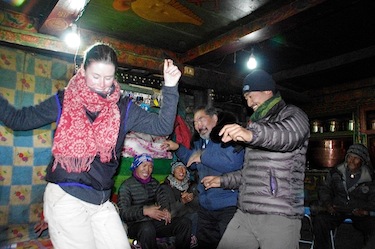
David Iqaqrialu and Shari Gearheard dance with their guide Dhawa Lama to traditional music after dinner with their local hosts in Tsum. (PHOTO BY HENRY HUNTINGTON)
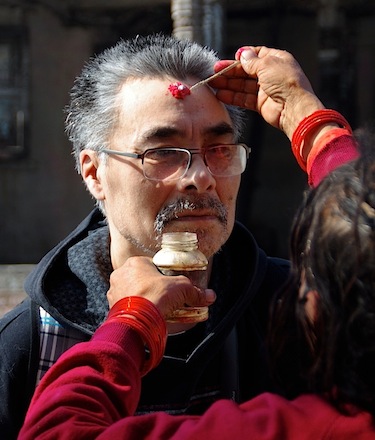
Laimikie Palluq gets a “tika” at a temple in Kathmandu. The tika represents the “third eye” and the idea of meditation and spiritual enlightenment. (PHOTO BY HENRY HUNTINGTON

The capital city of Kathmandu, Nepal is full of colours, sounds, and smells. (PHOTO BY HENRY HUNTINGTON)
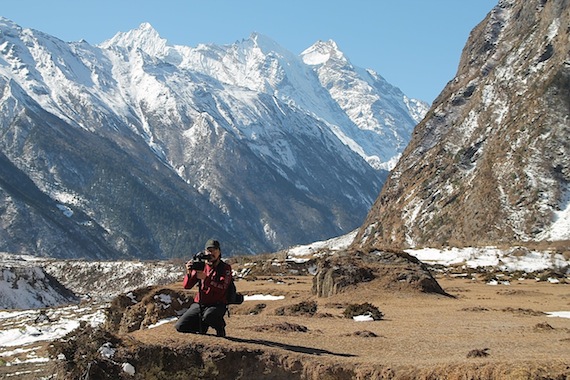
Mike Jaypoody films in the scenic Tsum Valley (PHOTO BY SHARI GEARHEARD)
Ask four Nunavummiut from Clyde River about their recent two-week trip to Nepal, and they’ll tell you 10,000-kilometre journey to the Himalayan country was “a trip of a lifetime.”
Hunters Laimikie Palluq and David Iqaqrialu, along with Mike Jaypoody, a young filmmaker and computer technician, and University of Colorado researcher Dr. Shari Gearheard travelled to Nepal Feb. 3 to 17 as part of a National Science Foundation-funded research project.

The project, led by Gearheard — who’s lived in Clyde River for the past eight years — and her Alaska-based colleague Dr. Henry Huntington, brought local snow and ice experts from Nunavut and Nepal together to talk about shared changes in the environment.
That’s because, although far apart, the Arctic Canadian and high-altitude Himalayan regions of Asia both depend upon snow and ice — and that environment of snow and ice is changing.
The impact of climate change wasn’t the only similarity the Nunavut group noticed between Nepal and Nunavut.
After visiting Nepal’s capital city of Kathmandu, seeing sites, and meeting with local environmental organizations and researchers, the group then travelled to the Tsum Valley.
There, residents of Tsum live a life close to the land: they farm and herd as their ancestors have done for generations.
Tsum, opened to foreigners only since 2008, is considered to be a sacred valley in Nepal, a place where all life is protected (it has the special designation of a ‘non-killing’ valley).
While in Tsum, the group from Nunavut stayed with a local family.
And, for the visiting Inuit, life in Tsum reminded them of growing up on the land of northern Baffin Island, before there were any settlements.
“Looking at the children, I saw myself,” said Iqaqrialu, referring to the small children he saw carrying firewood, helping with lifestock, or doing other chores in the village.
“I used to help my father just like they are doing.”
The Nunavummiut also saw how many of the environmental changes occurring in Tsum are similar to those experienced in Nunavut, during meetings with the people who live in the Tsum Valley.
“They are seeing many of the same changes, such as rapidly receding glaciers, changes in weather patterns, and some observations of new birds and animals,” said Gearheard.
And, like in Nunavut, it’s not only the physical environment that’s changing.
Tsum residents talked about social changes they face, such as a more rapid pace of life with the introduction of modern conveniences (the valley is only now getting electricity, satellite television access, and tourism).
A proposed road through the valley also creates worries about what changes may come along with that project.
Now that they’re back from Nepal the Clyde River travellers hope to share what they learned with their community and other Nunavummiut.
Jaypoody, who brought along his video cameras on the trip, is now editing the footage for a film.
Jaypoody and the others plan to show their videos and photos at a community gathering in Clyde River, to give their friends and family at home a better idea of what they saw and learned in Nepal.
Visiting the far-away country has helped them all appreciate what they have at home and the special aspects of their own culture.
“I will be talking about this to everyone, for a long time,” said Iqaqrialu, also an instructor at the Piqqusilirivik Cultural School in Clyde River.
With files from Shari Gearheard
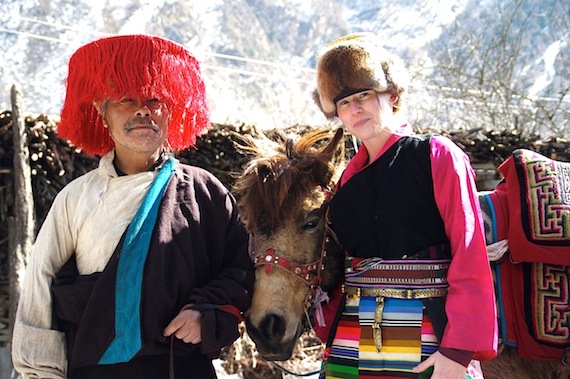
:Laimikie Palluq and Shari Gearheard dressed in the traditional clothing of Tsumbas, the people of Tsum Valley in Nepal. (PHOTO BY HENRY HUNTINGTON)
(0) Comments