


Many Nunavut government workers don’t know their Inuit language rights: languages commissioner
“They still do not feel free to use their preferred official language in meetings and when writing”
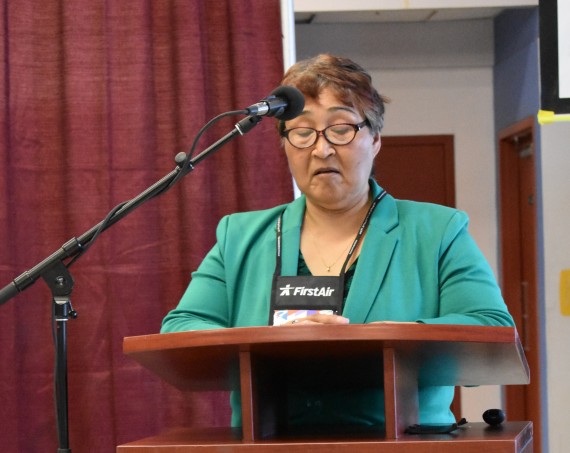
Nunavut Languages Commissioner Helen Klengenberg. A report by her office says that the Nunavut government has work to do to ensure its workers know their language rights. (FILE PHOTO)
The Office of the Languages Commissioner of Nunavut says the territorial government needs to ensure its employees know they have the right to work in the Inuit language.
In the commissioner’s annual report for 2017–18, the office shares the results of a survey it conducted in 2017. In it, 42 per cent of Government of Nunavut employees surveyed said they did not know they had protected rights to speak or write in Inuktut in the workplace.
That provision is spelled out in sections 11 and 12 of the Inuit Language Protection Act.
The survey also found that 77 per cent of the GN’s supervisors were aware that employees had the right to use Inuktut in the workplace, although somehow that message wasn’t getting across.
“The limited knowledge of the law and the lack of awareness-raising initiatives about the right to work in Inuktut has created an environment where employees do not know their rights and where management does not know its obligations,” the report said.
“Years have passed since employees were granted the right [in 2008] to work in the Inuit language in territorial institutions, yet they still do not feel free to use their preferred official language in meetings and when writing.”
Of the 106 Inuktut-speakers who took part in the survey, 73 per cent of them said internal communications are rarely or never conducted in Inuktut in the workplace.
The office, headed by Languages Commissioner Helen Klengenberg, said the GN has a role to play in changing that.
To that end, the commissioner’s office called on the GN to communicate details on employees’ right to work in Inuktut, which should include a zero-tolerance policy against any discrimination.
The office also said the GN’s recruitment policy must make clear that applicants can apply for jobs and be interviewed in Inuktut.
Other recommendations the office made came directly from respondents’ suggestions. Some said they need access to more language training and technology in the workplace, including Inuktut-friendly software and keyboards, which would help employees expand their terminology.
Many respondents also said that using Inuktut in the workplace would be easier if they had a larger and more supportive network of fellow Inuktut-speakers.

“Our goal is for anyone in Nunavut to be able to live their lives in the official language of their choice,” the commissioner’s office said.
In Nunavut, there are three official languages: the Inuit language (Inuktitut and Inuinnaqtun), or Inuktut, English and French.
But with English often serving as a dominant language, there is territorial legislation in place like the Official Languages Act and the Inuit Language Protection Act to give Nunavut’s Inuit and francophone communities the means to safeguard their own languages.
According to 2016 census data, Inuktut (which encompasses both Inuktitut and Inuinnaqtun) is the mother tongue of 63 per cent of Nunavummiut.
The number of Inuktut mother tongue speakers has increased by more than a thousand speakers from 2011, although the overall percentage of those speakers has decreased by 4.5 per cent in recent years.

Office received 13 language complaints last year
During the 2017–18 fiscal year, the Office of the Languages Commissioner of Nunavut recorded 13 language-related complaints.
Of those concerns, three were related to territorial institutions, four to municipalities, three to federal institutions, and another three to the private sector.
Eleven complaints were made about the provision of Inuktut, and two related to the use of French.
Two of those complaints stemmed from municipal elections in Kugluktuk and Coral Harbour, where the hamlet offices only posted election notices in English.
The complaint from Coral Harbour came after the fact, but the Kugluktuk complaint forced the hamlet to reschedule its election.
The other complaints were made to inform the office of a lack of Inuktut-language communications at a number of different private and public institutions.
The office also reviewed written communication put out by territorial institutions in 2017, including news releases, posters and public service announcements.
Among the 336 communications the office reviews, 89 per cent were done in all of Nunavut’s official languages—up from 87 per cent the previous year—and published simultaneously.
But a part of the Inuit Language Protection Act which came into force in mid-2017, which requires private sector organizations and federal departments and agencies to offer their communications and services to the public in Inuktut, has been slower to catch on.
Section three of the act requires those organizations and bodies to translate signs, posters, commercial advertising and even customer services in Inuktut, which the report acknowledged can be timely and costly for smaller organizations.
But the office said it was “facing resistance” from the federal government on that requirement, prompting meetings with the Treasury Board of Canada.
You can read the full report in Inuktut, English or French, below:
TD-69-5(2)-OLCN-2017-2018-AnnualReport by NunatsiaqNews on Scribd
(0) Comments