


Group heads to Clyde River to assess solar power potential
Greenpeace hoping trip helps to strengthen relations with Inuit
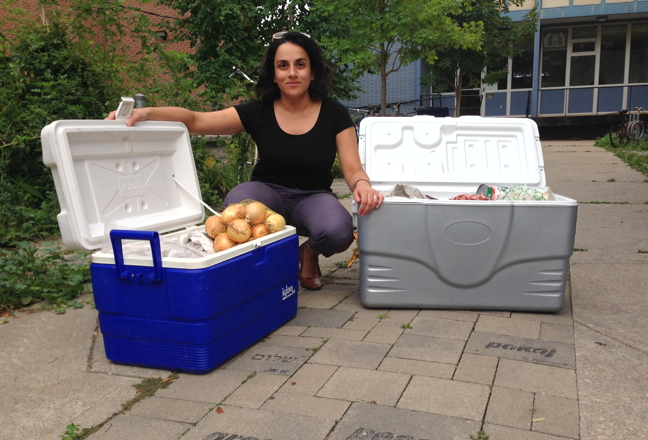
Greenpeace Canada staffer Farrah Khan poses with a couple of coolers of food she’s bringing to Clyde River this week for a feast the environmental organization plans to host in that North Baffin community. Clyde River Mayor Jerry Natanine brought the silver cooler full of country foods to share during court proceedings in Toronto in April so Khan said she’s returning the gesture. (PHOTO COURTESY GREENPEACE CANADA)
It’s fair to say that solar power in the North has enormous potential… when there’s sun.
So what if you could install solar panels on a building in Nunavut, feed power into the local grid and reduce that building’s need for power during the sunny season?
Duncan Martin, a lead solar panel installer and technician with Vancouver Renewable Energy, is on his way to Clyde River this week to assess the potential for solar energy in a remote northern community, to discuss options with local people and tell them roughly what it would cost.
“It’s one of those scenarios where you don’t know what you’re dealing with physically until you’re on the ground,” Martin said, on the phone from Vancouver Sept. 21.
“I’m just thrilled to see a community like this. There are so few opportunities to go up there with flights costing as much as they do. And to do it with this purpose, of looking into solar for Clyde River is icing on the cake.
He’s heading north courtesy of Greenpeace Canada which is sending a few of their staff along with him to grow their relationship with the people of Clyde River.

Greenpeace Canada has been working with Clyde River Mayor Jerry Natanine, the hamlet, and the local Nammautaq Hunters and Trappers Organization in their legal challenge against seismic testing off the east coast of Baffin island.
It was during Natanine’s visit to Toronto in April — when he was attending Federal Court of Appeal proceedings on seismic testing — that Greenpeace organizers asked the mayor what other expertise they could offer the community.
Natanine said efforts had been made in the past to explore solar energy use in, but it never amounted to anything and he suggested that would be a good project to pursue.
Greenpeace happens to know a few things about renewable energy. So they sought out Martin to conduct a local solar power assessment and their prime candidate at this point is Nunavut Arctic College’s Piqqusilirivvik building, which houses the culture school that opened in 2011.
Eric Corneau, NAC’s Nunatta Dean, was caught off guard when asked about the idea Sept. 22. He said he couldn’t find anyone at the college who had information about the planned solar assessment.
The Iqaluit Arctic College campus has been outfitted with solar panels since the late 1980s, Corneau said, and though technology has advanced since then, the old panels are still operating at about 75 per cent capacity.

He said he would definitely be interested in a solar panel installation at Piqqusilirivvik, but he’d like to hear some details first.
Also making the trip to Clyde River is filmmaker David Lavallée who is in the process of editing his next feature documentary on extreme oil extraction, which includes a segment on seismic testing and offshore oil exploration in Clyde River.
Lavallee is returning to North Baffin now on contract for Greenpeace to make a short film on the solar pilot.
If Martin deems the project viable, Greenpeace will use Lavallee’s film to crowd-source money to purchase and install the solar panels and to train local people on how to troubleshoot problems.
Martin said he’s helped to install solar systems on the Pacific Gulf Islands and in northern British Columbia but Clyde River would be much more remote and challenging.
He first has to see whether and how such a system could be connected to the local diesel “micro grid.”
Several things will have to be considered, Martin said, including fluctuations in power from the local grid, shade and the local climate.
Because the sun is low in the sky at that latitude, it would make sense to install the solar panels on a south-facing side of a building rather than on the roof, he said.
“It’s about reducing the demand for diesel but by no means are we coming up with a full alternative to it,” Martin said. “By being grid-tied, you can basically cut down the total amount [of diesel energy] needed.”
While it’s impossible to say in advance what such a project would cost, he estimated a similar-sized project in the South would be about $25,000. For Clyde River, you’d have to add the price of shipping equipment and spare materials.
If all goes well, Greenpeace would like to install the solar panels next summer as part of their effort to showcase alternatives to oil and gas usage, even in the North.
Greenpeace staffer Farrah Khan, an Arctic campaigner, will be accompanying Martin to Clyde River and is excited about the trip.
But she said she’s prepared for opposition from people who still hold a grudge against Greenpeace for decimating the northern seal skin economy and who might consider this a publicity stunt.
“I fully understand there are probably a lot of people who live there who still don’t trust Greenpeace, for good reason,” Khan said.
“And I think my role, if encounters like that arise, is just to listen. For me to understand fully the impact of the anti-sealing campaign of the 1970s and 80s will help me to improve our work going forward.”
The group does have the official sanction of Clyde River hamlet council who passed a motion to welcome them to town and to support their solar project.
Greenpeace members Khan and Jessica Wilson, along with Lavallee, are hoping to meet with hunters and trappers association members and hamlet councillors while in town and also host a community feast.
Khan said she has filled a couple of coolers of food to bring to Clyde for that feast.
One of those coolers arrived in Toronto with Natanine in April, filled with country foods the northern mayor brought to share with supporters. It’s fitting, Khan said, to return north with it, full of food again.
(0) Comments