


Inuit in Ottawa gather to combat suicide, celebrate life
Honest stories, earnest solutions, to high rates of Inuit suicide
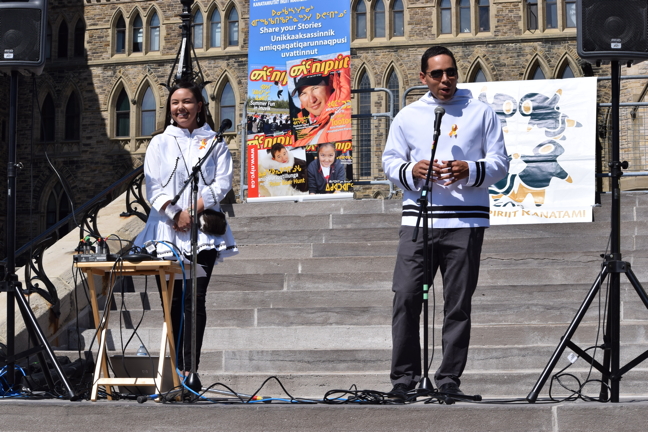
Natan Obed, president of the Inuit Tapiriit Kanatami, speaks about suicide in the North and how ITK is hoping to stem the tide, at a suicide prevention rally on Parliament Hill Sept. 9. (PHOTOS BY COURTNEY EDGAR)
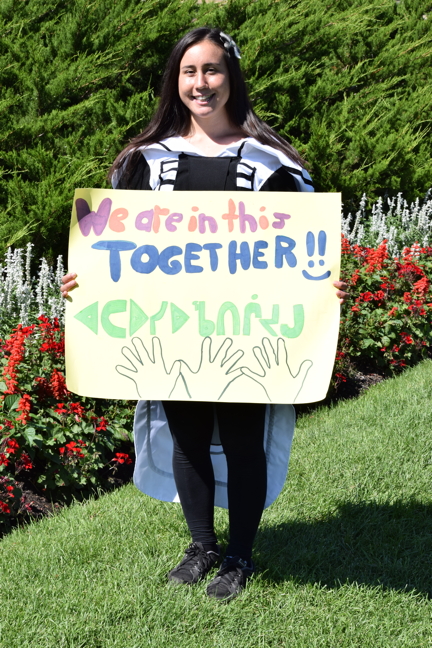
Katherine Takpannie, who attended the Celebrate life suicide prevention rally on Parliament Sept. 9, is sadly typical of many Inuit who have struggled with, or been impacted by, suicide.
OTTAWA—Katherine Takpannie, a 27-year-old student with the Ottawa-based college program, Nunavut Sivuniksavut, doesn’t hide the scars etched all the way up her left forearm. She points to the line closest to her elbow and says she made that one when she was 13.
Takpannie was living in Ottawa when she was 13 and ended up at the Children’s Hospital of Eastern Ontario as a result of the cut.
She spent 13 hours at CHEO, six of those hours passed out in a hospital room without being seen by a physician. She says she was “forgotten about” until someone eventually came into what they thought was an empty room, saw her blood-soaked bandages and determined that she needed stitches.
Then after a few more hours, staff sent her home, with no psychological assessment and no referral for mental health services.
Takpannie was on Parliament Hill Sept. 9 to participate in a World Suicide Prevention Day event and she took some out time to tell Nunatsiaq News why she was there.
She spent most of her early life in foster care. At age six months, she was taken from her parents due to their substance abuse problems and remained in foster care until she was 12.
She tried living with her mother again briefly in her teens but decided she would be better off living on her own. She was 15. Now, at age 27, Takpannie said she has felt more than her share of impact from suicide.
Her cousin committed suicide at the age of 13. The girl’s father, Takpannie’s uncle, has had severe drinking problems ever since.
“A hard life is the best way I can describe it,” Takpannie said.
“When my mom comes down to bring char and stuff we all sit down to eat as a family, and try to get him to stop drinking.”

Her aunt “drank herself to death” by the age of 52.
“I used to be very sad as a teenager,” Takpannie said. “One of my favourite quotes is, ‘This too shall pass.’ You’re not going to be happy forever, you’re not going to be sad forever—for every emotion: this too shall pass.”
But even that message doesn’t always bring solace.
When Takpannie was in Iqaluit recently for her grandfather’s funeral, her sister saw a woman by the water’s edge who was about to end her life and she was able to talk her out of it.
But the woman kept going back there on different days. With each attempt, Takpannie’s sister would intervene again and again. The woman did not end her life while they were in Iqaluit, but they don’t know what happened after they left the city.
These are just a few stories Takpannie can tell about how suicide has affected her and her family. And it’s why she attended the annual Celebrate Life event at Parliament Hill.
Organized by Inuit Tapiirit Kanatami and the National Inuit Youth Council, the event also involved Pauktuutit Inuit Women of Canada, the Ottawa Inuit Children’s Centre, Tungasuvvingat Inuit and the Ottawa Suicide Prevention Network.
And it followed the release of ITK’s National Inuit Suicide Prevention Strategy this past July—the first national strategy created by an Indigenous organization in Canada.
Inuit have the highest suicide rate in Canada, but ITK’s national strategy—coupled with the promise of $9 million in federal funding announced the day of its launch—is aiming to combat that.
“Suicide and mental health issues affect Inuit in a way that is different from most other Canadians,” said Natan Obed, president of ITK, at the Sept. 9 event.
“A lot of the challenges that we face today have roots in the ways we were coerced into communities. Many people did not live in communities before 1950. So between the years of 1950 and 1970, our culture went through a massive transformation, and a lot of our social inequity, the root of our mental health issues and the emergence of suicide as an issue that affects Inuit, only happened recently.”
According to Obed, it wasn’t until the 1970s that Inuit had an elevated rate of suicide in relation to other Canadians.
“I’m encouraged by that,” Obed said. “It tells me and it should tell all of you that this isn’t something that is just about Inuit. It isn’t something that is because of our ethnicity or because of where we live. It is because of the situations that we have been in.”
The ability of Inuit to overcome challenges and loss is incredible, he said.
“In the Arctic, where people hunted whales with harpoons and kayaks, and people hunted polar bear with dogs and spears,” Obed said, “these are things that other Canadians marvel about, and that we can take pride in that that is our legacy.”
The Canadian government is listening, he said.
“We have never released a strategy at ITK that was met with commitment on day one from the Government of Canada to help implement it, but also do it in partnership with us—not dictating to us how the Canadian government has to be first and foremost.”
But this is just the beginning, he said, and ITK continues to work hard to improve social equity, housing and healthcare delivery in Inuit communities.
“Our resilience is unparalleled and paramount to our being and our culture as a people,” Maatalii Okalik, president of the National Inuit Youth Council, told the crowd.
“We have an incredibly bright future,” Okalik said. “Despite all of the risks that we face as a people, we can get through this.”
(0) Comments