


Iqaluit council committee gives GN green light to “interim” jail
“Everybody that’s supporting us understands the urgency of the situation”
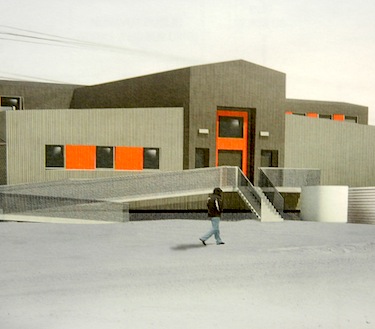
An artist’s depiction of how the new “interim” jail will look taken from the cover of blueprints prepared by Stantec Architecture Ltd. for the Government of Nunavut.

Chris Stewart, manager of capital and special projects for Nunavut’s justice department, and Jean-Pierre Deroy, right, its correctional services director, provide details about the minimum-security interim jail that the Government of Nunavut wants to build in Iqaluit during a special city council committee meeting on March 19. (PHOTO BY PETER VARGA)
(Updated)
In a decision that came down to one vote, Iqaluit city council’s lands and planning committee passed a motion allowing Nunavut’s department of justice to build an interim minimum-security facility for inmates this year.
The decision now goes to the entire council March 26 for consideration and final approval.
Council’s lands and planning committee passed the motion March 19, in a 4-3 vote decided by chairman Kenny Bell.
The decision is the first step towards a go-ahead for the new facility which will contain 24 cells and 48 beds. It’s designed to relieve overcrowding at the Baffin Correctional Centre – which now accommodates 115 inmates in a building designed for 60, according to Jean-Pierre Deroy, corrections director at Nunavut’s justice department.

The new jail would be located next to BCC.
“Certainly this is a long time coming,” BCC warden Ray Fast commented after councillors passed the motion. “First of all, for numbers of the inmates, the population is rising considerably, and, at the same time, we have a building that is deteriorating, so if you add those two things together it just exacerbates the problem.
“This will give us an opportunity to move the minimum security [inmates] into the new facility.”
It will also allow the justice department to bring the BCC, now more than 25 years old, “up to standard a little better and actually make it more bearable for the individuals that have to stay there until such time as a new facility can be built,” Fast said.
The motion passed after impassioned testimony by Deroy, who underlined the seriousness of overcrowding at the prison, where “it’s like trying to take a can of sardines and trying to stuff more sardines in there.”
Deroy and Chris Stewart, manager of capital and special projects for Nunavut’s justice department, presented plans for the new facility to council, and took their questions before the vote was passed.

The building has been referred to variously as an “interim jail” and a “relief structure,” but Deroy and Stewart called it the “Baffin Correctional Centre Interim Housing,” when presenting it to councillors.
The new building’s “interim” designation means it will be used to relieve overcrowding at the prison, said Stewart.
But the building will be a permanent structure that “can be re-purposed” for other uses by corrections in the future, he said.
Councillors said they were concerned about the location of the new building, near the BCC and close to the airport and the city centre.
“I think if we could have something on the Road to Nowhere, I would have no problem with that,” councillor Joanasie Akumalik told the justice officials. “But getting off a plane, especially in the tourist season, and having to drive through the community to the hotel, you see the facility right in your face. I think it’s not a good idea.”

Deroy said the new building — which has evolved from a temporary tent-like structure to a solid, steel girded-structure with a price tag of up to $15 million, was the best possible immediate solution to the “terrible problem of overcrowding” at the correctional centre.
“This is within my means to find funding for a project like this,” he told council. “Usually a project like that takes three to four years, and we’re breaking a record with this. Everybody that’s supporting us understands the urgency of the situation.”
Deroy emphasized that urgency with figures showing an astounding increase in the number of serious incidents by inmates at the prison.
In 2011-2012, he said, 233 incidents of assault by inmates on staff were recorded, compared to just 12 in 2001, when the prison was already just above its original capacity of 62 inmates.
“Last year was the first time we medevaced people down because of serious fights,” Deroy said. “Out of the 233 incidents, 76 staff were injured, either from breaking up a fight, or getting assaulted.
“Last year one of our nurses got punched in the face. You don’t hear about these problems because we deal with them and we try to hang on as best we can with what we have right now.”
Staff dealt with two near-riots last year, not to mention a fire last November where “we came close to losing a building,” Deroy told councillors.
The current inmate population of 115 puts corrections in “major trouble,” he said.
Even though prisoner-exchange agreements with other provinces and territories help relieve pressures at the facility, the BCC’s population is “still on a regular basis over 100.”
The federal government’s passing of omnibus crime Bill C-10, the Safe Streets and Communities Act, is expected to ramp up the urgency of a new larger facility, Deroy said.
The Safe Streets and Communities Act, would amend the Criminal Code, the Youth Criminal Justice Act and other federal laws to limit the use of conditional sentencing, create more mandatory minimum sentences and make the youth justice law more tough.
Corrections expects the bill to add “another 25 per cent on top of our regular increase” in prison population over the next three years.
Even before the passage of the federal bill, the justice department had been planning to build a larger prison to replace the current one, he said, so that Nunavut will not have to rely on other provinces and territories to relieve the overflow.
Some 50 territorial offenders are now serving time in the Northwest Territories and Ontario, he said.
Deroy expects Nunavut Corrections will need space for 300 prisoners over the next 10 to 15 years.
The new interim facility, with a capacity of 48 minimum-security inmates, is expected to include prisoners with mental health issues.
(0) Comments