


Iqaluit dog attack victim wants Nunavut-wide ban on pit bulls
Iqaluit resident suffered 100 puncture wounds

Annabella Piugattuk with her daughter Aqpakuluk, aged two. The Iqaluit mother wonders why authorities never checked with her about the pit bull dog attack she suffered in July 2012, which she alleges amounted to an attempted murder. She says that one year later, she and her two daughters remember the incident all too well. (PHOTO PETER VARGA)
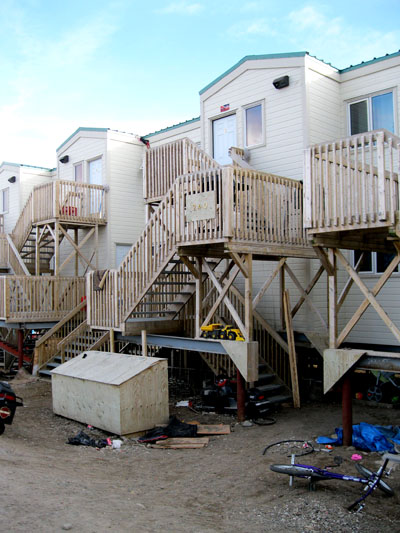
Annabella Piugattuk last year lived in unit 6 on the top floor of building 240, one floor above a unit occupied by a woman whose pit bull dog prowled the grounds below. The dog attack left Piugattuk with about 100 puncture wounds from dog bites in an attack that took place in front of more than 15 witnesses, she said. (PHOTO PETER VARGA)
Almost a year to the month after she was hospitalized with extensive puncture wounds inflicted by a pitbull dog and its owner, Annabella Piugattuk of Iqaluit wants to set the record straight about what happened.
She said it’s time for local authorities to get their act together on dog regulations.
And she wants dogs bred for fighting, such as pit bulls, banned from Nunavut.
“They’re not necessary dogs,” Piugattuk said. “I would rather have only Inuit and husky dogs in Nunavut.”

Piugattuk, 30, withstood an attack from her neighbour’s pit bull on July 15, 2012.
She says her neighbour, Saata Koochiajuke, then 23, directed her dog to “attack” and “kill” Piugattuk after a brief argument inside Piugattuk’s apartment, where Piugattuk lived with her two infant children and a roommate.
That attack left her hospitalized for almost three weeks.
An agreed statement of facts read in court Aug. 28, 2012, when Koochiajuke pleaded guilty to multiple charges arising from that and two other similar incidents, do not describe the attack accurately, Piugattuk said.
After her guilty pleas, Koochiajuke was sent to jail for 16 months and ordered to serve two years’ probation following her release from jail. She is forbidden to own a pet during her period of probation and must attend Alcoholics Anonymous meetings.
Agreed statements of fact, usually read into the record by Crown prosecutors, are often crafted by lawyers as part of plea agreements — when accused persons agree to plead guilty in exchange for negotiated sentences.

In her case, Piugattuk’s attacker entered guilty pleas to aggravated assault of a police officer, aggravated assault, assault with a weapon, uttering threats, resisting arrest and two counts of breach of probation.
But Piugattuk believes the trial’s outcome would have been very different had she been able to tell the court about what happened to her.
The Iqaluit resident said she was never asked to provide a statement and did not attend Koochiajuke’s court appearances.
She left Nunavut for British Columbia in late August, just before the trial, for a 10-day visit with an aunt who invited her “to relax” and recuperate.
“I was pretty shocked and traumatized still,” Piugattuk said.

At the time of the attack, Koochiajuke and Piugattuk had been neighbours for about three years in building 240, a multiplex apartment building on Umiaq Crescent in lower Iqaluit behind the Arctic Survival store.
The trouble started when the neighbour living beneath Piugattuk’s second-floor unit got a young pit bull, named Shadow, about six months before the attack, she said.
“I made complaints about Saata’s dog Shadow to the Iqaluit Housing Authority and the City of Iqaluit, many times.”
Her complaints ranged from the dog droppings that Shadow left “everywhere” around the property, to a dog-restraint chain that was not short enough to keep the hostile animal away from the stairs leading up to her unit.
Piugattuk’s complaints did nothing to resolve problems with the dog and its owner.
In the six-week period prior to the July 15 attack on Piugattuk, responses by Iqaluit municipal enforcement officers and the RCMP didn’t resolve anything either.
On June 2, 2012, Koochiajuke attacked a municipal enforcement officer who tried to subdue the dog with a tranquilizer gun. She spent a night in jail and returned home to her dog.
In the second incident, on July 5, 2012, an intoxicated Koochiajuke ordered her dog to attack a taxi driver who had sheltered a pedestrian from the threatening animal.
The driver suffered puncture wounds from dog bites. Municipal enforcement officers detained the dog and the RCMP detained its owner.
But dog and owner returned home and nothing would be resolved until after the attack on Piugattuk.
On July 15, Piugattuk, her roommate and niece entered their unit from the front porch when they saw Koochiajuke and her dog approach.
Someone neglected to lock the door when they entered the unit, Piugattuk said, and the women tended to her two daughters, aged one and three.
“I’m breastfeeding my baby,” Piugattuk said. “My niece is braiding the three-year-old’s hair, and we’re on the couch watching TV.”
The door opened, she says.
“Saata storms in and walks towards me and starts screaming ‘So you hate me, so you hate me and my dog!’
Piugattuk ordered her neighbour to leave, she said. When her neighbour refused, the mother grabbed Koochiajuke by the shirt and pulled her out.
“When I opened the door, she pushed me out of my house and she yelled right away, ‘Shadow, kill.’ And that’s where my first bite-marks are from, they’re on my left leg. And then the dog started pulling me down.”
The dog and owner each attacked Piugattuk on her porch at the top of the stairs. The dog bit her repeatedly while Koochiajuke kicked and pulled her hair. The ordeal lasted 20 minutes and didn’t stop until police arrived.
“I even saw little kids on their bicycles just watching me getting mauled. There was like over 15, maybe 20 people watching and witnessing this attack and they were all trying to tell them to stop it but they both wouldn’t stop.”
Police shot the dog with a tranquillizer gun a few times, but to no avail, she said, before they shot it dead with a firearm.
Piugattuk protected her head and neck during the attack, but suffered about 100 puncture wounds to her arms, legs, waist, and other unprotected areas of her body.
“I don’t want to die at this age, because I have babies and they need me,” she said.
Piugattuk said she was completely incapacitated for three days after the attack, and hospitalized for two and a half weeks.
She believes Koochiajuke should have been charged with attempted murder for the attack.
“Everybody that witnessed heard her say ‘kill her Shadow, kill,’” she said.
The attack has left Piugattuk’s daughters, now aged two and four, fearful of dogs. She and her children also suffer bouts of insomnia due to the attack, even one year later.
“My two-year-old says ‘anaana, anaana, puppy no bite me, puppy no bite.’ She says that a lot in her sleep,” Piugattuk said.
Piugattuk has made her living as an actress, having starred in the popular 2003 film The Snow Walker with Barry Pepper, a performance that gained her a nomination for a Genie award.
She also appeared in the short film Hunt, which was shot in Iqaluit in 2011.
But she has had a hard time dealing with the ordeal as a single mother.
She credits family and friends for helping her get through it. They suggested she take the incident to court, in view of the City of Iqaluit and the Iqaluit Housing Authority’s non-response to the incidents that led up to the assault.
She has declined to so, but has since checked with lawyers about her options.
“This was preventable in many areas,” says Piugattuk, pointing out that the dog and owner had attacked other residents before her ordeal, and that Iqaluit Housing broke a policy barring tenants from keeping pets.
She also wonders how the investigation and sentencing unfolded so quickly.
“It really hurts,” she says. “I don’t even know if all the witnesses made a statement. I wished and I prayed that the RCMP did their job in asking witnesses to come forward.”
She says the attack has not affected her aspirations as an actress, which she continues.
Piugattuk’s main concern now lies with seeing her kids grow up well, and seeing to it that vicious dogs are kept off the streets of Iqaluit.
(0) Comments