


Municipal association offering to help with Iqaluit’s money troubles
NAM pushing for hotel tax, energy savings
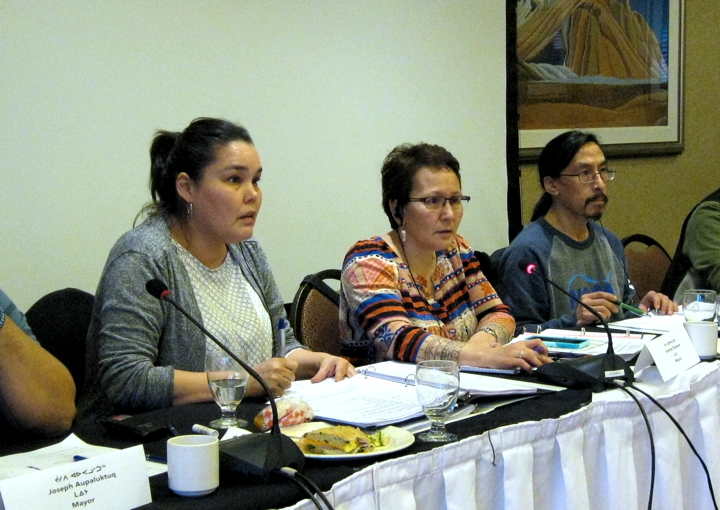
Nunavut Association of Municipalities executive director Madeleine d’Argencourt, left, and president Jeannie Ehaloak, preside over the association’s last annual general meeting in Iqaluit in November 2014. (PHOTO BY PETER VARGA)
The Nunavut Association of Municipalities promises to help facilitate extra revenues and cost savings for the City of Iqaluit starting with a proposal to allow hotel taxes.
“Typically hotel taxes in Canada have been used to support local infrastructure, support recreation facilities, tourism, and offset expenses,” Madeleine d’Argencourt, executive director of the association, told Iqaluit city council, March 10.
“This would be an amazing alternative revenue generation possibility for the city,” she said.
The territorial government must authorize the tax through the Cities, Town and Villages Act.
“That’s the piece that my office is working on right now,” d’Argencourt said. “The local municipal government sets the value and the rules within their bylaws.”
The association is also working directly with the city on an initiative to replace all streetlights with more energy-efficient LED lights, which consume 35 per cent less power.
LED systems are suited for “extreme temperatures of the North,” d’Argencourt said. Conversion to LED in Yellowknife has so far saved enough energy to provide power to 108 homes for a year, she said.
The association’s call for a hotel tax was one of several resolutions NAM passed at its annual general meeting last November. Others favoured by Iqaluit included three resolutions related to waste management which would address overflowing garbage dumps in Nunavut.
They included support for a territorial “backhaul program” to ship hazardous, recyclable, and bulk waste out of communities. Added to this was a “derelict vehicle” resolution calling for the Government of Nunavut to create a “license, tax or policy” to ensure all vehicles in the territory be shipped out once they have expired.
NAM also stated its support for a “solid waste management strategy,” which the government is pursuing.
D’Argencourt said the backhaul and derelict vehicle programs have stalled for the moment, although “it’s something my office is pushing heavily.”
Coun. Kenny Bell said he is skeptical of the association’s ability to lobby the government.

“We send resolutions, and nothing happens. It’s tiring,” he said.
D’Argencourt replied her association had been “defunct for many years” prior to her term, which began in 2014.
“I’ve worked hard in the past year to rebuild the profile and reputation of NAM,” she said. “We work hard to ensure that every fee we receive from members is used wisely.”
From her perspective, during her first year as executive director of the association, d’Argencourt said she has noticed smaller communities of the Baffin region have faced common hardships of their own.
Several Baffin communities have experienced high staff turnover among senior administrative officers, “which has led to a lot of capacity issues,” she said.

“I don’t know why that is, but as you know yourself, you’re going through a recruiting process,” she said, recalling that Iqaluit has been searching for a new chief administrative officer since last fall.
(0) Comments