


Name for ancient fish species honours late Martin Bergmann
“Holoptychius bergmanni” named for Polar Shelf director who died in 2011 Resolute Bay crash
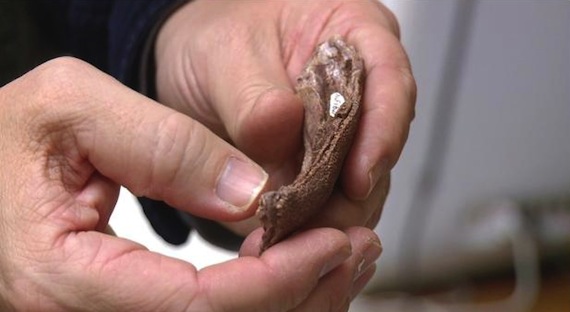
Dr. Ted Daeschler holds a lower jaw fossil of Holoptychius bergmanni, a new Devonian fish species he and colleagues discovered in Nunavut. (HANDOUT PHOTO)
A team of researchers from the United States have named a new fossil fish species “Holoptychius bergmanni” in honour of the late Martin Bergmann, former director of the Polar Continental Shelf Program, the organization that provided logistical support during the team’s Nunavut research trips.
Bergmann was killed in a crash of First Air flight 6560 in Resolute Bay in August 2011, shortly after the team’s most recent field season in Nunavut.
“We decided to choose Martin Bergmann to honour him, not ever having met him, but with the understanding that his work with PCSP made great strides in opening the Arctic to researchers,” said Jason Downs, a researcher from Drexel University in Philadelphia, in a university news release. “It’s an invaluable project happening in the Canadian Arctic that’s enabling this type of work to happen.”
The Polar Continental Shelf Program assisted the research team with many aspects of expedition logistics including flight operations to carry supplies and research personnel to research sites on Ellesmere Island.
The fossil specimens of Holoptychius bergmanni that researchers used to characterize this new species come from multiple individuals, the news release said. The fossil bones include lower jaws with teeth, skull pieces including the skull roof and braincase, and parts of the shoulder girdles. The complete fish would have been two to three feet long when it was alive 375 million years ago.
“The three-dimensional preservation of this material is spectacular,” said Ted Daeschler, also of Drexel University, in the news release. “For something as old as this, we’ll really be able to collect some good information about the anatomy of these animals.”

Daeschler and colleagues intend to return to Ellesmere Island for another field expedition this summer to search for fossils in older rocks at a more northerly field site than the one where they discovered T. roseae, known as Tiktaalik, and H. bergmanni.
Daeschler said Holoptychius and Tiktaalik were both large predatory fishes adapted to life in stream environments.
“We call it a ‘fish-eat-fish world,’ an ecosystem where you really needed to escape predation,” said Daeschler, describing life 375 million years ago in a geological era called the Devonian. “It was a tough world back there in the Devonian. There were a lot of big predatory fish with big teeth and a heavy armor of interlocking scales on their bodies.”
This is the second move by researchers to give a legacy to Bergmann’s Arctic research activities.
A research vessel docked in Cambridge Bay, operated by the Arctic Research Foundation, was also named after Bergmann.
(0) Comments