

New dictionary documents rare Inuit dialect
“It preserves the dialect in a way that it’s never been preserved”

Jean Briggs, left, pictured here in 2002 on a return visit to Gjoa Haven, was adopted by Rosie Kigeak, right, in the early 1960s to ease her transition into Utku lifestyle. Kigeak, who recently passed away, became Briggs’ most trusted collaborator on the dictionary of the Utku dialect. (FILE PHOTO)
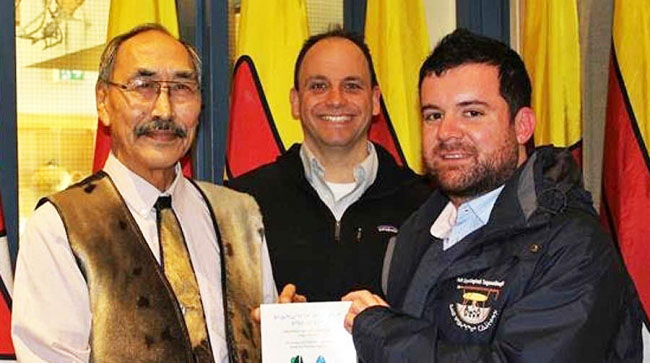
Nunavut’s education minister Paul Quassa, Nunavut Arctic College’s Sean Guistini and Nunavut linguist Conor Cook show off the new Utkuhiksalingmiut dictionary at the legislative assembly last October. Cook co-authored the book with anthropologist Jean Briggs and U of Toronto linguist Alana Johns. (PHOTO BY ERIC CORNEAU/NAC)
The language once spoken by the Utkuhiksalingmiut, like many Inuktut dialects, has faded out of use over the last few decades, and is now only spoken by a small group of elders.
But a new dictionary published late last year preserves much of the Utkuhiksalik dialect in a new 700-page book.
The Utkuhiksalingmiut are a group of Inuit who once lived in an area of the central Arctic, along the northern border that divides today’s Kivalliq and Kitikmeot regions of Nunavut around the Back River.
As those Inuit settled into communities such as Gjoa Haven and Baker Lake, the language blended with other dialects from the interior, and with Netsilik and coastal Hudson Bay dialects.
Now you can learn more about the Utkuhiksalik dialect in Utkuhiksalingmiut Uqauhiitigut: Dictionary of Utkuhiksalingmiut Inuktitut Postbase Suffixes, which was recently published by Nunavut Arctic College.
This dictionary includes the many suffixes used to form words in Inuktut; some terms require as many as six “post bases,” or chunks.
The material was all gathered by Memorial University anthropologist Jean Briggs, whose work in the central Arctic spans more than five decades.
In the 1960s, Briggs spent a year and a half living as the adopted daughter of an Utkuhiksalingmiut family at a camp in Chantrey Inlet. Her work there led to her famous book, Never in Anger, published in 1971.
Although her purpose there was to observe social and emotional relationships among Inuit, learning the language was part of her daily study.
Her adoptive family did that by “acting out the words;” or showing examples, Briggs said.
For English speakers, Briggs provides an example of the complexity of the language: qaurimangngilaarunnaqtuq translates as “they might faint.”
She breaks down the word: qauri (to be conscious) + ma (state of being) + ngngit (not) + laaq (there is a possibility that) + runnaq (might) + tuq (third person singular participle.) Ngngit is the most common of all negatives in Inuktitut, she added.
Over time, Briggs became fluent in the language, and even after her time living among the Utkuhiksalingmiut, she frequently returned to the region until the 1990s (you can read an interview with Briggs from 2002 in Nunatsiaq News here.)
During that time, of course, many of the Utkuhiksalingmiut who camped along the Back River had settled in either Gjoa Haven or Baker Lake.
“And so the few people who actually spoke Utkuhiksalingmiutitut from Chantrey Inlet, their speech got mixed up with other peoples’ speech,” Briggs said in a telephone interview.

“Nothing is the same as the language that any of them grew up with. It’s not that the dialect has changed, but they’ve all mixed.”
The Utkuhiksalingmiut dictionary is based on 600 hours of recordings made by Briggs during her visits to the region.
On the urging of some of her linguist friends, including the book’s co-author, Alana Johns of the University of Toronto, Briggs, now 86, decided to go through the language recordings.
Another of the book’s co-authors, Iqaluit-based linguist Conor Cook, processed the hours of word definitions.
“[But] a lot of credit needs to go to the knowledge and work that was put into this project by the speakers of Utkuhiksalik dialect who worked with Jean,” said Cook, naming the late Rosie Kigeak in Gjoa Haven, her sisters Katie Kamimmalik and Salomie Qitsualik, as well as Joedee Joedee in Baker Lake.
“In the process of organizing the dictionary entries, I got to see (mostly through Jean’s notes) a lot of the very detailed and precise explanations and discussions by these speakers about what exactly a word meant and what context it could be used in,” Cook said.
“A lot of the material in this dictionary is really a testament to a strong scholarly tradition within Inuit culture of precise language use and of talking about language, and I really hope that tradition is preserved.”
After the dictionary was published last October, Nunavut’s education minister Paul Quassa stood up in the legislative assembly to announce its publication.
Quassa then gave a copy to his fellow cabinet ministers and MLAs.
“I encourage both northern and southern readers to continue preserving and promoting Inuit culture through our language and the joys of reading,” he told the legislature.
It’s not clear how and where the dictionary will be used, giving the rarity of the dialect.
When Briggs last visited Gjoa Haven to show residents the dictionary, their response was “Oh, that’s what you were doing all those years,” she recalled, laughing.
“But it preserves the dialect in a way that it’s never been preserved,” said Briggs. “There is no written text.”
Utkuhiksalingmiut Uqauhiitigut: Dictionary of Utkuhiksalingmiut Inuktitut Postbase Suffixes is available for sale at Arctic Ventures Marketplace in Iqaluit, and on online at amazon.ca.
(0) Comments